
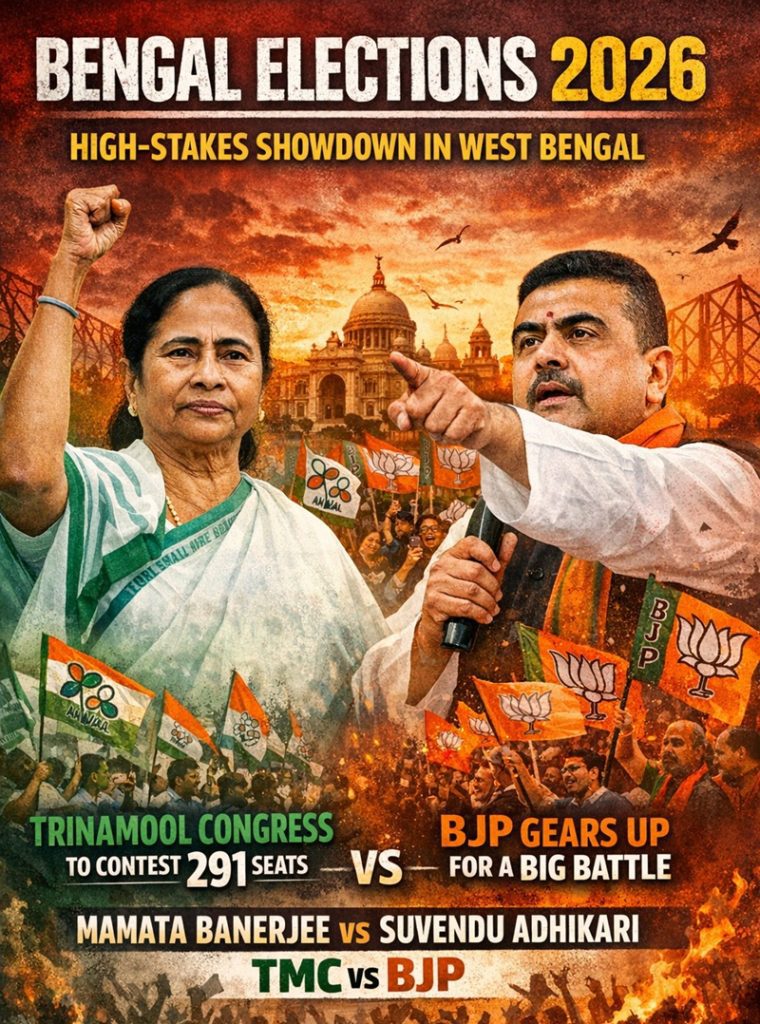
Bengal Elections 2026: Mamata Banerjee’s Trinamool Congress to Contest 291 Seats, Suvendu Adhikari’s BJP Sets Stage for High-Stakes Showdown
KOLKATA — West Bengal is gearing up for one of the most closely watched state elections in recent history, with political heavyweights Mamata Banerjee and Suvendu Adhikari at the center of an intense electoral battle. Announcing her party’s strategy, Chief Minister Mamata Banerjee declared that the Trinamool Congress (TMC) will contest 291 out of the 294 assembly constituencies, leaving the remaining three seats in the Darjeeling hills to TMC’s ally, the Bharatiya Gorkha Prajatantrik Morcha (BGPM), led by Anit Thapa.
This announcement sets the stage for a high-voltage political confrontation between Banerjee, who has dominated Bengal politics for over a decade, and Adhikari, who left TMC to join the Bharatiya Janata Party (BJP) and has rapidly emerged as the face of the opposition in the state. Political analysts predict that this election could redefine Bengal’s political landscape, with implications not just for state governance but for national politics as well.
TMC’s Strategy: Retaining Dominance Amid Challenges
Mamata Banerjee, often called “Didi” by her supporters, has been a central figure in Bengal politics since 2011, when she led TMC to victory against the long-standing Left Front government. Her leadership has been credited with significant development projects, social welfare schemes, and a strong grassroots organization that has allowed TMC to maintain a commanding presence across the state.
Announcing the list of candidates, Banerjee emphasized unity and voter engagement. “We will contest 291 of the 294 seats. The remaining three seats will be contested by our ally, Anit Thapa-led BGPM, in the Darjeeling hills,” she said. The decision reflects TMC’s confidence in its organizational strength and voter base, particularly in rural and semi-urban constituencies.
Political strategists point out that TMC’s approach focuses on three core pillars:
- Grassroots mobilization: Leveraging the party’s extensive network of local leaders and volunteers.
- Social welfare campaigns: Highlighting achievements in health, education, and women’s empowerment programs.
- Countering anti-incumbency: Addressing concerns over inflation, employment, and governance to neutralize opposition attacks.
BJP and Suvendu Adhikari: A Rising Opposition Force
Suvendu Adhikari, once a protégé of Mamata Banerjee and a key TMC leader, has emerged as the principal challenger. His switch to the BJP in recent years has altered the state’s political dynamics. Adhikari has campaigned extensively across Bengal, positioning himself as a candidate for change and promising to address governance issues that he argues TMC has neglected.
The BJP’s campaign strategy under Adhikari revolves around:
- Targeting constituencies with anti-incumbency sentiments.
- Mobilizing urban and semi-urban voters concerned with employment, law, and development.
- Leveraging national leadership support to energize the party’s base.
Adhikari’s rise is seen as a serious threat to TMC, particularly in districts where his influence is strong, such as Nadia, North 24 Parganas, and Howrah. Analysts note that the BJP may gain in constituencies with disillusioned voters, but overcoming TMC’s entrenched grassroots network remains a significant challenge.
Historical Election Trends in West Bengal
To understand the stakes, it is essential to review Bengal’s electoral history:
- 2011: TMC ended the 34-year rule of the Left Front, signaling a political shift.
- 2016: Mamata Banerjee retained power with a decisive majority, demonstrating strong voter loyalty.
- 2021: TMC again secured a resounding victory against the BJP, despite a high-stakes campaign and aggressive opposition strategies.
These results underscore TMC’s ability to mobilize voters and maintain a stronghold even against national parties. However, the 2026 elections will test whether the party can sustain this dominance amid evolving political challenges.
Candidate List Highlights
TMC’s announced candidates include veteran leaders and new faces strategically positioned to retain strongholds and capture swing constituencies. Key highlights include:
- Mamata Banerjee herself will contest from Nandigram, a high-profile constituency that has historically attracted intense political attention.
- Senior leaders are contesting in constituencies such as Kolkata South, Howrah, and North 24 Parganas, reinforcing the party’s strength in urban centers.
- In the Darjeeling hills, the BGPM will contest three seats, a crucial region where ethnic politics and regional identity play a significant role.
The BJP, meanwhile, is fielding candidates with a mix of local leaders, defectors from TMC, and national party members, aiming to maximize their reach and challenge TMC’s dominance.
Darjeeling Hills: A Key Battleground
The Darjeeling hills have a distinct political environment, influenced by the Gorkha community and regional issues such as autonomy, development, and cultural identity. BGPM, allied with TMC, aims to consolidate support in this region. Analysts note that even minor shifts in voter sentiment here could impact overall results, given the small number of seats but high political visibility.
Key Issues for Voters
Several issues are expected to dominate voter concerns:
- Employment and Economic Growth: Rising unemployment, particularly among youth, remains a central issue.
- Inflation and Cost of Living: Price hikes in essentials have created voter anxiety, which opposition parties aim to exploit.
- Infrastructure and Development: Roads, healthcare, and urban amenities are major considerations in semi-urban constituencies.
- Education and Welfare: TMC highlights its programs, including scholarships and healthcare initiatives, as proof of governance effectiveness.
- Local Governance and Representation: Especially in the hills and rural areas, voters are sensitive to representation that understands regional issues.
Campaign Strategies
Both parties are employing aggressive campaign strategies:
- TMC: Focused on rallies, door-to-door outreach, and showcasing achievements. Social media campaigns emphasize Banerjee’s leadership and past developmental work.
- BJP: Leveraging national leadership figures to energize supporters, conducting targeted campaigns in swing constituencies, and focusing on urban voter concerns.
Experts expect the campaign to be highly polarized, with direct clashes between Mamata and Suvendu narratives dominating the discourse.
Voter Demographics and Turnout
West Bengal’s electorate is diverse:
- Rural voters: Traditionally strong TMC supporters.
- Urban voters: Swing voters who may lean toward BJP if dissatisfied with governance.
- Youth voters: Increasingly influential, with concerns about employment and education.
- Ethnic and regional groups: Particularly in Darjeeling and tribal areas, local identity plays a crucial role.
Turnout predictions suggest 80–85% participation, with close attention on constituencies where margins were historically narrow.
Expert Analysis and Predictions
Political analysts emphasize that while TMC retains an organizational advantage, the BJP’s strategic campaigning under Adhikari could lead to gains in key districts. “The election will not just be about numbers; it will be about narratives, leadership perception, and grassroots mobilization,” says Dr. Ranjit Mukherjee, a political science professor at Jadavpur University.
The 2026 Bengal election is also being closely watched nationally, as it may indicate trends for upcoming parliamentary elections. A strong TMC performance could reinforce regional party influence, while significant BJP gains may signal a shift in voter sentiment in eastern India.
Implications for State and National Politics
- For TMC: Retaining power would reinforce Mamata Banerjee’s status as a formidable regional leader and strengthen her bargaining position in national coalitions.
- For BJP: Gains in Bengal could signal the party’s growing influence beyond its traditional strongholds and challenge TMC’s narrative of invincibility.
- For National Politics: The election may shape strategies for 2029 parliamentary elections, influencing alliances and regional political calculations.
This article may be prepared with the assistance of artificial intelligence (AI) and is reviewed before publication. While we aim for accuracy and timeliness, readers should verify important facts from official or primary sources. If you believe any information is inaccurate or that any content infringes your rights, please contact ainewsbreaking.com for review and appropriate action.