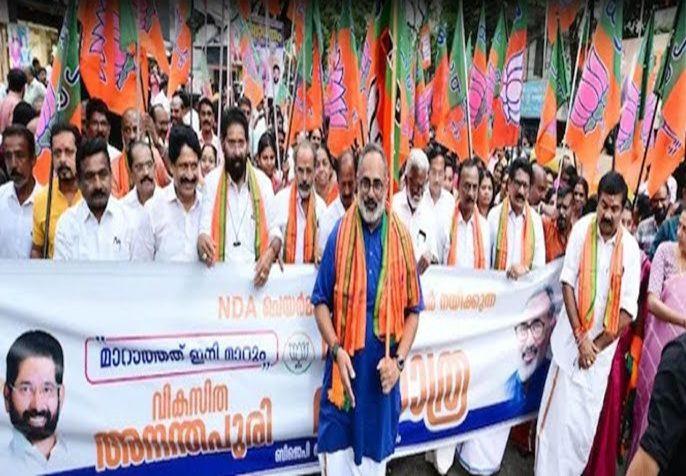
BJP Unveils First List of 47 Candidates for 2026 Kerala Assembly Elections: High‑Profile Faces Including Rajeev Chandrasekhar & K Surendran Signal Strategic Push to Expand Footprint
he political landscape in Kerala has entered a new, high‑intensity phase as the Bharatiya Janata Party (BJP) officially released its first set of candidates for the 2026 Kerala Legislative Assembly elections. This announcement, which includes a robust slate of 47 nominees from across the state, marks a critical step in the party’s strategy to challenge the traditional dominance of the United Democratic Front (UDF) and the Left Democratic Front (LDF) in Kerala — a state where the BJP has historically struggled to make deep electoral inroads.
Context: Kerala’s Political Landscape
Kerala’s political ecosystem has long been a battleground between the centrist UDF, led by the Indian National Congress, and the left‑leaning LDF, dominated by the Communist Party of India (Marxist). For decades, governance in the state has oscillated between these two fronts, with both the Congress and CPI(M) establishing deep grassroots networks and voter loyalties. The BJP, on the other hand, has traditionally been the third player with limited representation in the state assembly.
However, recent shifts have signaled changing political currents. In the 2024 Lok Sabha elections, for the first time, the BJP secured a Lok Sabha seat in Kerala when actor‑turned‑politician Suresh Gopi won from Thrissur — a symbolic breakthrough that underscored the party’s expanding appeal. Despite its modest performance in past assembly polls, this victory energized the BJP’s cadre and set the stage for a more ambitious campaign in 2026.
The First Candidate List: Strategic Choices
On March 16, 2026, the Bharatiya Janata Party announced the first list of 47 candidates for the upcoming Kerala assembly elections. This was the party’s first major public step in presenting its electoral vision and candidate lineup for all 140 constituencies scheduled to be contested in the polls.
High‑Profile Faces Headlining the List
Among the most prominent figures in this initial list are:
- Rajeev Chandrasekhar — Former Union Minister and current state president of BJP Kerala, fielded from the Nemom constituency. His nomination reflects the party’s focus on experienced political leadership and a major drive toward winning urban seats.
- K. Surendran — Veteran BJP leader and former state party president, slated to contest from Manjeshwar. Surendran’s deep roots in Kerala’s political field and his experience make him an important asset for the BJP in a key northern Kerala constituency.
- V. Muraleedharan — Union Minister of State and a well‑known national leader, chosen to contest from Kazhakoottam — a seat with strong contesting potential.
- Navya Haridas — A rising face in the BJP, selected for Kozhikode North, highlighting the party’s effort to promote youth leadership and representation of women.
- Advocate George Kurian — Fielded from Kanjirappally, bringing legal expertise and a professional profile to the BJP’s slate of candidates.
This diverse mix of candidates — blending seasoned politicians with emerging leaders — underscores a strategic blueprint aimed at appealing to a broad cross‑section of Kerala’s electorate. By targeting constituencies with both historical significance and potential for BJP growth, the party has signaled it is leaving no stone unturned in its preparation for the state polls.
Regional Plays: Strategic Seat Selections
Kerala’s political geography is uniquely complex, with regional variations in voter behavior, caste dynamics, and socio‑economic priorities. The BJP’s candidate choices reflect a nuanced understanding of this complexity.
Nemom — A Seat with Symbolic Importance
Nemom is not just any constituency — it was the site of the BJP’s first assembly victory in Kerala in 2016 when O. Rajagopal won the seat. Although the party lost it in 2021, the nomination of Rajeev Chandrasekhar signals a renewed attempt to reclaim a seat that has symbolic significance for the party, combining legacy appeal with current political heft.
Manjeshwar — Gateway to Northern Kerala
Northern Kerala’s Manjeshwar constituency is another key battleground with a diverse electorate. K. Surendran’s candidacy from this seat will test the BJP’s ability to galvanize support beyond its traditional base and navigate intricate local alliances and voter expectations.
Urban Focus: Kozhikode and Kazhakoottam
Urban areas like Kozhikode North and Kazhakoottam have become strategic targets for the BJP as it seeks to tap into urban voter aspirations — particularly among youth, professionals, and marginalized communities responding to development‑oriented narratives. Navya Haridas and V. Muraleedharan’s campaigns in these constituencies reflect this urban strategy.
Wider Implications: BJP’s Strategic Push in Kerala
The release of a 47‑candidate list at this stage — well ahead of polling dates — demonstrates the BJP’s organizational readiness and its intent to shape public discourse early. This move represents a clear message: the party is positioning itself not as a fringe political actor but as a serious contender in Kerala’s top electoral contest.
Political analysts see this as part of a broader national strategy that seeks to slowly erode regional strongholds of non‑BJP forces by combining local leadership with national figures, infrastructure narratives, and targeted welfare promises. Considering Kerala’s history of alternating governments, an early start could allow the BJP to consolidate ground support and influence voter sentiment over time.
Beyond the First List: What’s Next?
This first list of 47 candidates represents just one phase of the BJP’s election campaign. The party is expected to announce additional candidates as the election timetable unfolds. These announcements will likely be tailored to emerging alliances, local electoral math, and constituency‑level dynamics.
Meanwhile, other major political outfits like CPI(M) and CPI have also released their candidate lists — indicating that the election season is now fully underway. The Communist Party of India (Marxist) announced 81 candidates, and the Communist Party of India unveiled 25 candidates, underscoring a competitive multiparty atmosphere ahead of polling day.
This article may be prepared with the assistance of artificial intelligence (AI) and is reviewed before publication. While we aim for accuracy and timeliness, readers should verify important facts from official or primary sources. If you believe any information is inaccurate or that any content infringes your rights, please contact ainewsbreaking.com for review and appropriate action.