
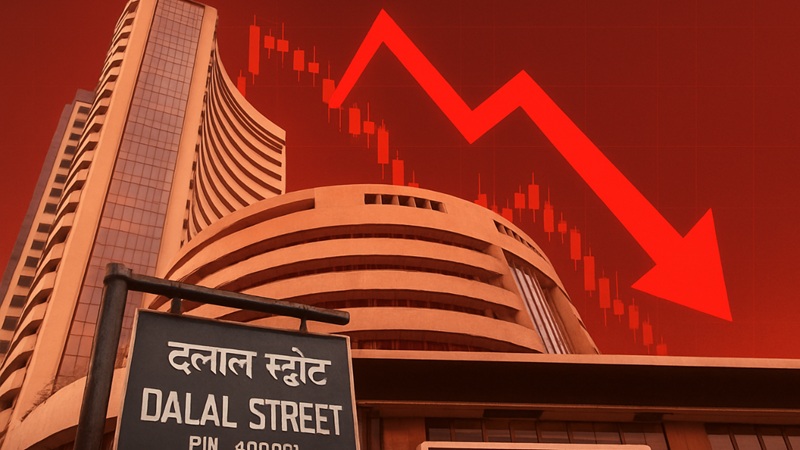
Dalal Street Bloodbath: Sensex Plunges 2,496 Points, Nifty Nears 23,000 as Rs 12 Lakh Crore Vanishes
Indian equity markets witnessed one of their sharpest single-day collapses in recent months on Thursday, March 19, 2026, as a global risk-off mood, surging crude oil prices and deepening geopolitical tensions triggered a full-scale selloff across Dalal Street. By the closing bell, investors had lost nearly Rs 12 lakh crore in wealth, with benchmark indices Sensex and Nifty 50 plunging around 3.3% each in a brutal market rout. The crash was broad-based, relentless and symbolic of the nervousness gripping global financial markets as energy insecurity and inflation fears returned to the forefront.
The BSE Sensex tumbled 2,496 points to settle at 74,207, while the Nifty 50 slumped 775 points to end at 23,002, barely managing to stay above the psychologically crucial 23,000 level. The fall came after Indian markets had staged an uptick over the previous three sessions, making Thursday’s decline even more dramatic. The speed and scale of the correction reflected panic selling rather than a routine bout of profit-taking, as investors rushed to reduce exposure to risk assets amid rising uncertainty.
At the heart of the market collapse was the sudden surge in crude oil prices. According to NDTV’s market report, Brent crude jumped to $111.4 per barrel after fresh attacks on critical energy infrastructure in Iran and Qatar. That spike sent shockwaves through global markets, but the impact was especially severe for India because the country depends heavily on imported crude. Higher oil prices immediately raise concerns over inflation, transport costs, input expenses for companies, the government’s fiscal math and the country’s current account balance. For the stock market, that combination is toxic.
The pressure intensified because the latest spike in oil is not being seen as a temporary blip alone. Investors are increasingly worried that the geopolitical confrontation in West Asia could prolong supply disruptions or keep energy prices elevated for longer than expected. NDTV noted that the Strait of Hormuz, which carries about one-fifth of the world’s oil flows, remains at the center of concern as tensions continue to escalate. Any threat to shipping through that vital route immediately translates into fears of tighter global supply, higher freight and insurance costs, and greater volatility across commodities and currencies.
For Indian equities, the implications are multi-layered. A sustained rise in oil prices can weaken the rupee, increase imported inflation, and reduce disposable income for consumers. Companies in sectors such as aviation, paints, chemicals, logistics, cement and consumer goods face margin pressure when energy and transportation costs climb. Banks and financial stocks may also come under stress if higher inflation keeps interest rates elevated or affects borrower repayment capacity. Thursday’s market action suggested that investors were not merely reacting to headlines; they were rapidly repricing risk across sectors. This broader interpretation is an inference based on the oil spike, the breadth of the selloff and the sectors that declined.
The magnitude of the wealth destruction underscored the ferocity of the crash. The total market capitalization of BSE-listed companies fell from Rs 439 lakh crore to Rs 427 lakh crore in just one day, erasing roughly Rs 12 lakh crore from investor wealth. Such a steep destruction of value in a single session is significant not only for traders and institutions but also for millions of retail investors who have become increasingly active participants in the Indian equity story over the last few years. It also affects sentiment around mutual funds, SIP flows and near-term appetite for fresh equity exposure.
What made the session even more alarming was the sheer breadth of the decline. In the Sensex pack, all 30 stocks ended in the red, a clear sign that the selloff was not confined to one or two vulnerable sectors. The biggest losers on the index included Eternal, down 5.65%, Bajaj Finance, down 5.42%, Mahindra & Mahindra, down 5.25%, HDFC Bank, down 5.13%, and Larsen & Toubro, down 4.72%. These are bellwether names spanning finance, automobiles, banking and infrastructure, which indicates that investors were exiting both cyclical and defensive positions rather than selectively rotating within the market.
The picture on the Nifty 50 was equally grim. ONGC was the only gainer, benefiting from the rally in crude prices, while Shriram Finance emerged as the top loser with a fall of 6.71%. ONGC’s outperformance highlighted one of the few conventional hedges in such an environment: upstream energy producers often gain when crude rises, as their realizations improve. But one oil-linked gainer was nowhere near enough to offset the pain elsewhere. Thursday’s trading made it clear that the market was in capital-preservation mode, with investors seeking safety rather than bargains.
Foreign institutional behavior also remained a major source of concern. NDTV reported that foreign fund outflows continued unabated, compounding the pressure from weak global cues. FII selling tends to amplify market stress because it adds to rupee weakness and removes a key source of liquidity from the system. When foreign investors turn risk-averse at the same time that oil prices rise and global uncertainty intensifies, emerging markets such as India tend to face sharper swings. The combination of external selling and domestic panic can create a self-reinforcing cycle in which prices fall faster than fundamentals alone might justify.
Global sentiment has also turned fragile, and Indian markets were not insulated from that shift. The latest geopolitical flare-up has revived fears of a broader energy shock, at a time when central banks and businesses were only beginning to gain confidence that inflation risks were becoming more manageable. A new oil spike threatens to reverse that progress. Investors worldwide are reassessing exposure to equities, especially in oil-importing economies. India, despite its strong structural growth story, remains vulnerable in the short term when crude surges sharply because the transmission into inflation and corporate costs can be swift. This is an inference drawn from the oil import dependence and the market reaction observed in the session.
From a technical perspective, the market’s close near key psychological levels may keep traders on edge in the next few sessions. The Nifty’s close at 23,002 leaves it perched just above the 23,000 mark, a level that now takes on symbolic as well as tactical importance. If the index decisively breaks below that threshold in the coming sessions, nervousness could intensify further. Likewise, the Sensex’s steep fall to 74,207 may trigger more scrutiny of support zones and institutional positioning. While long-term investors may view corrections as opportunities, short-term participants are likely to remain highly sensitive to headlines on oil and the Middle East.
The selloff also raises questions about sector leadership in an uncertain macro environment. Financials came under heavy pressure despite their role as market leaders in recent years, suggesting that investors are worried about the broader economic consequences of an oil shock. Automakers and industrials were hit as well, reflecting fears of higher input costs and weaker demand if inflation accelerates. Construction and infrastructure names may suffer if project costs rise and capital spending assumptions are reconsidered. Meanwhile, energy-linked companies could continue to outperform selectively, but even there the gains may remain uneven unless crude strength becomes sustained rather than event-driven. This sector interpretation is an inference based on the named losers and the macro drivers cited in the report.
For retail investors, days like this are a harsh reminder that markets do not move in a straight line. Over the last few years, many first-time investors have become accustomed to buying dips and watching markets recover quickly. But geopolitical shocks and commodity spikes tend to behave differently from routine corrections because they alter the macro backdrop. They can affect everything from inflation expectations and currency stability to bond yields and earnings estimates. That is why Thursday’s crash felt more unsettling than an ordinary selloff driven by valuation concerns alone. The market was reacting to a possible change in the external environment, not just to stretched prices. That framing is an inference supported by the report’s emphasis on oil, the Middle East conflict and foreign outflows.
Still, periods of intense volatility often force a reset in market expectations. If crude prices stabilize and geopolitical tensions ease, some of the fear premium built into the market could unwind just as quickly as it appeared. Conversely, if the energy shock deepens or the Strait of Hormuz faces prolonged disruption, equities could remain under pressure and investors may continue shifting toward safer assets or defensive themes. The next phase for Indian markets will therefore depend less on domestic earnings in the immediate term and more on whether global energy risks intensify or begin to cool. This is a forward-looking inference based on the current catalysts identified in the report.
Thursday’s session will likely be remembered as a warning shot for complacent markets. A sharp rise in oil, persistent foreign outflows, weak global cues and heightened geopolitical anxiety combined to produce a perfect storm on Dalal Street. With Rs 12 lakh crore wiped out in a single day, the message from the market was unambiguous: global shocks can still overwhelm local optimism in a matter of hours. The coming sessions will show whether this was a panic-driven one-day bloodbath or the start of a more prolonged period of volatility. For now, investors are left grappling with a bruising reality — when crude surges and uncertainty spreads, even strong markets can crack fast.
This article may be prepared with the assistance of artificial intelligence (AI) and is reviewed before publication. While we aim for accuracy and timeliness, readers should verify important facts from official or primary sources. If you believe any information is inaccurate or that any content infringes your rights, please contact ainewsbreaking.com for review and appropriate action.