
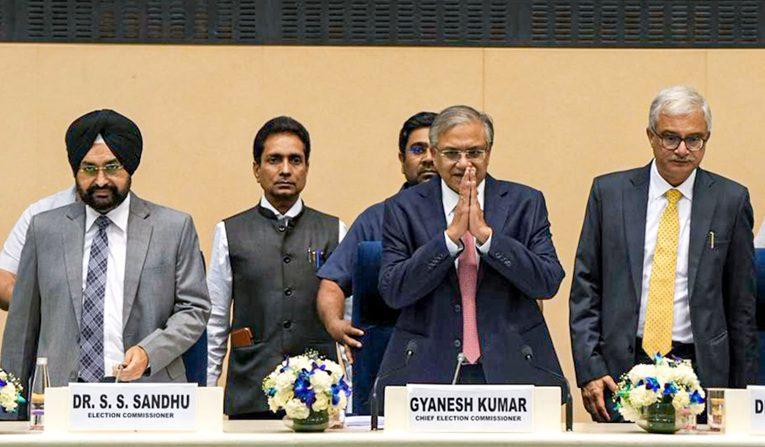
EC Announces Assembly Election 2026 for West Bengal, Tamil Nadu, Kerala, Assam and Puducherry; Voting from April 9, Results on May 4
India Prepares for a Major Electoral Season
India’s political landscape is set for a major democratic exercise as the Election Commission of India (ECI) has officially announced the schedule for the 2026 Legislative Assembly elections in five regions: West Bengal, Tamil Nadu, Kerala, Assam, and the Union Territory of Puducherry. The announcement marks the beginning of intense political campaigning and sets the stage for one of the most closely watched electoral battles of the year.
The elections are significant not only because of the large number of voters involved but also because the results will determine the political direction of several key states across eastern, southern, and northeastern India. Political parties have already begun gearing up for fierce contests, alliances, and high-stakes campaigns as they seek to capture or retain power in these regions.
The Election Commission released the detailed election timetable during a press conference in New Delhi. The schedule outlines polling dates, nomination deadlines, and the counting date, providing clarity for candidates, political parties, and voters alike.
Full Election Schedule for 2026 Assembly Polls
The election process will take place in April 2026, with counting of votes scheduled for early May.
Polling Dates by State
Assam
- Polling Date: April 9, 2026
- Counting of Votes: May 4, 2026
Kerala
- Polling Date: April 9, 2026
- Counting of Votes: May 4, 2026
Puducherry
- Polling Date: April 9, 2026
- Counting of Votes: May 4, 2026
Tamil Nadu
- Polling Date: April 23, 2026
- Counting of Votes: May 4, 2026
West Bengal
- Phase 1: April 23, 2026
- Phase 2: April 29, 2026
- Counting of Votes: May 4, 2026
The Election Commission has indicated that the entire election process will be completed by early May, shortly before the terms of the current assemblies expire.
Why These Elections Are Important
The 2026 assembly elections are considered politically significant because they involve large states and a huge voter base. Collectively, these elections will involve millions of voters across multiple regions of the country.
Each of the states has unique political dynamics and local issues that will influence the outcome of the elections. The results could reshape political alliances and influence national political strategies ahead of future general elections.
West Bengal: A Crucial Political Battlefield
West Bengal will witness voting in two phases on April 23 and April 29, marking a major shift from previous elections that were conducted in several phases. The state has 294 assembly constituencies, making it one of the most politically significant contests in this election cycle.
The reduction in the number of phases aims to streamline the voting process and ensure better management of election logistics and security. The state has historically been a battleground between major national and regional political parties.
Political observers expect a fierce contest as parties try to consolidate their support bases in urban and rural regions alike.
Tamil Nadu: Single-Phase Election for 234 Seats
Tamil Nadu, one of India’s most politically active states, will vote in a single phase on April 23. The election will decide the fate of the 234-member Tamil Nadu Legislative Assembly.
The state has a long tradition of strong regional parties dominating the political landscape. The upcoming election is expected to feature intense campaigning, large rallies, and high voter turnout.
Tamil Nadu has millions of eligible voters, including a significant number of first-time voters who could influence the outcome of the election.
Kerala: Single-Day Voting in a Highly Competitive Race
Kerala will go to the polls on April 9, with voters deciding the composition of the 140-seat legislative assembly.
Kerala’s political environment is traditionally dominated by two major alliances that alternate power in the state. The upcoming election will test whether the current ruling coalition can maintain its support or if the opposition can regain power.
Kerala is also known for high voter turnout and politically aware voters, making the electoral contest particularly competitive.
Assam: Key Northeast Contest
Assam will also vote on April 9 in a single phase. The election will determine the leadership of the 126-member Assam Legislative Assembly.
Assam’s political landscape has evolved significantly in recent years, with strong competition between national parties and regional forces. The outcome of this election will influence political dynamics across the northeastern region of India.
Issues such as development, infrastructure, regional identity, and economic growth are expected to dominate the campaign agenda.
Puducherry: Polls for the Union Territory Assembly
The Union Territory of Puducherry will also hold its assembly elections on April 9, with results announced on May 4. The election will determine the composition of the 30-member legislative assembly.
Despite its smaller size, Puducherry’s election is politically significant due to its strategic alliances and regional political influence.
Election Commission’s Preparations
The Election Commission has emphasized that it will ensure free, fair, and transparent elections across all five regions. Officials have stated that strict measures will be implemented to prevent electoral malpractice, violence, and illegal inducements to voters.
Security arrangements, deployment of polling personnel, and monitoring of campaign activities will be carried out to maintain the integrity of the electoral process.
The Commission also highlighted the importance of voter participation and encouraged citizens to exercise their democratic rights responsibly.
Key Political Players
The upcoming elections are expected to see participation from major national and regional parties. Political alliances and campaign strategies will play a crucial role in determining the outcome.
In different states, various parties will focus on local issues such as economic development, welfare schemes, employment opportunities, and governance performance.
The elections are expected to feature intense campaigning, with leaders traveling across states to connect with voters and promote their party agendas.
Campaign Season Begins
With the election dates now announced, political parties are likely to accelerate their campaign efforts. The coming weeks will witness large public rallies, political speeches, and grassroots mobilization.
Candidates will also begin filing their nominations and preparing for one of the most competitive electoral contests in recent years.
The campaign period will allow parties to present their visions for governance, development, and social welfare in their respective states.
Counting Day: May 4
The counting of votes for all five regions will take place on May 4, 2026, when the results will determine which parties or alliances form governments in each state and the Union Territory.
Election results will be closely monitored across the country, as they will shape the political landscape and potentially influence national politics.
This article may be prepared with the assistance of artificial intelligence (AI) and is reviewed before publication. While we aim for accuracy and timeliness, readers should verify important facts from official or primary sources. If you believe any information is inaccurate or that any content infringes your rights, please contact ainewsbreaking.com for review and appropriate action.