
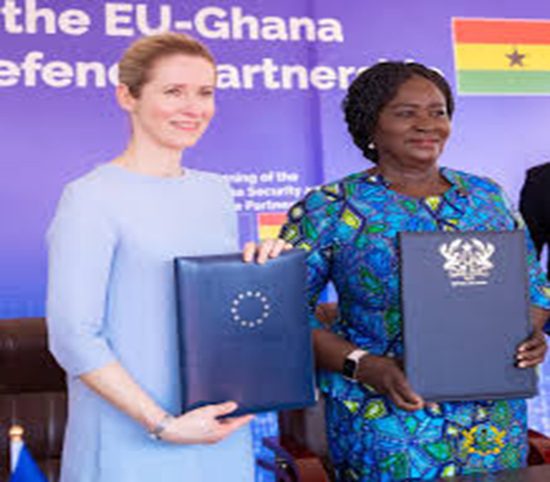
Ghana and European Union Sign Landmark Defence Pact to Counter Rising Islamist Militancy in West Africa
In a major step toward strengthening regional security, Ghana and the European Union have signed a landmark defence agreement aimed at combating the growing threat of militant Islamist groups spreading across West Africa.
The deal marks a significant deepening of cooperation between Africa and Europe, as both sides seek to prevent instability in the Sahel region from spilling into coastal nations like Ghana.
A Strategic Partnership Against a Growing Threat
The agreement comes at a time when extremist violence—linked to groups affiliated with Islamic State and Al-Qaeda—has surged across the Sahel, particularly in countries such as Mali, Burkina Faso, and Niger.
While Ghana has largely remained stable, security analysts warn that militant groups are increasingly pushing southward, raising fears of infiltration into coastal West African states.
The new defence pact is designed to:
- Strengthen Ghana’s military and intelligence capabilities
- Improve border surveillance and counterterrorism operations
- Enhance coordination between Ghanaian and EU security forces
- Provide training, equipment, and logistical support
Why Ghana Matters in West Africa’s Security Landscape
Ghana is widely regarded as one of the most stable democracies in Africa. However, its geographic location—bordering countries affected by insurgencies—makes it a critical frontline state in the fight against extremism.
In recent years:
- Northern regions of Ghana have reported sporadic security incidents
- Refugee flows from neighboring conflict zones have increased
- Authorities have heightened vigilance along porous borders
The EU sees Ghana as a key partner in preventing a wider regional security crisis.
What the Defence Deal Includes
The agreement between Ghana and the European Union is expected to include multiple layers of cooperation:
1. Military Training and Capacity Building
EU member states will provide specialized training to Ghanaian armed forces, focusing on:
- Counterinsurgency tactics
- Intelligence gathering
- Crisis response operations
2. Equipment and Technology Support
The deal will facilitate access to:
- Surveillance drones
- Communication systems
- Border monitoring technologies
3. Intelligence Sharing
Enhanced intelligence cooperation will allow for:
- Real-time threat assessments
- Tracking of militant networks
- Disruption of cross-border operations
4. Financial Assistance
The EU is expected to allocate funding to support:
- Security infrastructure
- Counterterrorism programs
- Community resilience initiatives
EU’s Broader Strategy in the Sahel
The European Union has been actively involved in stabilizing the Sahel through:
- Military training missions
- Development aid programs
- Partnerships with regional governments
However, recent coups and political instability in countries like Mali and Niger have complicated these efforts, forcing the EU to rethink its strategy.
By strengthening ties with relatively stable nations like Ghana, the EU aims to create a buffer against the southward spread of militancy.
Rising Islamist Militancy: A Regional Challenge
The Sahel has become one of the world’s most volatile regions, with militant groups exploiting:
- Weak governance
- Poverty and unemployment
- Ethnic tensions
- Vast, ungoverned territories
Attacks have increased dramatically over the past decade, with thousands of civilians and security personnel killed.
The involvement of groups linked to Islamic State and Al-Qaeda has further internationalized the conflict, raising concerns in Europe about:
- Terrorism spillover
- Migration pressures
- Regional destabilization
Ghana’s Response and Preparedness
Authorities in Ghana have taken proactive steps to strengthen security:
- Increasing military presence in northern regions
- Enhancing border patrols
- Engaging local communities to counter radicalization
The new agreement with the EU is expected to significantly bolster these efforts.
Potential Challenges Ahead
While the defence pact is a major step forward, several challenges remain:
1. Complex Nature of Insurgency
Militant groups operate across borders and adapt quickly, making them difficult to defeat through military means alone.
2. Risk of Spillover
Despite preventive measures, instability in neighboring countries could still impact Ghana.
3. Balancing Security and Civil Liberties
Counterterrorism operations must be carefully managed to avoid:
- Human rights violations
- Alienation of local communities
Global and Regional Reactions
The agreement has been welcomed by:
- Security analysts as a proactive measure
- Regional partners seeking stability
- International organizations focused on counterterrorism
However, some observers caution that long-term success will depend on addressing root causes of extremism, including poverty and governance challenges.
This article may be prepared with the assistance of artificial intelligence (AI) and is reviewed before publication. While we aim for accuracy and timeliness, readers should verify important facts from official or primary sources. If you believe any information is inaccurate or that any content infringes your rights, please contact ainewsbreaking.com for review and appropriate action.