
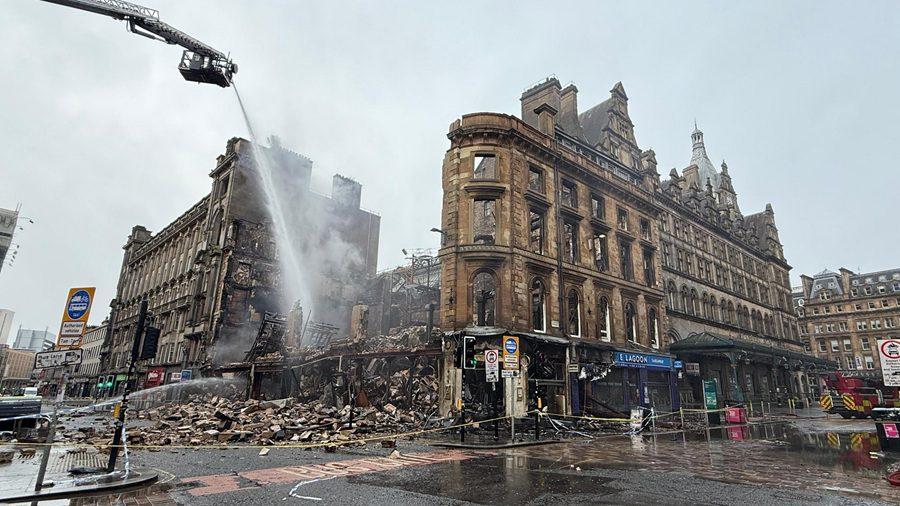
Historic Glasgow Building Demolition Begins After Massive Fire Near Glasgow Central Station
Demolition work has begun on a historic building in central Glasgow after it was severely damaged in a devastating fire that broke out near Glasgow Central Station. The blaze, which erupted earlier in March 2026 in a nearby building on Union Street, caused extensive structural damage and led authorities to conclude that the remaining structure posed a significant safety risk to the public.
The decision to demolish the fire-ravaged building came after engineers and city officials conducted structural assessments and determined that the remaining parts of the building were unstable and could collapse at any time. As a result, the demolition is being carried out to protect pedestrians, railway passengers, and nearby businesses in one of Scotland’s busiest urban areas.
The incident has had widespread consequences for Glasgow’s city centre, disrupting rail services, forcing road closures, and raising concerns about safety in older heritage buildings.
The Fire That Sparked the Crisis
How the Fire Started
The devastating blaze began on 8 March 2026 in a vape shop located inside a historic building at the junction of Union Street and Gordon Street in Glasgow city centre. Witnesses reported hearing an explosion shortly before thick smoke and flames started pouring from the building’s ground floor.
Within minutes, the fire spread rapidly through the multi-storey structure, fueled by flammable materials inside the premises. The Victorian-era building—known locally as Union Corner or Forsyth House—dated back to 1851 and housed several small businesses, including restaurants and retail outlets.
Emergency services quickly responded to the unfolding disaster. The Scottish Fire and Rescue Service deployed multiple fire engines, aerial ladder platforms, and specialized equipment to tackle the inferno.
Large-Scale Emergency Response
The scale of the fire soon escalated into one of the most serious incidents Glasgow city centre has seen in years.
- More than 200 firefighters were deployed to fight the blaze.
- Several nearby streets were closed.
- Local businesses and buildings were evacuated as a precaution.
- Rail services at Glasgow Central were halted due to the proximity of the flames.
During the height of the blaze, the building’s iconic dome collapsed, and parts of the façade began to crumble as the fire weakened the structure.
Firefighters worked through the night to contain the flames and prevent them from spreading to nearby landmarks, including the adjacent hotel and railway station.
Authorities later credited firefighters with preventing the fire from spreading to nearby historic structures, which could have caused even greater damage.
Impact on Glasgow Central Station
Major Rail Disruption
The blaze caused significant disruption at Glasgow Central Station, the busiest railway hub in Scotland.
Because the fire-damaged building sits directly beside the station, officials feared that collapsing masonry could fall onto the station platforms or surrounding streets.
As a result:
- High-level platforms were closed.
- Train services were suspended or rerouted.
- Some trains terminated early at other stations.
In the days following the fire, the station’s lower-level services gradually resumed, but the main high-level platforms remained closed while safety inspections continued.
Officials warned that full reopening of the station could take weeks because the demolition work must be completed before engineers can safely inspect and repair infrastructure near the site.
Structural Damage and Safety Concerns
Why Demolition Became Necessary
After firefighters extinguished the blaze, engineers began assessing the stability of the fire-damaged structure.
Their findings were alarming.
The building had suffered:
- Severe structural weakening
- Collapsed internal floors
- Damaged external walls
- Ongoing partial collapses
In the days following the fire, pieces of the building continued to fall, including sections of the southern gable wall.
City officials concluded that the structure was “seriously compromised” and could collapse without warning.
Glasgow City Council therefore ordered the building to be demolished in the interests of public safety.
Demolition Work Begins
Securing the Area
Before demolition could begin, authorities had to establish a large safety perimeter around the site.
This included:
- Road closures around Union Street
- Restricted pedestrian access
- Safety monitoring by engineers
- Coordination with railway authorities
Construction crews and specialist demolition teams moved equipment into the city centre under tight supervision.
According to officials, demolition work will proceed carefully in stages to avoid further damage to nearby buildings and railway infrastructure.
Complex Urban Demolition
Demolishing a fire-damaged building in a dense city centre presents unique challenges.
The site sits next to major infrastructure, including:
- Scotland’s busiest railway station
- Commercial buildings
- Busy pedestrian streets
- Underground rail lines
Because of these factors, demolition teams must dismantle parts of the building piece by piece, rather than using large-scale controlled explosions.
Some parts of the façade and chimney structures have already been removed to reduce the risk of sudden collapse.
Businesses Destroyed in the Fire
The blaze destroyed several businesses that operated inside the historic building.
Among them were:
- A vape shop believed to be the origin of the fire
- Food outlets
- Retail stores
- Small independent businesses
Many shop owners lost their premises and stock in the fire.
Local residents and business owners described the destruction as heartbreaking, noting that the building had been a familiar part of the city centre for generations.
Heritage Loss for Glasgow
The demolition marks the end of a historic building that had stood for more than 170 years.
Union Corner was considered a B-listed Victorian structure, meaning it held cultural and architectural significance.
Some heritage groups initially hoped the building might be preserved or restored.
However, engineers determined that the structural damage was too severe.
Safety concerns ultimately outweighed conservation considerations, leading authorities to approve demolition.
Investigation Into the Fire
Authorities are continuing to investigate the cause of the blaze.
Early reports suggest the fire began in the ground-floor vape shop, though investigators are still examining the circumstances.
Possible factors being examined include:
- Electrical faults
- Battery explosions
- Storage of flammable materials
Officials are also trying to locate the owner of the shop as part of the investigation.
Economic and Transport Impact
Impact on Commuters
The fire and demolition have created major disruption for commuters traveling through Glasgow.
Thousands of passengers use Glasgow Central Station every day.
Because of the closures:
- Many train routes have been altered.
- Passengers have had to change trains at other stations.
- Travel times have increased.
Transport authorities have been working to restore normal services as quickly as possible.
Impact on the Local Economy
The incident has also affected businesses in the surrounding area.
Problems include:
- Reduced foot traffic
- Road closures
- Delivery disruptions
- Loss of retail premises
Local business groups have called for financial support and recovery plans to help affected companies.
Government and City Response
Scottish government officials have established a coordination group to oversee recovery efforts following the fire.
The group will focus on:
- Supporting affected businesses
- Restoring transport services
- Assessing long-term redevelopment of the site
Local authorities have also promised to work with heritage organizations to document the building before demolition is completed.
What Happens Next
Reopening the Station
Rail authorities have said that full reopening of Glasgow Central Station cannot happen until demolition is completed and the area is declared safe.
After demolition:
Demolition work has begun on a historic building in central Glasgow after it was severely damaged in a devastating fire that broke out near Glasgow Central Station. The blaze, which erupted earlier in March 2026 in a nearby building on Union Street, caused extensive structural damage and led authorities to conclude that the remaining structure posed a significant safety risk to the public.
The decision to demolish the fire-ravaged building came after engineers and city officials conducted structural assessments and determined that the remaining parts of the building were unstable and could collapse at any time. As a result, the demolition is being carried out to protect pedestrians, railway passengers, and nearby businesses in one of Scotland’s busiest urban areas.
The incident has had widespread consequences for Glasgow’s city centre, disrupting rail services, forcing road closures, and raising concerns about safety in older heritage buildings.
The Fire That Sparked the Crisis
How the Fire Started
The devastating blaze began on 8 March 2026 in a vape shop located inside a historic building at the junction of Union Street and Gordon Street in Glasgow city centre. Witnesses reported hearing an explosion shortly before thick smoke and flames started pouring from the building’s ground floor.
Within minutes, the fire spread rapidly through the multi-storey structure, fueled by flammable materials inside the premises. The Victorian-era building—known locally as Union Corner or Forsyth House—dated back to 1851 and housed several small businesses, including restaurants and retail outlets.
Emergency services quickly responded to the unfolding disaster. The Scottish Fire and Rescue Service deployed multiple fire engines, aerial ladder platforms, and specialized equipment to tackle the inferno.
Large-Scale Emergency Response
The scale of the fire soon escalated into one of the most serious incidents Glasgow city centre has seen in years.
- More than 200 firefighters were deployed to fight the blaze.
- Several nearby streets were closed.
- Local businesses and buildings were evacuated as a precaution.
- Rail services at Glasgow Central were halted due to the proximity of the flames.
During the height of the blaze, the building’s iconic dome collapsed, and parts of the façade began to crumble as the fire weakened the structure.
Firefighters worked through the night to contain the flames and prevent them from spreading to nearby landmarks, including the adjacent hotel and railway station.
Authorities later credited firefighters with preventing the fire from spreading to nearby historic structures, which could have caused even greater damage.
Impact on Glasgow Central Station
Major Rail Disruption
The blaze caused significant disruption at Glasgow Central Station, the busiest railway hub in Scotland.
Because the fire-damaged building sits directly beside the station, officials feared that collapsing masonry could fall onto the station platforms or surrounding streets.
As a result:
- High-level platforms were closed.
- Train services were suspended or rerouted.
- Some trains terminated early at other stations.
In the days following the fire, the station’s lower-level services gradually resumed, but the main high-level platforms remained closed while safety inspections continued.
Officials warned that full reopening of the station could take weeks because the demolition work must be completed before engineers can safely inspect and repair infrastructure near the site.
Structural Damage and Safety Concerns
Why Demolition Became Necessary
After firefighters extinguished the blaze, engineers began assessing the stability of the fire-damaged structure.
Their findings were alarming.
The building had suffered:
- Severe structural weakening
- Collapsed internal floors
- Damaged external walls
- Ongoing partial collapses
In the days following the fire, pieces of the building continued to fall, including sections of the southern gable wall.
City officials concluded that the structure was “seriously compromised” and could collapse without warning.
Glasgow City Council therefore ordered the building to be demolished in the interests of public safety.
Demolition Work Begins
Securing the Area
Before demolition could begin, authorities had to establish a large safety perimeter around the site.
This included:
- Road closures around Union Street
- Restricted pedestrian access
- Safety monitoring by engineers
- Coordination with railway authorities
Construction crews and specialist demolition teams moved equipment into the city centre under tight supervision.
According to officials, demolition work will proceed carefully in stages to avoid further damage to nearby buildings and railway infrastructure.
Complex Urban Demolition
Demolishing a fire-damaged building in a dense city centre presents unique challenges.
The site sits next to major infrastructure, including:
- Scotland’s busiest railway station
- Commercial buildings
- Busy pedestrian streets
- Underground rail lines
Because of these factors, demolition teams must dismantle parts of the building piece by piece, rather than using large-scale controlled explosions.
Some parts of the façade and chimney structures have already been removed to reduce the risk of sudden collapse.
Businesses Destroyed in the Fire
The blaze destroyed several businesses that operated inside the historic building.
Among them were:
- A vape shop believed to be the origin of the fire
- Food outlets
- Retail stores
- Small independent businesses
Many shop owners lost their premises and stock in the fire.
Local residents and business owners described the destruction as heartbreaking, noting that the building had been a familiar part of the city centre for generations.
Heritage Loss for Glasgow
The demolition marks the end of a historic building that had stood for more than 170 years.
Union Corner was considered a B-listed Victorian structure, meaning it held cultural and architectural significance.
Some heritage groups initially hoped the building might be preserved or restored.
However, engineers determined that the structural damage was too severe.
Safety concerns ultimately outweighed conservation considerations, leading authorities to approve demolition.
Investigation Into the Fire
Authorities are continuing to investigate the cause of the blaze.
Early reports suggest the fire began in the ground-floor vape shop, though investigators are still examining the circumstances.
Possible factors being examined include:
- Electrical faults
- Battery explosions
- Storage of flammable materials
Officials are also trying to locate the owner of the shop as part of the investigation.
Economic and Transport Impact
Impact on Commuters
The fire and demolition have created major disruption for commuters traveling through Glasgow.
Thousands of passengers use Glasgow Central Station every day.
Because of the closures:
- Many train routes have been altered.
- Passengers have had to change trains at other stations.
- Travel times have increased.
Transport authorities have been working to restore normal services as quickly as possible.
Impact on the Local Economy
The incident has also affected businesses in the surrounding area.
Problems include:
- Reduced foot traffic
- Road closures
- Delivery disruptions
- Loss of retail premises
Local business groups have called for financial support and recovery plans to help affected companies.
Government and City Response
Scottish government officials have established a coordination group to oversee recovery efforts following the fire.
The group will focus on:
- Supporting affected businesses
- Restoring transport services
- Assessing long-term redevelopment of the site
Local authorities have also promised to work with heritage organizations to document the building before demolition is completed.
This article may be prepared with the assistance of artificial intelligence (AI) and is reviewed before publication. While we aim for accuracy and timeliness, readers should verify important facts from official or primary sources. If you believe any information is inaccurate or that any content infringes your rights, please contact ainewsbreaking.com for review and appropriate action.