
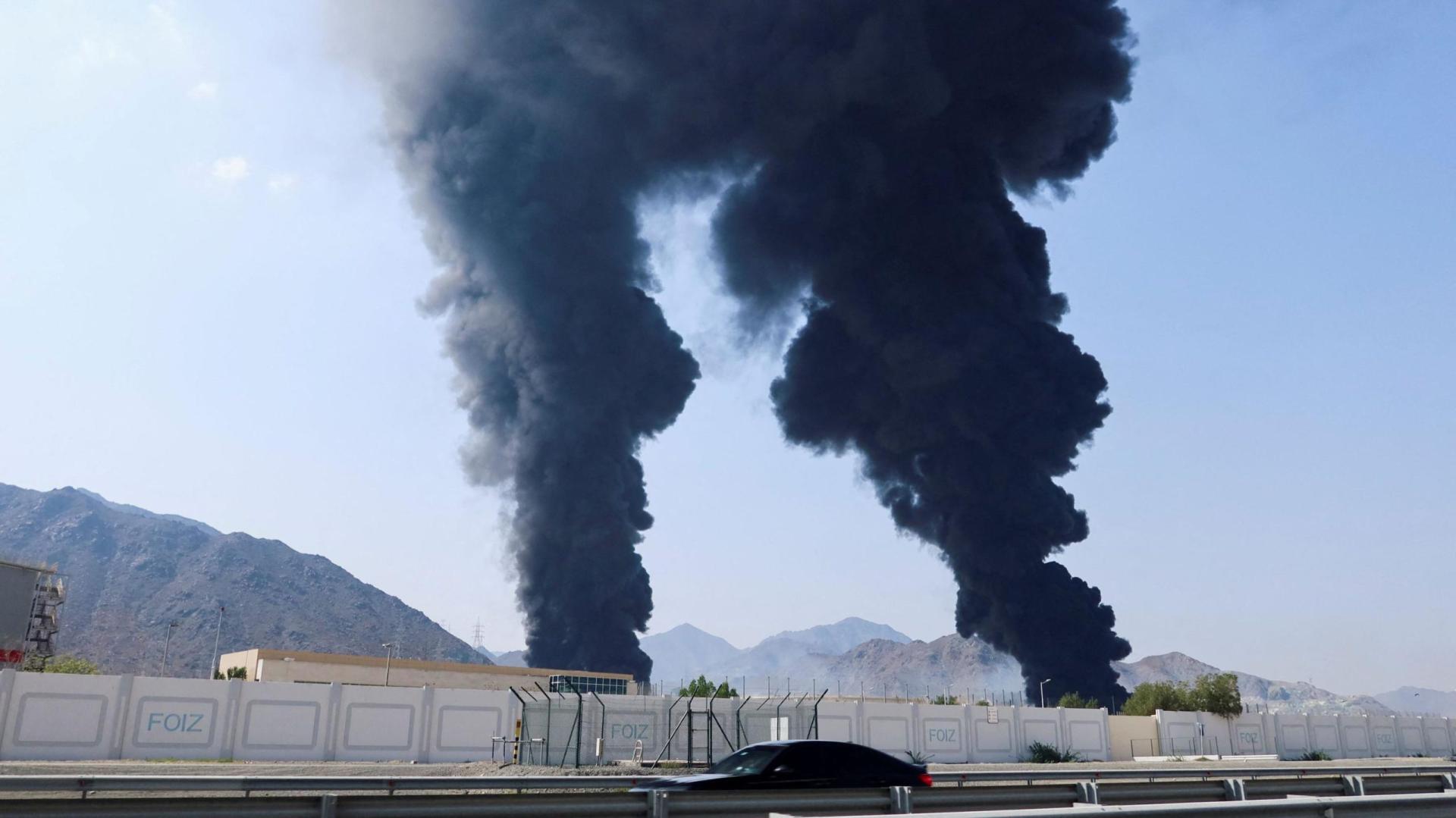
UAE Crisis Escalates: Fujairah Oil Hub Ablaze After Drone Attack, Pakistani Civilian Killed in Abu Dhabi Missile Debris
he United Arab Emirates (UAE) is facing one of its most intense security crises in recent history as a series of drone and missile attacks continue to strike critical infrastructure and civilian areas. On March 17, 2026, a major fire erupted at the Fujairah oil hub following a drone strike, while in Abu Dhabi, falling debris from an intercepted missile tragically killed a Pakistani national.
These developments come amid a rapidly escalating regional conflict involving Iran, the United States, and Israel, with the Gulf region increasingly becoming a battleground for retaliation and strategic strikes.
Fujairah Oil Hub Engulfed in Flames
A drone strike triggered a massive fire at the Fujairah Oil Industry Zone, one of the world’s most important oil storage and export facilities. Civil defence teams rushed to contain the blaze as authorities temporarily halted oil loading operations at the port.
Fujairah plays a crucial role in global energy supply chains. The port handles approximately 1 million barrels of crude oil per day, making it responsible for about 1% of global oil demand.
The attack is particularly significant because Fujairah serves as a strategic alternative route for oil exports that bypass the Strait of Hormuz—a chokepoint that has been increasingly threatened amid rising tensions.
This is not an isolated incident. Reports indicate that this is the second or third attack on Fujairah within days, raising alarm over the vulnerability of energy infrastructure in the Gulf.
Oil Operations Disrupted
Following the attack, oil loading operations were either partially or fully suspended as a safety precaution. While some terminals have resumed operations, the disruption has already impacted global energy markets.
The repeated targeting of Fujairah highlights a broader strategy aimed at destabilizing oil supply chains. With the Strait of Hormuz facing near shutdown conditions, the importance of Fujairah has increased significantly—and so has its exposure to attacks.
Global oil prices have surged sharply amid fears of prolonged disruptions, with markets reacting to the possibility of reduced supply from the region.
Pakistani National Killed in Abu Dhabi
In a tragic development, a Pakistani civilian was killed in Abu Dhabi after debris from an intercepted missile fell in the Bani Yas area.
The UAE’s air defence systems had successfully intercepted incoming threats, but fragments from the destroyed missile still caused fatal damage on the ground.
This incident underscores a growing danger: even successful interceptions cannot fully eliminate the risks posed by falling debris in densely populated urban areas.
According to broader conflict data, debris from intercepted missiles and drones has already caused multiple civilian casualties and infrastructure damage across the UAE.
Airspace Shutdown and Explosions Across UAE
As the attacks intensified, the UAE temporarily shut down its airspace as a precautionary measure. Flights were suspended before operations resumed once authorities declared the situation stable.
Residents in cities like Dubai reported hearing loud explosions, which officials later confirmed were the result of air defence systems intercepting incoming missiles and drones.
Emergency alerts were issued to citizens, urging them to seek shelter and avoid open areas during the attacks.
Wider Regional Conflict Driving Attacks
The attacks on the UAE are part of a broader regional escalation linked to the ongoing conflict between Iran and a U.S.-Israel alliance.
Iran has reportedly launched hundreds of missiles and drones targeting the UAE since late February, citing retaliation against Western military actions.
This conflict has spread across multiple countries, with incidents reported in Iraq, Saudi Arabia, Qatar, and Lebanon.
The Strait of Hormuz—a vital global shipping route—has been heavily affected, with maritime traffic significantly reduced due to security threats.
Impact on Global Oil Markets
The attacks have triggered significant volatility in global energy markets.
- Oil prices have surged due to supply fears
- Shipping routes are disrupted
- Key infrastructure remains under threat
With Fujairah under repeated attack and the Strait of Hormuz facing instability, analysts warn of a potential prolonged energy crisis.
The International Energy Agency has already hinted at the possibility of tapping global reserves if supply disruptions worsen.
Repeated Targeting of Critical Infrastructure
Beyond Fujairah, other strategic sites in the UAE have also been targeted:
- Shah gas field in Abu Dhabi experienced a drone-induced fire
- Dubai airport fuel facilities were struck in earlier attacks
- Tankers near Fujairah have reported damage from projectiles
This pattern suggests a coordinated effort to cripple the UAE’s energy and logistics infrastructure.
Rising Civilian Risk
One of the most alarming aspects of the crisis is the increasing threat to civilians.
Even when air defence systems successfully intercept incoming threats, falling debris continues to pose deadly risks.
Urban areas such as Abu Dhabi and Dubai have experienced:
- Falling shrapnel
- Fires caused by intercepted projectiles
- Structural damage to buildings
The death of the Pakistani national highlights how civilians are becoming unintended victims of a high-tech conflict fought in the skies.
International Reactions
Global reactions to the crisis have been mixed.
- Some countries have called for immediate de-escalation
- Others have resisted involvement in securing the Strait of Hormuz
- Western leaders have expressed concern over the widening conflict
Meanwhile, former U.S. President Donald Trump has criticized allies for not committing enough resources to address the crisis.
This article may be prepared with the assistance of artificial intelligence (AI) and is reviewed before publication. While we aim for accuracy and timeliness, readers should verify important facts from official or primary sources. If you believe any information is inaccurate or that any content infringes your rights, please contact ainewsbreaking.com for review and appropriate action.