 France deploys patrol fleet to curb Channel migrant crossings
  From a Nepal in Pain, a Young Leader Makes a Case for Climate Reparations
  Ukraine transfers two North Korean POWs to South Korea.
  Australia probes AI‑driven breach of My Health Record portal
  Engineering student’s ‘suicide’ turns out to be murder two arrested
 Indian Stock Market Today: Crude Oil Near 108, Fed Rate Hike Bets Rise What It Means for Sensex, Nifty and Rupee
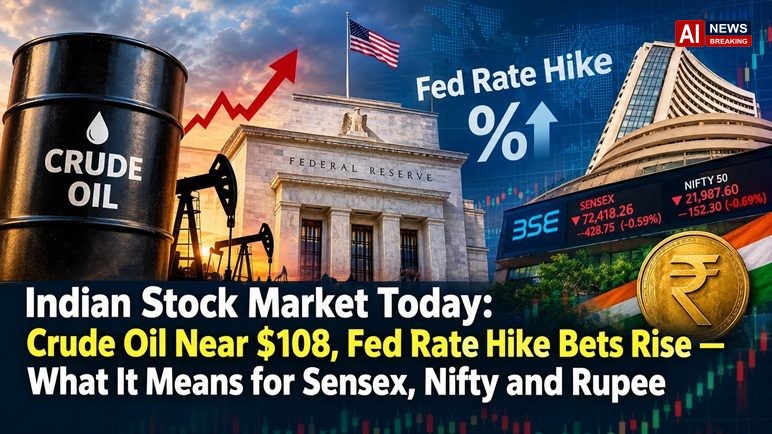
Indian stock markets are facing a fresh wave of uncertainty as Brent crude remains above $100 a barrel and approaches $108, while expectations of a US Federal Reserve rate hike have strengthened ahead of the September 15–16 policy meeting. The combination is putting pressure on the rupee, government bond yields and foreign-investor sentiment, even as domestic institutional buying and strength in IT stocks provide some support.
For India, the key risk is the interaction between expensive crude, a stronger US dollar and tighter global financial conditions. A prolonged oil shock could increase India’s import bill and inflation pressures, while higher US interest rates could encourage global investors to move money toward dollar assets and away from emerging markets.
Key Points
- Brent crude is near $108 a barrel, creating fresh inflation and import-cost concerns for India.
- The Fed is widely expected to raise rates by 25 basis points at its September 15–16 meeting, according to a Reuters economist poll.
- US 10-year Treasury yields have moved above 5%, increasing pressure on global equity valuations.
- The rupee closed around ₹95.55 per dollar, according to Reuters, after losing more than 1% the previous week.
- Foreign investors sold about ₹930.90 crore of Indian equities in the latest reported session, while domestic institutions bought about ₹1,968.17 crore.
- Nifty IT gained nearly 4%, highlighting the importance of sector rotation in the current market.
- India’s foreign-exchange reserves stand at about $785 billion, providing a substantial buffer against currency volatility.
- A sustained move in crude above $110 could increase pressure on India’s inflation outlook, rupee and equity valuations.
- The market’s next major catalyst is likely to be the Fed’s rate decision and forward guidance.
Indian Stock Market Today: Why Investors Are Watching Crude and the Fed
The Indian stock market entered Tuesday, September 15, with investors focused on two powerful global market forces: surging crude oil prices and the changing outlook for US interest rates.
Brent crude was trading around $107.37 a barrel on Tuesday, while US crude was around $103.24, according to Reuters. Oil prices have remained elevated as escalating tensions in the Middle East threaten energy infrastructure and raise concerns about global supply.
At the same time, expectations for a Federal Reserve rate hike have increased sharply.
A Reuters poll published ahead of the Fed’s September 15–16 meeting found that 85% of economists expected the US central bank to raise its policy rate by 25 basis points to a range of 3.75%–4.00%. Economists also increasingly expect at least one additional rate increase by the end of March 2027.
For Indian investors, these developments matter because crude oil and US interest rates directly influence the rupee, inflation, bond yields, foreign portfolio flows and equity valuations.
The market is therefore dealing with several interconnected risks at the same time.
Sensex and Nifty Face a Difficult Global Environment
Indian equities have shown resilience despite the deterioration in the global macroeconomic environment, but volatility has increased significantly.
On September 11, Indian shares suffered a broad-based selloff as Brent crude crossed $108 a barrel. The Sensex fell as much as 742 points, while the Nifty 50 touched an intraday low of 23,231.
The latest session has shown that investors are not uniformly bearish, however.
On September 15, Indian benchmarks initially opened higher before giving up some gains. The Nifty moved below 23,400 during the session while the Sensex also reversed into negative territory. At the same time, the Nifty IT index gained nearly 4%, demonstrating that sector-specific opportunities remain even when the broader market is under pressure.
This divergence is important.
The market is not simply responding to one global risk. Investors are rotating between sectors according to how each business is expected to perform under higher oil prices, a weaker rupee, tighter monetary conditions and changing technology expectations.
Crude Oil Near $108: India’s Biggest Immediate Risk
The biggest macroeconomic concern for India is arguably crude oil.
Brent crude has moved sharply higher amid renewed geopolitical tensions and disruptions involving critical Middle Eastern energy infrastructure. On September 15, Brent was around $107.37 a barrel, while US crude was above $103.
The problem for India is straightforward.
India imports most of the crude oil it consumes.
When international oil prices rise, Indian refiners and the wider economy face higher import costs. The impact eventually travels through fuel prices, transportation costs, manufacturing expenses, logistics and consumer prices.
A temporary rise in crude may be manageable.
A prolonged period above $100 is considerably more challenging.
If crude remains around $105–110 for an extended period, investors may begin reassessing India’s inflation outlook, corporate margins and current-account position.
Why $108 Crude Is So Important for India
Oil prices affect India through several channels.
The first is the import bill.
Higher crude prices mean India has to spend more dollars to purchase energy from international markets.
The second is the rupee.
Higher oil payments increase demand for dollars, while foreign investors may simultaneously reduce exposure to Indian equities during periods of global risk aversion.
The third is inflation.
Fuel and transportation costs influence a wide range of goods and services.
The fourth is corporate profitability.
Companies that use large quantities of fuel or petroleum-based inputs may see their operating costs increase.
The fifth is monetary policy.
If oil pushes inflation higher, expectations for interest-rate cuts can weaken, and the Reserve Bank of India may have less room to ease policy.
This creates a chain reaction:
Crude oil rises → India’s import bill increases → rupee comes under pressure → inflation risk rises → bond yields rise → monetary easing becomes harder → equity valuations face pressure.
Rupee Under Pressure as Oil and US Rates Rise
The Indian rupee has become another major focus for investors.
Reuters reported on September 15 that the rupee had depreciated more than 1% during the previous week, ending at around ₹95.55 per US dollar. The currency has been pressured by elevated oil prices and growing expectations of a US rate hike.
A weaker rupee is not automatically negative for the Indian economy.
Indian exporters can benefit because overseas revenue converts into more rupees.
IT companies, in particular, can benefit from a weaker domestic currency when a large share of their revenue is earned in US dollars.
That helps explain why IT stocks can outperform even when the broader market is weak.
But the currency effect is more complicated at the national level.
For an oil-importing economy, a weaker rupee makes imported crude more expensive in domestic currency.
Therefore, the combination of higher oil prices and a weaker rupee can amplify India’s inflationary pressure.
The Double Blow: Expensive Oil and a Strong Dollar
Indian investors are therefore watching a particularly uncomfortable combination.
Crude oil is rising in dollar terms.
At the same time, the US dollar can strengthen when investors anticipate higher Federal Reserve rates.
For India, that means the local-currency cost of oil can rise even faster than the international crude price suggests.
Suppose crude remains at elevated levels while the rupee depreciates further.
Indian companies and consumers could face higher energy costs without any additional increase in the dollar price of oil.
That is why currency stability has become an increasingly important part of the Indian stock-market outlook.
Fed Rate Hike Bets Strengthen
The Federal Reserve is another major source of uncertainty.
The US central bank is scheduled to conclude its September 15–16 meeting with a policy decision on Wednesday.
According to a Reuters economist poll, 85% of economists expected a 25-basis-point hike, taking the federal funds target range to 3.75%–4.00%. The shift represents a significant change from earlier expectations of a pause.
Persistent inflation and higher oil prices have changed the policy debate.
The Fed faces a difficult balancing act.
If it keeps rates too low while inflation remains elevated, price pressures could become entrenched.
If it raises rates too aggressively, it could weaken economic growth and employment.
The market is therefore paying close attention not only to the rate decision itself but also to the Fed’s assessment of future inflation and interest rates.
Why a Fed Hike Matters for Indian Stocks
A US rate hike can affect India through global capital flows.
Higher US interest rates make dollar-denominated assets more attractive relative to emerging-market assets.
If US Treasury yields rise, international investors may reduce exposure to riskier markets.
That can result in foreign portfolio outflows from Indian equities and bonds.
The impact can be particularly strong when investors are already worried about geopolitical tensions and expensive valuations.
This is why the Fed decision is important for Indian markets even though it is made in Washington.
The modern financial system is deeply interconnected.
A change in US monetary policy can influence the dollar, Treasury yields, emerging-market currencies and equity markets within hours.
US 10-Year Yield Crosses 5%
The bond market is sending an additional warning signal.
The US 10-year Treasury yield moved above 5.02% on Tuesday, its highest level since 2007, according to Reuters. Rising oil prices and renewed inflation concerns have contributed to the increase in yields.
For equity investors, higher Treasury yields can be problematic.
US government bonds are generally considered among the world’s safest assets.
When their yields rise significantly, investors may demand a higher expected return from riskier assets such as emerging-market equities.
That can put pressure on valuations.
Indian stocks are particularly sensitive to this dynamic because foreign institutional investors play an important role in domestic equity markets.
Foreign Investors Remain a Key Market Variable
Foreign portfolio flows have become an important indicator of market direction.
On September 15, foreign institutional investors were reported to have sold Indian equities worth approximately ₹930.90 crore, while domestic institutional investors bought around ₹1,968.17 crore.
This contrast demonstrates the growing importance of domestic liquidity.
Indian mutual funds, insurance companies and other domestic institutions can provide support when foreign investors sell.
That does not eliminate volatility, but it can prevent global selling pressure from translating into an even deeper market decline.
The strength of domestic institutional buying is therefore one of the factors investors are watching closely.
Can Domestic Investors Protect the Indian Market?
Domestic institutional investors have become an important stabilising force in Indian equities.
When global funds sell, domestic investors can absorb part of that supply.
This creates a different market structure from previous cycles, when foreign flows had a much greater influence over short-term index movements.
However, domestic buying cannot completely neutralise macroeconomic risks.
If crude remains above $100 for a prolonged period, inflation rises and corporate earnings estimates are reduced, Indian investors could also become more cautious.
Domestic liquidity can cushion the market.
It cannot permanently override fundamentals.
Nifty IT Emerges as a Relative Winner
One of the most interesting developments in the current market is the relative strength of IT stocks.
The Nifty IT index rose nearly 4% during Tuesday’s session even as broader benchmarks struggled.
A weaker rupee can provide some support to Indian technology exporters because their revenues are heavily dollar-linked.
However, the IT sector faces its own structural uncertainty.
The global AI boom has raised questions about the long-term business models of traditional software and technology-service companies.
Investors are therefore likely to differentiate between companies benefiting from AI-driven technology spending and those facing disruption from automation.
AI Concerns Add Another Layer of Volatility
The Indian market is also being influenced by the recent selloff in global AI-linked stocks.
Concerns raised by technology leaders about the speed and safety of advanced AI development have contributed to weakness in several AI-related companies.
For Indian IT companies, the situation is complicated.
On one hand, companies could benefit from increased demand for AI implementation, cloud migration and digital transformation.
On the other hand, investors worry that AI automation could reduce the amount of traditional technology-services work required in some areas.
This makes AI both an opportunity and a risk for Indian IT stocks.
Which Indian Sectors Are Most Vulnerable to Expensive Oil?
Higher crude prices do not affect all sectors equally.
Airlines
Airlines are particularly sensitive because aviation turbine fuel represents a significant operating cost.
If crude remains elevated, airlines can face higher fuel expenses and potentially weaker margins.
Paint Companies
Paint manufacturers use petroleum-derived raw materials.
Higher crude prices can therefore increase input costs.
Tyres
Tyre manufacturers are also exposed to petroleum-linked raw-material prices.
Chemicals
The chemical sector can face higher feedstock and energy costs.
Logistics
Transportation companies can face higher fuel expenses.
Consumer Companies
Higher fuel and transportation costs can eventually affect distribution expenses and consumer purchasing power.
Oil and Gas Companies
The impact is more mixed.
Upstream producers can benefit from higher crude prices, while downstream companies face different margin dynamics depending on product prices and refining spreads.
Which Sectors Could Benefit?
Some companies can benefit from the same macroeconomic conditions that hurt others.
IT
A weaker rupee can support the translation of dollar revenues into rupees.
Energy
Oil and gas producers can benefit from stronger commodity prices.
Exporters
Companies earning substantial foreign-currency revenue can gain from rupee depreciation.
Select Metals and Commodities
Some commodity producers may benefit from higher global prices, although their performance also depends on demand and input costs.
The important point is that investors should not treat the Indian market as one homogeneous asset.
The impact of oil, currency and interest rates varies significantly by sector.
What Happens If Crude Goes Above $110?
A move above $110 would likely become an important psychological threshold for investors.
It would not automatically trigger a market crash.
The key question would be how long crude remains above that level.
A temporary spike caused by geopolitical headlines could reverse quickly.
A sustained period above $110 would be more serious because businesses and policymakers would have more difficulty absorbing the higher costs.
Markets would likely begin focusing more intensely on inflation forecasts, RBI policy and corporate earnings.
The RBI May Face a More Difficult Policy Environment
The Reserve Bank of India has a complicated task ahead.
India’s domestic economy remains relatively resilient, but higher global oil prices can create imported inflation.
Reuters reported that August consumer inflation was 4.82%, while Indian government bond yields have already been moving higher.
The possibility of tighter domestic monetary conditions is therefore becoming more relevant.
If inflation remains elevated, the RBI may have less flexibility to cut rates.
If the rupee weakens sharply, policymakers may also need to focus on currency stability.
This means investors should watch not only the Fed but also the RBI’s response to changing global conditions.
Indian Bond Yields Are Sending a Signal
India’s 10-year government bond yield ended the previous week around 7.0233%, according to Reuters.
Rising yields can have important consequences for equities.
When bond yields rise, fixed-income investments can become relatively more attractive.
Higher yields can also increase the cost of borrowing for companies.
For highly leveraged businesses, that can affect profitability.
The relationship between bonds and equities is therefore becoming increasingly important in the current environment.
India’s Foreign Exchange Reserves Provide Some Cushion
India is not without protection against external shocks.
Reuters reported that India’s foreign exchange reserves had reached a record $785 billion.
Large reserves give the Reserve Bank of India significant capacity to manage excessive volatility in the foreign-exchange market.
That does not mean the rupee cannot weaken.
It means policymakers have a stronger buffer against disorderly movements.
This could help prevent a temporary oil shock from turning into a broader currency crisis.
What Does This Mean for Sensex?
The Sensex is likely to remain sensitive to global risk sentiment.
Large-cap companies with strong balance sheets can provide some stability, but the index remains exposed to changes in foreign flows, interest rates and earnings expectations.
If crude prices stabilise below the recent highs, investors could regain confidence.
If oil continues climbing, pressure could return quickly.
The Sensex may therefore remain volatile even if India’s underlying economic fundamentals remain relatively strong.
What Does This Mean for Nifty?
For the Nifty 50, the key question is whether the index can maintain important support levels while global markets remain unsettled.
The index has already experienced sharp moves as oil prices surged.
Investors should watch whether selling remains concentrated in vulnerable sectors or spreads across the broader market.
A recovery led by IT, financials and large-cap stocks would suggest investors are selectively buying weakness.
A broad decline accompanied by heavy foreign selling would indicate a deeper risk-off environment.
What Does This Mean for the Rupee?
The rupee remains one of the clearest indicators of the current external pressure.
A combination of expensive crude, stronger US yields and foreign portfolio outflows could keep the currency under pressure.
The Reserve Bank’s foreign-exchange reserves provide a buffer, but markets will continue watching the pace of intervention and changes in India’s external balance.
The rupee’s performance will also influence corporate earnings.
Export-oriented companies can benefit from depreciation, while import-dependent businesses can suffer.
Three Risks Indian Investors Should Watch
1. Crude Oil Risk
If Brent remains above $100 for an extended period, inflation and corporate-cost pressures could intensify.
2. Fed Risk
A 25-basis-point hike may already be partly priced into markets, but the Fed’s future guidance could create a larger reaction.
A signal that more hikes are coming could strengthen the dollar and pressure emerging markets.
3. Currency Risk
A further depreciation of the rupee could increase imported inflation and make crude even more expensive in local currency.
These risks are interconnected.
That makes them more significant than any one factor considered separately.
What Could Trigger a Relief Rally?
Despite the risks, several developments could support Indian equities.
The first would be a decline in crude prices.
If geopolitical tensions ease and supply disruptions are resolved, oil could retreat quickly.
The second would be a less-hawkish Fed outlook.
Even if the Fed raises rates by 25 basis points, markets could respond positively if policymakers signal that the move is not the beginning of an aggressive tightening cycle.
The third would be continued domestic institutional buying.
Strong domestic liquidity could help absorb foreign selling.
The fourth would be stable corporate earnings.
If Indian companies continue delivering strong earnings despite higher costs, investors may become more comfortable with current valuations.
What Could Make the Selloff Worse?
The biggest danger would be a simultaneous deterioration across several variables.
For example:
Crude above $110 + rupee below current levels + US yields above 5% + continued FPI selling + weaker corporate earnings
would create a much more difficult environment for Indian equities.
Investors would then have to price in higher inflation, tighter monetary policy and lower earnings expectations at the same time.
That combination could produce a deeper correction.
The Market Is Moving From Liquidity to Fundamentals
The current environment may mark a shift in how investors evaluate Indian stocks.
During periods of abundant liquidity, rising markets can tolerate high valuations.
But when global rates rise and commodities become expensive, fundamentals become more important.
Investors begin asking whether earnings can justify valuations.
They look more closely at debt, cash flows, margins and return on capital.
This could lead to greater divergence between individual stocks.
High-quality companies with strong balance sheets may continue attracting investors even when the broader market is volatile.
Why the Fed Decision Is More Important Than the Hike Itself
The market already has a significant amount of information about the expected rate move.
The bigger question may be what the Fed says about the future.
A 25-basis-point hike accompanied by a relatively cautious outlook could be interpreted as a one-off response to inflation.
A hike accompanied by signals of further tightening could create a much stronger reaction in global markets.
For Indian equities, the second scenario would probably be more challenging because it could push US yields and the dollar higher.
Oil and Interest Rates Could Create a Valuation Reset
The combination of higher crude and higher interest rates is particularly important because both can affect equity valuations.
Oil can reduce corporate margins.
Interest rates can increase the discount rate applied to future earnings.
Together, they can reduce the price investors are willing to pay for stocks.
This does not necessarily mean India’s long-term growth story has changed.
It means the price investors are willing to pay for that growth may change.
India’s Long-Term Story Remains Different
Despite the immediate risks, India’s structural economic story remains comparatively strong.
Domestic consumption, infrastructure investment, digitalisation and manufacturing expansion remain important long-term themes.
The country also has substantial domestic savings flowing into financial markets.
These factors can help the Indian market recover when global conditions stabilise.
But long-term strength does not eliminate short-term macroeconomic volatility.
Investors can be bullish about India over the next decade and cautious about equities over the next few months.
Both views can coexist.
What Investors Should Watch From Here
The next few sessions could be critical for Indian markets.
Investors should monitor:
- Brent crude: Whether oil remains above $100 and whether it approaches or breaks $110.
- US 10-year Treasury yield: Whether the yield remains above 5%.
- Federal Reserve: The September 16 rate decision and forward guidance.
- Dollar index: A stronger dollar could increase pressure on emerging-market currencies.
- Rupee: Whether ₹95–96 per dollar becomes a new trading range.
- FPI flows: Whether foreign investors continue selling Indian equities.
- DII buying: Whether domestic institutions continue absorbing foreign outflows.
- RBI policy expectations: Whether markets begin pricing a tighter Indian monetary policy.
- Corporate earnings: Whether higher energy and financing costs begin affecting profit forecasts.
- Nifty and Sensex breadth: Whether selling spreads beyond a handful of sectors.
Indian Market Outlook: Volatility Likely to Stay Elevated
The Indian stock market is currently caught between strong domestic fundamentals and increasingly difficult global conditions.
Crude oil near $108 is a major concern for an oil-importing economy.
The expected Fed hike introduces another layer of pressure through global interest rates and the dollar.
The rupee’s weakness adds to the cost of imported energy.
At the same time, domestic institutional buying, resilient economic activity and selective sectoral strength are preventing a straightforward market collapse.
This means the most likely near-term environment is one of high volatility and strong sector rotation.
Investors may continue moving money between exporters, energy companies, defensive stocks, financials and technology names depending on changes in oil, currencies and global rates.
Conclusion: Crude, Fed and Rupee Hold the Key to India’s Next Market Move
The Indian stock market is entering a crucial period as three major variables move in an unfavourable direction: crude oil prices are near $108 a barrel, expectations of a US Federal Reserve rate hike have risen sharply, and the rupee remains under pressure near ₹95.55 per dollar.
Each factor presents a challenge on its own.
Together, they create a much more complicated environment.
Higher crude threatens to increase India’s import bill and inflation.
A Fed hike could strengthen the dollar and keep global financial conditions tight.
A weaker rupee can make imported oil even more expensive.
The result is a potentially difficult backdrop for Sensex and Nifty valuations.
Yet the Indian market is showing resilience.
Domestic institutional investors continue to provide support, while some sectors — particularly IT — are showing relative strength. India’s large foreign-exchange reserves also give policymakers a significant buffer against excessive currency volatility.
The immediate market direction will therefore depend heavily on what happens to crude prices and what the Federal Reserve signals about future interest rates.
If oil prices stabilise and the Fed indicates that the current tightening cycle will remain limited, Indian equities could find room to recover.
If crude moves decisively above $110, US yields continue climbing and the Fed signals further hikes, pressure on the rupee and Indian equities could intensify.
For investors, the central lesson is clear: the next phase of the Indian market will be driven less by a single headline and more by the interaction between oil, interest rates, currency movements, foreign flows and corporate earnings.
AI Insight: The current Indian market setup shows how closely India’s equity market is connected to global commodity and monetary-policy cycles. The most important risk is not crude oil, the Fed or the rupee individually, but the possibility that all three move against Indian assets simultaneously. A sustained oil price above $100 can raise India’s import costs and inflation, while a higher US policy rate and Treasury yields can strengthen the dollar and reduce the relative attractiveness of emerging-market assets. However, India’s large foreign-exchange reserves, strong domestic institutional participation and resilient economic activity provide meaningful protection against a disorderly selloff. The market is therefore likely to become increasingly selective: companies with strong balance sheets, pricing power, dollar revenues or relatively low energy sensitivity could outperform, while highly leveraged and oil-sensitive businesses may face greater pressure. For long-term investors, the current volatility may ultimately be less about the end of India’s growth story and more about a repricing of risk and valuations in a higher-cost global financial environment.