 France deploys patrol fleet to curb Channel migrant crossings
  From a Nepal in Pain, a Young Leader Makes a Case for Climate Reparations
  Ukraine transfers two North Korean POWs to South Korea.
  Australia probes AI‑driven breach of My Health Record portal
  Engineering student’s ‘suicide’ turns out to be murder two arrested
 Calcutta HC orders CWC to return 3-year-old to couple despite adoption lapse
**
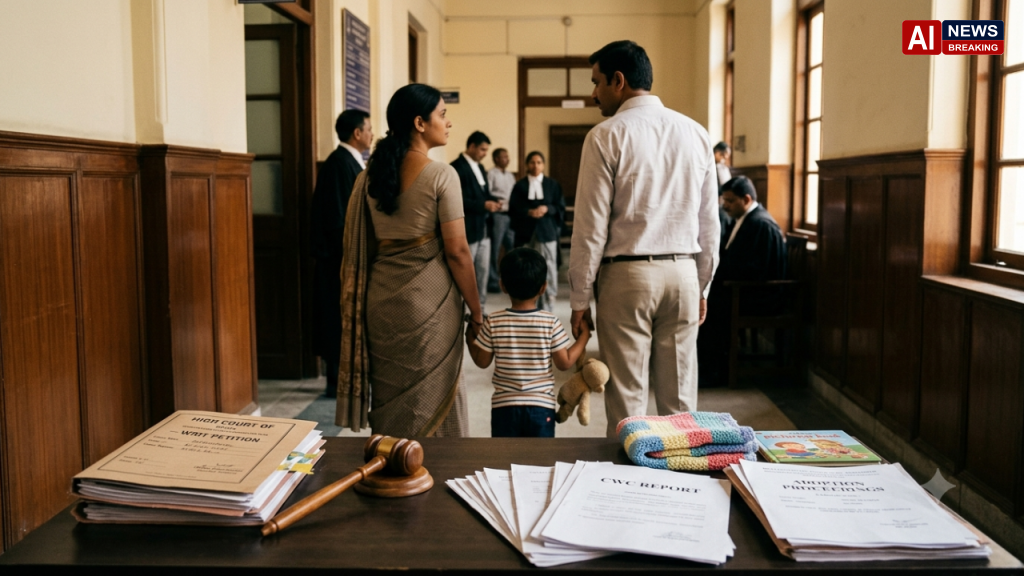
Calcutta HC orders CWC to return 3-year-old to couple despite adoption lapse - AI News Breaking
calcutta orders return 3yearold:
The Calcutta High Court on Monday issued a directive that a Child Welfare Committee (CWC) must hand over custody of a three‑year‑old boy to the couple who have been looking after him since his birth in February 2023. The judgment, delivered by a bench headed by Justice Anirban Bhattacharjee, underscored that the CWC had no legal justification for retaining the child and that the couple’s continued care could not be dismissed as an unlawful arrangement.At the heart of the dispute is the fact that the boy, whose identity has been concealed to protect his privacy, was never classified as an orphan nor was he abandoned by his biological parents. According to the court’s findings, the child’s birth was registered in the local municipal records, and his parents had initially placed him under the care of the couple, a retired teacher and her husband, after a brief period of hospitalization..
The couple, who reside in the same neighbourhood, provided the child with daily care, schooling and medical attention, effectively acting as de facto parents for more than twelve months before the CWC intervened.The CWC’s involvement began after a routine inspection by the district child welfare office, which flagged the arrangement as a potential case of illegal adoption. The committee, citing concerns over the lack of formal adoption paperwork, ordered the child to be taken into its custody pending an investigation. The couple, who had not filed any formal adoption petition, contended that they were merely acting as temporary caregivers while the child’s biological mother recovered from a serious illness..
They argued that the child’s welfare was best served by remaining with the family that had already formed an emotional bond with him.During the hearing, counsel for the couple highlighted that the child’s biological mother had expressed a clear intention to reunite with her son once her health improved, but had not been able to do so within the expected timeframe. The mother, a garment worker from a nearby suburb, had been hospitalized for complications related to childbirth and had been under continuous medical supervision. The court noted that the mother’s condition, while improving, still required significant care, and that the child’s best interests were arguably served by staying with the couple who had already established a stable environment.The CWC, in its defense, argued that it was acting in accordance with the Juvenile Justice (Care and Protection of Children) Act, 2015, which mandates that any child not formally placed under a legal adoptive order be placed under the protective jurisdiction of a welfare committee..
The committee maintained that its role was to ensure that the child’s rights were protected, and that any informal arrangement without statutory approval could potentially expose the child to legal vulnerabilities. It further claimed that the couple’s failure to approach a court for a formal adoption made the arrangement precarious under existing law.Justice Bhattacharjee, however, found that the statutory framework did not compel the CWC to remove a child from a home where he was neither orphaned nor abandoned. He referred to precedent set by the Supreme Court in the case of “Shashidhar vs..
State of Karnataka” (2022), which held that the welfare of a child must be assessed on a case‑by‑case basis, taking into account the emotional bonds formed and the practical realities of the child’s everyday life. The judge emphasised that the CWC’s decision to take the child into its care was “premature and unsupported by any substantive legal provision.”In its order, the High Court instructed the CWC to immediately return the child to the couple and to cease any further custodial claims unless a formal adoption petition is filed and adjudicated by a competent court. The court also directed the district child welfare officer to provide the couple with a detailed report on the procedural steps required to regularise the adoption, including the necessary documentation and timelines..
The couple was advised to file a petition under the Juvenile Justice Act within thirty days if they wish to obtain legal recognition as the child’s adoptive parents.Legal experts observing the case noted that the judgment could have wider implications for adoption processes across the country. Professor Ramesh Kumar, a specialist in family law at the University of Calcutta, remarked that the ruling clarifies the limits of CWC authority in situations where a child is not legally classified as a ward of the state. “The decision reaffirms that a child’s best interests cannot be reduced to a bureaucratic checklist,” he said..
“It also signals to welfare committees that they must exercise caution before intervening in family arrangements that are informal but not illegal.”Child rights advocates, while welcoming the court’s focus on the child’s emotional well‑being, urged caution in interpreting the ruling as a blanket endorsement of informal care arrangements. Anjali Mehta, director of the NGO Save the Children India, warned that “while this judgment protects a specific child, it should not be taken to mean that informal adoptions are permissible without oversight.” She called for a review of the adoption framework to make the process more accessible for families who wish to adopt but are deterred by procedural delays and complexities.The couple, who have lived in the same neighbourhood for over two decades, expressed relief at the court’s decision. In a brief statement, they said they had always intended to formalise the adoption once the child’s biological mother’s health allowed for a decision..
“We are grateful that the court recognised the bond we have built with the child,” they said. “Our only wish now is to secure his future legally, so that he can grow up without uncertainty.”The district administration has indicated that it will comply with the court’s order and will work with the CWC to ensure a smooth transition of the child back to his caregivers. Officials also said they would review the procedural guidelines governing CWCs to prevent similar disputes in the future..
In a separate note, the Child Welfare Department announced plans to launch an outreach programme aimed at educating the public about the legal pathways for adoption and the responsibilities of informal caregivers.The case has already sparked discussion on social media platforms, with many users sharing personal experiences of informal caregiving and urging the government to simplify adoption procedures. While some commenters praised the court’s emphasis on the child’s emotional needs, others cautioned that unchecked informal arrangements could lead to exploitation. The debate reflects a broader societal conversation about balancing legal safeguards with the practical realities of child care in India’s diverse and densely populated urban centres.As the matter moves forward, the couple’s next step will be to approach the Calcutta Civil Court with a formal adoption petition..
The legal process, which typically involves a home study, background checks and a court hearing, can take several months. If successful, the adoption would be recorded under the Juvenile.
Updated: September 18, 2026
Calcutta High Court ordered the Child Welfare Committee to return a three‑year‑old boy to the couple who have cared for him since birth, finding the committee had no legal basis to retain the child. The ruling clarifies that informal caregiving arrangements need not be deemed unlawful unless the child is truly orphaned or abandoned, but urges families to pursue formal adoption filings.
Insight: The court’s ruling signals that the law must weigh a child’s emotional bonds as much as paperwork—recognizing that informal caregiving can be more protective than bureaucratic “default” custody. Yet it also reminds policymakers that a lax stance on informal care risks turning ad hoc arrangements into legal loopholes, demanding a clearer,