 France deploys patrol fleet to curb Channel migrant crossings
  From a Nepal in Pain, a Young Leader Makes a Case for Climate Reparations
  Ukraine transfers two North Korean POWs to South Korea.
  Australia probes AI‑driven breach of My Health Record portal
  Engineering student’s ‘suicide’ turns out to be murder two arrested
 West Bengal Government launches portal to foster grassroots innovation in eastern region
** The West Bengal government has unveiled the “Seva First Innovation Challenge – Eastern Zone”, a three‑month open call for home‑grown ideas tackling health, agriculture, water and waste issues across the state’s 23 eastern districts. Selected projects will receive seed grants (INR 5‑50 lakh) and mentorship, aiming to turn local ingenuity into scalable, climate‑resilient solutions.
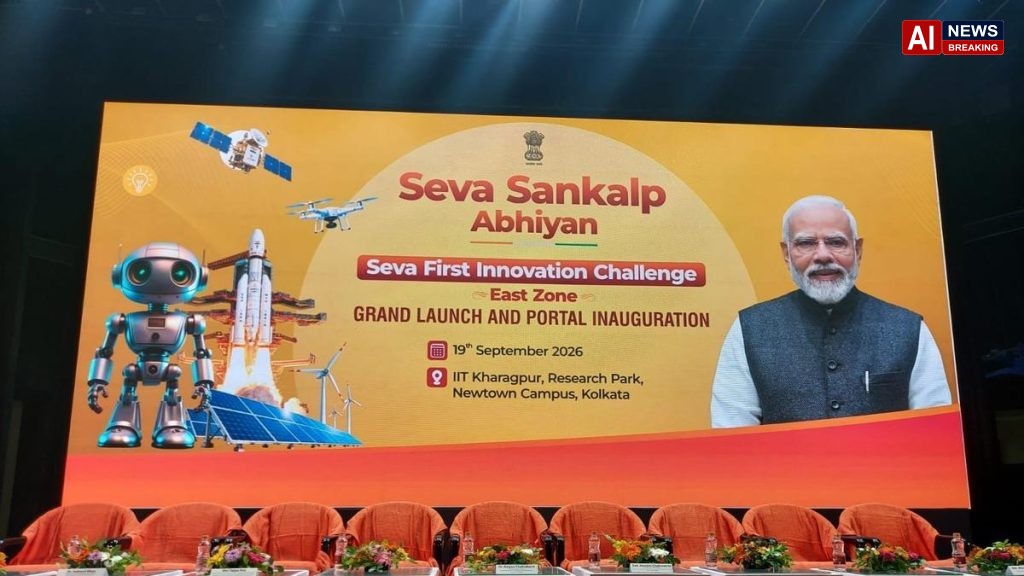
West Bengal Government launches portal to foster grassroots innovation in eastern region - AI News Breaking
The state government of West Bengal has unveiled a new digital platform designed to capture and develop home‑grown ideas that could address some of the region’s most pressing problems. Dubbed the “Seva First Innovation Challenge – Eastern Zone”, the portal invites entrepreneurs, students, NGOs and ordinary citizens to submit proposals that aim to improve access to healthcare, reduce agricultural losses, tackle water scarcity and enhance waste management. According to officials, the initiative seeks to build a pipeline of scalable solutions that can be tested, refined and eventually rolled out across the state’s 23 districts in the eastern corridor.The launch, which took place on Monday at the ariat in Kolkata, was marked by speeches from the Chief Minister, Mamata Banerjee, and the Minister for Science and Technology, Ashima Patra..
Both leaders emphasized the government’s commitment to “leveraging local ingenuity” and moving beyond top‑down policy prescriptions. Banerjee highlighted that the state’s diverse geography – from the Sundarbans delta to the Hooghly floodplains – creates unique challenges that can only be solved with context‑specific interventions. She added that the portal will be open for a three‑month submission window, after which a panel of experts will shortlist projects for pilot testing.The portal operates on a tiered evaluation system..
Initial screening will assess the feasibility, relevance and potential impact of each submission, while a second round will involve detailed technical review and stakeholder consultation. Projects that pass both stages will receive seed funding ranging from INR 5 lakh to INR 50 lakh, as well as mentorship from government agencies, academic institutions and industry partners. The funding model mirrors similar schemes in Karnataka and Gujarat, which have reported success in bringing low‑cost innovations to market.Healthcare access, one of the four focus areas, has been a particular concern in the eastern zone, where remote villages often lack permanent clinics and face chronic shortages of medicines..
The portal’s call for solutions includes proposals for tele‑medicine platforms, low‑cost diagnostic kits and mobile health units powered by renewable energy. Suman Ghosh, director of the West Bengal Institute of Medical Sciences, noted that “a well‑designed digital health solution could bridge the gap between specialist care in Kolkata and primary health centres in the hinterland, provided it is culturally adapted and affordable.”Agricultural loss, especially due to post‑harvest spoilage, is another priority. The region’s staple crops such as rice, jute and pulses suffer from inadequate storage facilities, leading to losses estimated at 15 percent of total yield each year..
The challenge invites ideas ranging from solar‑powered cold chains to low‑tech, community‑managed grain silos. According to a recent report by the Department of Agriculture, improving post‑harvest handling could increase farmer incomes by up to 20 percent, a boost that the state hopes to realize through home‑grown innovation rather than imported technology.Water scarcity, though less visible than floods in a state famous for its monsoons, has become acute in several districts due to over‑extraction of groundwater and salinity intrusion in coastal belts. Submissions are expected to address both supply and demand management, including rainwater harvesting, smart irrigation controllers and low‑cost desalination units..
Environmental scientist Prof. Arindam Chakraborty of Jadavpur University warned that “any solution must be resilient to climate variability and should involve community stewardship to ensure long‑term sustainability.”Waste management, the final pillar of the challenge, reflects the growing burden of solid waste generated by expanding urban centres such as Howrah, Kalyani and Durgapur. The portal seeks proposals that can improve segregation at source, promote recycling and convert organic waste into biogas or compost..
The state’s current solid waste processing capacity handles only about 60 percent of the total generated, leaving a substantial amount to be dumped in landfills or waterways. Officials hope that innovative, low‑cost models can be replicated across municipalities to meet the national Swachh Bharat targets.A dedicated team within the West Bengal Innovation Council will oversee the portal’s operation, providing technical assistance to applicants and ensuring transparency throughout the selection process. The council, formed in 2022, reports directly to the Chief Minister’s office and has previously managed the “Digital West Bengal” initiative, which expanded broadband connectivity to over 90 percent of villages..
Its involvement is intended to lend credibility and streamline coordination between different departments, a lesson learned from earlier multi‑agency programmes that suffered from bureaucratic bottlenecks.The launch has attracted attention from the private sector, with several venture capital firms and corporate social responsibility arms expressing interest in co‑funding promising projects. Representatives from Tata Trusts and the Infosys Foundation met with state officials to discuss possible partnership models that could provide additional resources beyond the initial seed grants. Industry observers note that such collaboration could accelerate the scaling of successful pilots, turning local prototypes into market‑ready products that could be exported to other Indian states facing similar challenges.Critics, however, caution that the portal’s success will depend on rigorous monitoring and an equitable distribution of support..
Advocacy groups have pointed to past schemes where funding was disproportionately allocated to urban innovators, leaving rural voices under‑represented. In response, the government has pledged to reserve a minimum of 30 percent of the total budget for proposals originating from villages with populations under 5,000. An independent audit committee, comprising members from academia and civil society, will be tasked with reviewing the selection outcomes and publishing an annual report.If the Seva First Innovation Challenge achieves its stated goals, West Bengal could become a model for participatory development in India, demonstrating how state‑level platforms can harness grassroots creativity to tackle systemic issues..
As the portal goes live, the next three months will reveal the breadth of ideas emerging from the eastern zone’s schools, farms, clinics and community centres. The government’s willingness to fund and mentor these concepts signals a shift toward a more inclusive innovation ecosystem, one that places ordinary citizens at the centre of problem‑solving rather than at its periphery..
Updated: September 20, 2026
If West Bengal can translate crowd‑sourced prototypes into scalable services, it may rewrite the playbook for state‑led development, proving that local ingenuity can outpace top‑down bureaucracy. Yet the platform’s true test will be its ability to sustain rural participation and transparent oversight, lest the promise of inclusive innovation dissolve into another urban‑centric funding echo chamber.