 Australia probes AI‑driven breach of My Health Record portal
  Engineering student’s ‘suicide’ turns out to be murder; two arrested
  Canada’s Capital Bids Good Riddance to Trump Avenue as Tensions With U.S. Rise
  Pentagon investigates after China obtains parts from F-35 stealth fighter jet
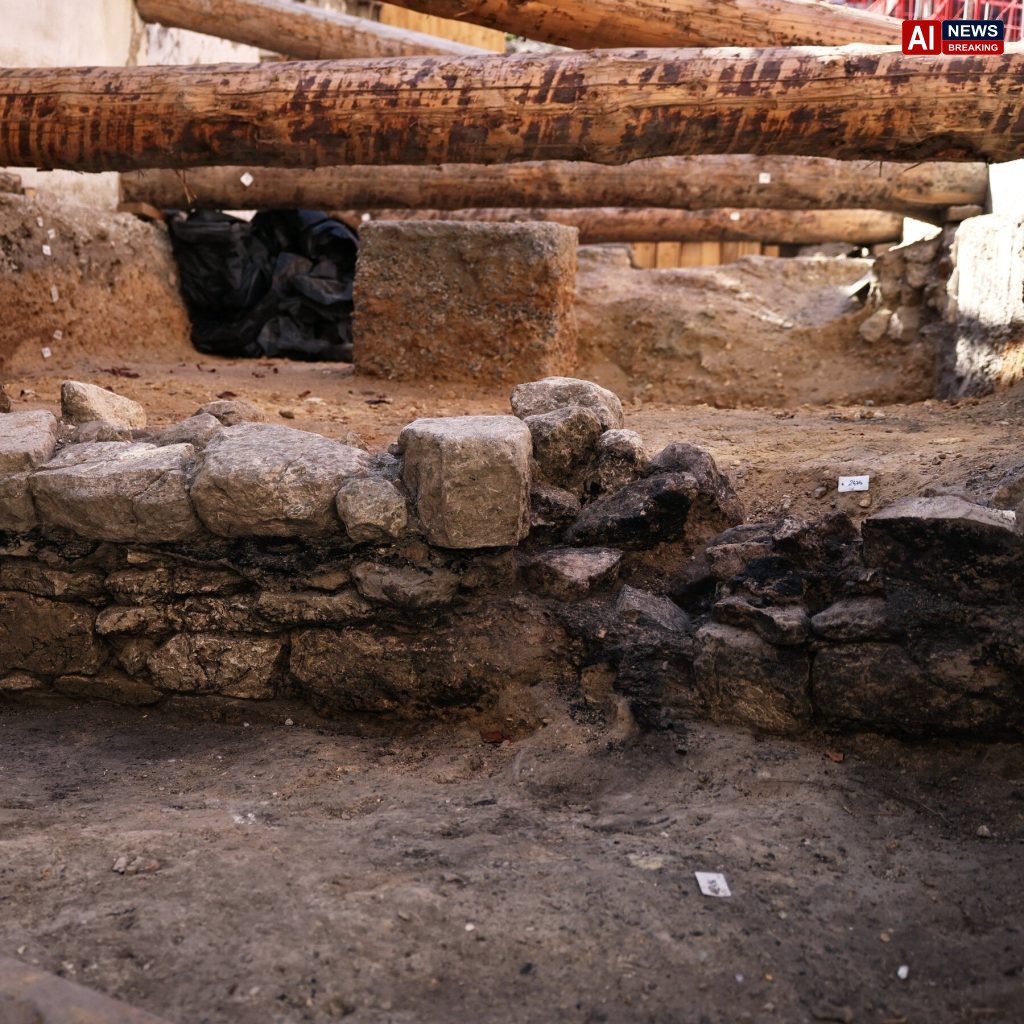
 Ancient Wall Found in Paris Provides Clues to City’s Origins
Ancient Wall Found in Paris Provides Clues to City’s Origins - AI News Breaking
ancient wall found paris:
Ancient Wall Found in Paris Provides Clues to City’s Origins A team of archaeologists working within the grounds of a major Parisian hospital has unearthed a series of stone blocks that appear to form an ancient defensive wall. The fragments, recovered from the island of the Seine that lies behind the hospital’s north wing, have sparked a renewed debate among historians about the earliest phases of Paris, a city whose origins are often tied to the Roman conquest of the 1st century BCE. The discovery came after a routine ground-penetrating radar survey, commissioned by the hospital to assess the stability of its foundations..
Researchers noted a series of anomalies beneath the soil that suggested the presence of a continuous stone structure. Excavations were subsequently authorised, and the first layer of wallwork was revealed in late March. Radiocarbon dating of organic material trapped within the stone joints places the construction of the wall between 80 and 50 BCE..
This period coincides with Julius Caesar’s campaigns in Gaul, when he was consolidating control over the region and establishing Roman administrative centres. The wall’s estimated dimensions – roughly 300 metres in length and 1.5 metres in height – suggest a modest fortification rather than a city gate. The shape of the wall is also noteworthy..
Unlike the straight lines typical of Roman military fortifications, the wall curves gently, following a natural bend in the riverbank. This curvature indicates that the builders adapted the structure to local topography, a feature more common in Gallic settlement patterns of the same era. Archaeologists have compared the stonework to that found at the nearby remains of Lutetia, the Roman settlement that later became Paris..
While the material and construction technique are consistent, the wall appears to predate the main urban core. If so, it could represent an earlier settlement that existed before the Romans imposed their administrative framework. The site’s location on an island in the Seine offers an intriguing possibility that the wall served as a defensive barrier against riverine incursions..
The island, once connected to the mainland by a narrow strip of land, would have been vulnerable to flooding and attacks from neighbouring tribes. The wall’s placement suggests a strategic choice to protect the nascent settlement from both natural and human threats. In addition to the stone blocks, the dig uncovered a series of pottery shards and iron tools..
The pottery, with its distinctive red slip and geometric decoration, matches artefacts from other Gallic sites in the region. The iron tools, though corroded, are consistent with those used by craftsmen in the late Iron Age, indicating that the settlement was capable of producing its own building materials. Historians have reacted with cautious optimism..
Elise Martin, a professor of ancient history at the Sorbonne, notes that “the evidence points to a complex, layered history of occupation.” She warns that further excavation is needed to confirm whether the wall was indeed part of a larger fortification system or a standalone structure. The hospital’s involvement in the discovery has raised questions about the management of archaeological sites within urban settings. The institution has pledged to preserve the site and collaborate with the National Institute for Cultural Heritage to ensure that future excavations are carried out responsibly..
This collaboration may set a precedent for other medical facilities situated near historically significant areas. Local authorities have already begun to plan for the potential tourism impact of the find. A small visitor centre is proposed to be established on the island, allowing the public to view the wall and learn about Paris’s pre‑Roman past..
This initiative would complement existing attractions such as the Musée du quai Branly and the nearby Musée d’Orsay, providing a broader context for the city’s long history. The find also has implications for the broader narrative of Roman influence in Gaul. If the wall indeed dates to the period of Caesar’s conquest, it could serve as tangible evidence of the rapid Romanisation of the region..
Scholars will be closely monitoring future studies, particularly those that may identify inscriptions or other artefacts that could link the wall directly to Roman military engineers. Meanwhile, the hospital’s staff have expressed gratitude for the serendipitous nature of the discovery. “It reminds us that history can lie just beneath our feet,” one doctor remarked..
The team hopes that this unexpected find will inspire both the medical community and the public to appreciate the layered heritage that surrounds modern urban life..
Updated: September 23, 2026
Archaeologists beneath a Paris hospital have uncovered a curved stone wall dating to 80–50 BCE, hinting at a pre‑Roman settlement that may predate the Roman‑era Lutetia. The find, discovered during a routine stability survey, could reshape views on the city’s early history and spur plans for a new visitor centre on the Seine island.
Insight: The wall’s Gallic curvature suggests that early Parisian settlers prioritized local topography over Roman engineering ideals, hinting at a pre‑Roman polity that negotiated its own defensive strategy. This undermines the neat narrative of a swift Roman takeover, instead foregrounding a layered, contested past that modern Paris must reckon with—both in heritage preservation and in redefining its identity beyond the “Roman conquest” myth.