 Fighting Intensifies in Yemen, Raising Fresh Fears of All-Out War
  FBI releases classified ‘Patel Report’ examining past failures at the bureau
  Why Were 4 Pilots Aboard FlyDubai Flight 1073?
  Take a Historic Stroll Down Oxford Street, London’s Shopping Artery
  OpenAI launches enterprise AI platform Dots.
 Earth’s geographic poles wander more than we had thought
**
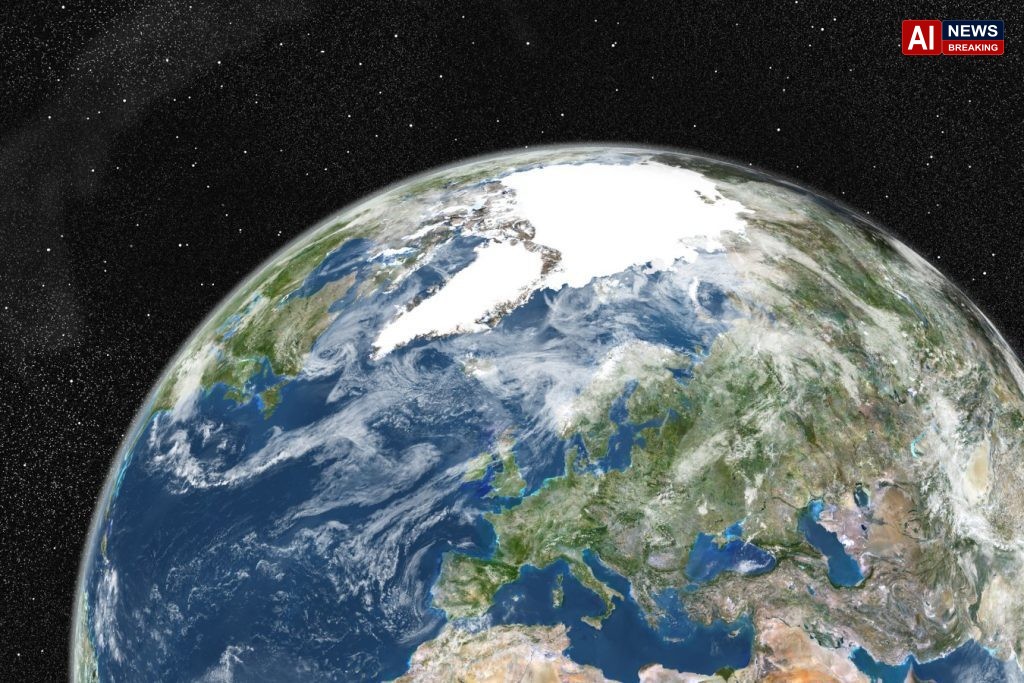
Earth’s geographic poles wander more than we had thought - AI News Breaking
earths geographic poles wander:
The Earth’s geographic poles – the points where the planet’s axis of rotation meets its surface – have long been regarded as essentially fixed, shifting only by a few metres over millennia. A new study published this week challenges that assumption, suggesting that the poles may have wandered far more dramatically than previously believed. By analysing ancient sea‑level records preserved in sedimentary rocks from the last 50 million years, an international team of geophysicists has reconstructed the timing and magnitude of true polar wander events, revealing episodes in which the solid Earth rotated up to several degrees relative to its spin axis..
The findings have implications for our understanding of mantle convection, plate tectonics and the stability of Earth’s climate system over geological time.True polar wander differs from the more familiar magnetic pole reversals and from the relatively modest drift of the rotational pole caused by the redistribution of water and ice on the planet’s surface – the so‑called Chandler wobble and polar motion measured by modern satellite geodesy. In true polar wander, the entire solid shell of the planet – crust and mantle – reorients as a response to changes in the distribution of mass within the deep interior. When a large mass anomaly, such as a plume of hot mantle material or the subduction of an oceanic plate, grows or migrates, the planet seeks a new equilibrium in which the added mass sits closer to the equator, thereby reducing the planet’s rotational energy..
This process can cause the geographic poles to shift by degrees, moving entire continents thousands of kilometres relative to the spin axis.The new research draws on a global database of eustatic sea‑level curves derived from the fossil record of marine organisms, coral reefs and sedimentary sequences. By correlating these curves with the known positions of continents at various geological epochs, the authors inferred the latitude of the coastline at the time each sea‑level marker was deposited. Small but systematic deviations from expected latitudes can be explained only if the underlying landmasses have moved relative to the Earth’s rotation axis..
Using a Bayesian inversion technique, the team quantified the most likely true polar wander path over the past 50 million years, identifying three major reorientation events. The largest, occurring around 30 million years ago, involved a shift of approximately 7° – roughly 770 kilometres at the surface – and was contemporaneous with the rapid uplift of the Himalayas and the formation of the Tibetan Plateau.The timing of the identified wander events coincides with periods of intense mantle plume activity recorded in volcanic rock suites from the Pacific and Indian oceans. In particular, the 30‑million‑year‑old shift aligns with the arrival of the South Atlantic mantle plume beneath what is now the African continent, a process that would have added a substantial mass anomaly to the planet’s lower mantle..
The authors argue that the mantle flow associated with this plume altered the global distribution of density, prompting the solid Earth to reorient in order to minimise its rotational kinetic energy. A secondary, smaller shift of about 3° around 15 million years ago appears to be linked to the subduction of the Pacific Plate beneath the North American margin, an event that redistributed mass at the planet’s surface and in the upper mantle.These results are not without precedent. Geological evidence for true polar wander has been documented in the Precambrian, where the movement of continents such as Laurentia appears to have been driven by mantle dynamics..
However, the magnitude of the more recent wanderings described in the new study exceeds earlier estimates that placed late Cenozoic pole shifts at less than one degree. The discrepancy arises partly from the improved resolution of sea‑level proxies and partly from the application of sophisticated statistical models that can disentangle true polar wander from local tectonic uplift or subsidence. The authors caution, however, that uncertainties remain, particularly in regions where the sedimentary record is fragmented or where post‑depositional deformation may have altered original sea‑level signals.The implications of a more mobile geographic pole extend beyond academic interest..
Climate models that simulate ice‑sheet dynamics and ocean circulation often assume a static rotation axis, yet a shift of several degrees would alter the distribution of solar insolation across latitudes, potentially affecting the growth and decay of polar ice caps. For instance, a northward displacement of the geographic pole would increase solar exposure at high northern latitudes, accelerating ice melt, while simultaneously reducing insolation in the southern hemisphere. Over geological timescales, such changes could feed back into the carbon cycle, influencing atmospheric CO₂ concentrations and, by extension, global temperature trends.Moreover, the study about the stability of the Earth’s magnetic field..
Although magnetic pole reversals are driven by processes in the liquid outer core, the orientation of the solid mantle can influence core‑mantle coupling, which in turn may affect the geodynamo. Some researchers have speculated that episodes of rapid true polar wander could coincide with periods of magnetic field instability, a hypothesis that now warrants closer scrutiny given the newly identified wander events.The findings also have practical relevance for modern navigation and satellite geodesy. While current GPS and inertial navigation systems account for the small, well‑characterised motions of the rotational pole measured today, a better understanding of long‑term pole behaviour could improve the accuracy of reference frames used for Earth observation, especially when reconstructing past positions of sea‑level markers or archaeological sites..
In the context of sea‑level rise projections, distinguishing between true polar wander‑induced changes in sea level and those driven by thermal expansion or ice melt becomes essential for coastal planning.Critics of the study point out that the reliance on sea‑level proxies may conflate true polar wander with regional tectonic uplift, particularly in areas of active mountain building where vertical motions can be several centimetres per year. The authors respond by highlighting their use of a global dataset that averages out regional anomalies, as well as sensitivity tests that demonstrate the robustness of the inferred wander path against plausible variations in uplift rates. Nonetheless, they acknowledge that further work – including the integration of paleomagnetic data, which records the direction of the Earth’s magnetic field at the time of rock formation – could provide an independent check on their conclusions.Future research will likely focus on extending the true polar wander record further back in time, employing high‑resolution paleoclimatic archives such as speleothems and ice cores, alongside advances in mantle tomography that map the present‑day distribution of density anomalies..
By linking these diverse data streams, scientists hope to construct a comprehensive narrative of how the Earth’s interior and surface have co‑evolved, shaping the planet’s habitability. The new study serves as a reminder that even fundamental aspects of Earth’s geometry, long thought to be immutable.
A new geophysical analysis of ancient sea‑level records suggests Earth’s geographic poles have shifted by up to 7° in the past 50 million years, driven by mantle mass anomalies and plate movements. The findings could reshape models of mantle convection, climate dynamics and long‑term navigation reference frames.
If the solid Earth can swivel by dozens of kilometres to balance mantle mass shifts, then “fixed” latitudes are a fleeting illusion—our climate, ice sheets and even magnetic stability may have been riding a moving platform all along.
This forces us to rethink long‑term climate models and navigation baselines as