 FBI releases classified ‘Patel Report’ examining past failures at the bureau
  Why Were 4 Pilots Aboard FlyDubai Flight 1073?
  Take a Historic Stroll Down Oxford Street, London’s Shopping Artery
  OpenAI launches enterprise AI platform Dots.
  Explainer | PepsiCo, Monster challenge order against use of ‘Energy Drink’ labels but why FSSAI calls them misleading
 Ukraine’s president warns Russia has abandoned war rules
In a televised interview, Ukrainian President Volodymyr Zelensky said Russia has abandoned all traditional war rules, creating a “new war order” that blurs the line between combatants and civilians. Recent coordinated missile and Shahed‑type drone attacks have struck Kyiv’s telecom hub, a regional hospital, schools and data centres, prompting international condemnation, heightened air‑defence deployments and calls for ICC investigations into possible war crimes.
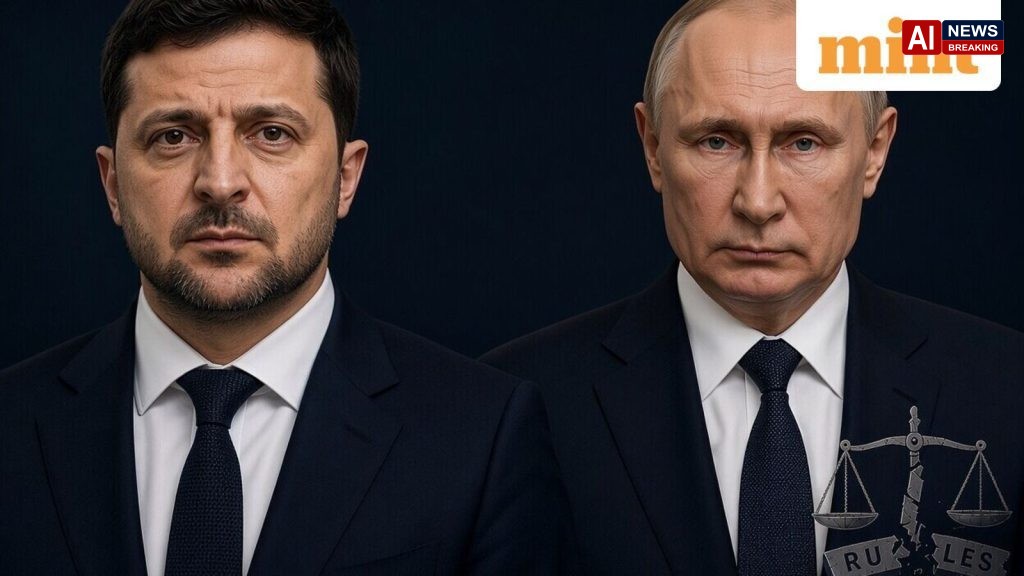
Ukraine's president warns Russia has abandoned war rules - AI News Breaking
ukraines president warns russia:
The Ukrainian president has warned that Russia is operating without any set of rules, describing a new, chaotic “war order” that has emerged as Moscow intensifies its aerial campaign against Kyiv and other Ukrainian cities. In an interview broadcast on state television, President Volodymyr Zelensky said the shift reflected a deliberate abandonment of the conventions that have traditionally governed armed conflict, a move that has seen strikes on schools, hospitals, data centres and other civilian infrastructure. “There are no rules now,” he declared, adding that the Russian leadership appears intent on erasing any distinction between military and civilian targets.Zelensky’s remarks came on the heels of a series of coordinated missile and drone attacks that have rattled Ukraine’s capital for the third consecutive week..
On Tuesday, a barrage of Shahed‑type loitering munitions struck the central business district, causing severe damage to a major telecommunications hub and temporarily disrupting internet services for millions. The following day, a missile strike hit a regional hospital in the Kyiv suburb of Brovary, killing at least eight patients and prompting a wave of condemnation from international health organisations. These incidents, the president suggested, illustrate a broader strategy aimed at destabilising the country’s civil infrastructure and undermining morale.Analysts say the pattern of attacks points to a shift from targeting strictly military installations to a more indiscriminate approach that seeks to cripple essential services..
“What we are witnessing is a deliberate escalation in the targeting of non‑military assets, which is a violation of international humanitarian law,” said Dr Anna Koval, a senior fellow at the Institute for Strategic Studies in Kyiv. She noted that the Russian command appears to be leveraging the chaos of winter and the strain on Ukraine’s defence budget to pursue a campaign of terror that goes beyond conventional battlefield objectives.The president’s description of a “new war order” resonates with similar observations made by NATO officials, who have warned that Moscow is increasingly employing tactics that blur the lines between combatants and civilians. In a statement released after the latest attacks, the NATO ary General said that the targeting of schools, hospitals and data centres not only contravenes the Geneva Conventions but also threatens the resilience of democratic societies that depend on open information networks..
“Such actions are designed to sow fear and erode the social fabric, and they must be met with a unified international response,” the statement read.In response to the heightened threat, Ukrainian authorities have accelerated the deployment of air defence systems across the capital and in key regional centres. The United States and several European allies have pledged additional Patriot and NASAMS batteries, while also expediting the delivery of spare parts for Ukraine’s existing air‑defence infrastructure. “Our goal is to create a layered shield that can intercept both high‑altitude missiles and low‑cost drones,” explained Colonel Oleh Hryniv, commander of Kyiv’s air‑defence brigade..
He added that while the new systems will improve interception rates, the sheer volume of incoming munitions remains a daunting challenge.Civilian resilience, however, is being tested on multiple fronts. The repeated targeting of educational facilities has forced schools to adopt remote learning on an ad‑hoc basis, disrupting the education of more than 300,000 pupils in the capital region alone. Health services are similarly strained; the Ministry of Health reported that more than 150 hospitals have been partially or fully damaged since the start of the year, forcing a reallocation of resources and the evacuation of critical patients to less vulnerable areas..
The data‑centre attacks have also raised concerns about the security of Ukraine’s digital infrastructure, which has become a lifeline for both government operations and civilian communication.International bodies have called for investigations into the alleged war crimes, with the International Criminal Court (ICC) announcing that it will open a preliminary examination into the attacks on civilian objects in Ukraine. The ICC’s prosecutor, Karim Khan, stated that the evidence gathered thus far suggests a systematic pattern that could constitute a breach of the Rome Statute. “If the allegations are substantiated, individuals responsible for ordering or executing these attacks could be held accountable under international law,” Khan said at a press conference in The Hague.Meanwhile, Moscow has denied any intention to abandon the laws of war, insisting that all its operations are directed at legitimate military targets..
In a televised address, President Vladimir Putin dismissed Zelensky’s accusations as “propaganda” and accused the West of “fabricating narratives” to justify further sanctions. Russian officials have also claimed that many of the sites struck were being used for military purposes, a contention that independent observers have found difficult to verify given the fog of war and the rapid pace of the conflict.The growing divergence between the narratives of Kyiv and Moscow underscores the broader geopolitical battle for legitimacy. Western governments have responded by tightening sanctions on Russian defense firms and by expanding support for Ukraine’s reconstruction efforts..
The European Union announced a €1.5 billion package aimed at rebuilding damaged schools and hospitals, emphasizing the need to restore essential services as quickly as possible. The United Nations, for its part, has called for an emergency session of the Security Council to discuss the humanitarian implications of the attacks, though it is unclear whether a consensus can be reached given Russia’s veto power.As the conflict enters its third year, the spectre of an unbridled war order looms large over both the Ukrainian populace and the international community. Zelensky’s warning reflects a grim assessment of a battlefield that now extends far beyond front lines, engulfing the very institutions that underpin civilian life..
Whether the combined diplomatic pressure and military aid supplied by the West can curb the escalation remains to be seen, but the urgency of protecting schools, hospitals and the digital backbone of society has never been more pressing. The coming weeks will likely determine whether the “new war order” will become a lasting feature of the conflict or a transient phase in a war that has already reshaped the contours of modern warfare..
Updated: October 2, 2026
Zelensky says Russia has abandoned traditional combat rules, launching indiscriminate strikes on schools, hospitals and data centres as part of a broader “new war order.” Kyiv is bolstering air defences and seeking international backing while the ICC prepares a war‑crimes probe into the civilian attacks.
Insight: Zelensky’s “new war order” signals a strategic pivot: by weaponising civilian infrastructure, Russia aims to fracture societal cohesion faster than Kyiv can rebuild it.
If the West’s layered air‑defence and reconstruction pledges can outpace the cascade of terror strikes, the conflict may shift