 Trump criticizes election officials in Arizona’s Maricopa County over error affecting 3,000 ballots
  Arizona opens Taiwan trade office in Phoenix
  US citizen who was shot by immigration agent files lawsuit
 Arizona opens Taiwan trade office in Phoenix
**
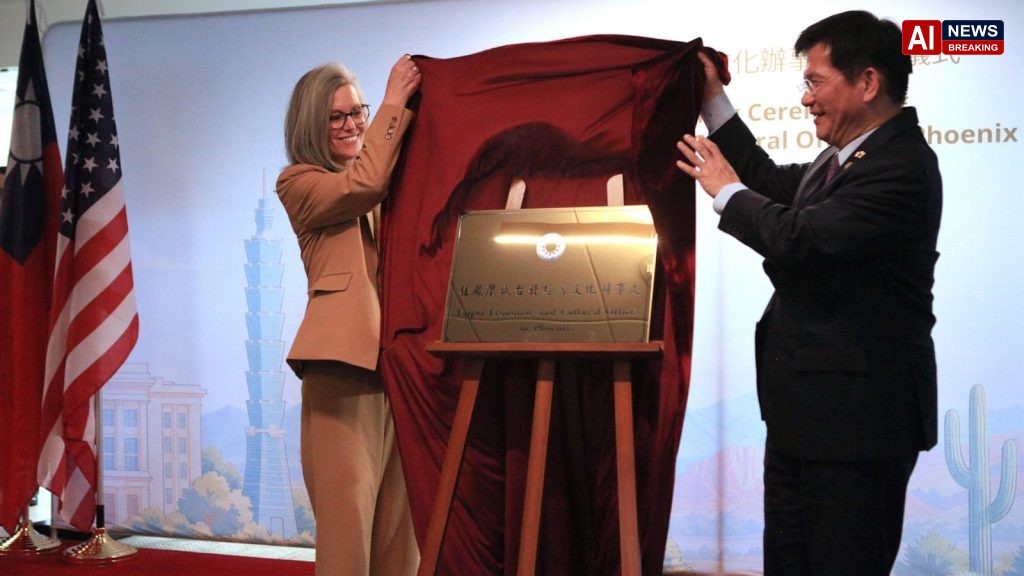
Arizona opens new Taiwan representative office, rejecting warning from China - AI News Breaking
Arizona’s governor, Katie Hobbs, and senior officials from Taipei inaugurated a new Taiwan Economic and Cultural Office in Phoenix on Tuesday, marking the first such diplomatic outpost in the southwestern United States. The office, which will be housed in a renovated building in downtown Phoenix, is intended to foster trade, investment, tourism and educational exchanges between Arizona and Taiwan, as well as to provide consular assistance to Taiwanese citizens residing or travelling in the region. The ceremony was attended by a delegation of Taiwanese business leaders, members of the Arizona Senate, and representatives of local chambers of commerce, underscoring the growing economic ties between the two economies..
Governor Hobbs highlighted the “mutual benefits” of closer cooperation, noting that Arizona’s technology sector, aerospace industry and agricultural exports align closely with Taiwan’s strengths in semiconductor manufacturing, renewable energy and high‑tech services.The office’s creation arrives amid heightened diplomatic friction between Washington and Beijing over Taiwan’s international status. China’s foreign ministry issued a statement the day before the opening, urging “all parties to respect the One‑China principle” and warning that “any official contacts that undermine the consensus will be met with serious consequences.” The Chinese government has long objected to any form of official representation for Taiwan outside of its own territory, viewing such moves as a breach of its sovereignty claims. Nonetheless, the Arizona administration defended the decision as a “state‑level economic initiative” that does not interfere with federal foreign policy, citing the United States’ longstanding practice of allowing sub‑national entities to pursue trade and cultural links with foreign partners.The Taiwan Economic and Cultural Office will operate under the auspices of Taiwan’s Ministry of Economic Affairs and will be staffed by a small team of Taiwanese officials and local American hires..
Its core functions will include facilitating business matchmaking events, providing market research to Arizona firms interested in entering Taiwanese markets, and assisting Taiwanese students seeking to study at Arizona universities. The office will also serve as a point of contact for Taiwanese tourists, many of whom are drawn to Arizona’s national parks and desert resorts, and for Arizona residents wishing to travel to Taiwan for business or leisure.Economic analysts note that the timing of the office’s launch coincides with a broader diversification strategy in Arizona’s economy. Over the past decade, the state has attracted significant investment from semiconductor manufacturers, including a $12 billion chip plant announced by Taiwan Semiconductor Manufacturing Company (TSMC) in 2023..
That project, which will create thousands of high‑skill jobs, has positioned Arizona as a critical node in the global supply chain for advanced micro‑electronics. Governor Hobbs argued that a dedicated Taiwan office would streamline communication between TSMC, its local subcontractors and state regulators, reducing bureaucratic hurdles and accelerating the rollout of ancillary infrastructure such as power grids and water management systems.Taiwanese officials present at the opening emphasized that the office is part of a larger “global outreach” strategy aimed at strengthening Taiwan’s economic resilience amid growing geopolitical pressure. Taiwan’s Minister of Economic Affairs, Wang Mei-hua, said that the Phoenix office would serve as a “bridge” for small and medium‑sized enterprises seeking to tap into the U.S..
market, particularly in sectors such as renewable energy technology, agritech and biotech. She also highlighted that the office would promote cultural exchanges, including Taiwanese language programs in Arizona schools and joint artistic exhibitions, thereby deepening people‑to‑people ties beyond purely commercial interests.Local business leaders expressed optimism that the new office could catalyze additional foreign direct investment. James Liu, CEO of a Phoenix‑based aerospace components manufacturer, noted that “having a direct line to Taiwan’s trade officials simplifies a lot of the due‑diligence work we have to do..
It also signals a level of commitment that can attract partners who might otherwise look elsewhere.” Similarly, the Arizona Chamber of Commerce and Industry released a statement praising the initiative as “a forward‑looking step that aligns with the state’s vision of becoming a hub for high‑tech innovation and international collaboration.”Critics, however, warned that the move could draw Arizona into the cross‑strait rivalry that has intensified since the United States affirmed its “strategic ambiguity” regarding Taiwan’s defense in 2022. A group of lawmakers from Arizona’s minority party filed a resolution urging the governor to seek clarification from the federal government before proceeding with any further diplomatic engagements with Taiwan. They argued that state‑level actions, while legally permissible, might complicate Washington’s broader diplomatic calculus with Beijing, especially as the U.S..
continues to balance economic ties with China against its commitments to Taiwan’s security.The federal response to the Phoenix office has been muted. The State Department’s spokesperson, when asked about the development, reiterated that “the United States maintains its One‑China policy while also supporting a robust, rule‑based international order,” without directly commenting on the Arizona initiative. Legal scholars point out that the U.S..
Constitution grants the federal government exclusive authority over foreign affairs, but the Supreme Court has historically allowed states considerable leeway in conducting “commercial diplomacy” that does not imply formal recognition of foreign sovereigns. In that context, the Phoenix office is likely to be viewed as a permissible economic liaison rather than a diplomatic mission.International observers see the Arizona office as part of a pattern of sub‑national entities in the United States and elsewhere establishing quasi‑diplomatic presences for Taiwan. Over the past five years, several U.S..
states, cities and universities have opened similar offices or “representative bureaus,” often framed as trade and cultural centers. These initiatives have been welcomed by Taipei as a means of expanding its global footprint without directly challenging the One‑China principle. At the same time, they have prompted Beijing to increase diplomatic pressure on local officials, including public statements, economic warnings and, in some cases, restrictions on Chinese investment in the host jurisdictions.The opening ceremony concluded with a reception featuring Taiwanese cuisine and a presentation of Arizona’s latest renewable‑energy projects, underscoring the shared interest in clean‑technology cooperation..
Both sides pledged to explore joint ventures in solar panel manufacturing, given Arizona’s abundant sunshine and Taiwan’s expertise in photovoltaic technology. In addition, a scholarship fund was announced to support Taiwanese students pursuing degrees in Arizona’s engineering schools, a move that officials said would help address the talent gap in the region’s growing tech sector.As the office begins operations, its success will likely be measured by the volume of trade deals it facilitates, the number of Taiwanese tourists it assists, and the depth of academic exchanges it nurtures. For Governor Hobbs, the venture represents a tangible way to diversify Arizona’s economy and reinforce its position as a bridge between the United States and Asia’s leading semiconductor producer..
For Taiwan, it adds another footh.
Updated: October 6, 2026
Arizona’s gamble on a Taiwan outpost signals a shift toward sub‑national foreign policy, where economic imperatives quietly test the limits of the federal “One‑China” stance.
If the office spurs chip‑chain investment, it could embed Arizona deeper into the geopolitical tug‑of‑war, making the state a strategic pawn that Beijing may target with economic pressure.