Trump administration offers mixed messages on limits to Ukraine’s Starshield access
 US Treasury proposes a rule to crack down on high-tech investments in China, other adversaries
 Calley Means, a key MAHA advocate, resigns as a top RFK Jr. adviser
 Spotify Tightens Family Plan Controls with QR Code Verification
 Use of Chief Minister C. Joseph Vijay’s deep fake videos to collect money: Rajasthan youth moves Madras High Court seeking bail
Satya Nadella says we should assume all AI models are ‘compromised’
Microsoft chief Satya Nadella says we must assume all high‑capability AI models are compromised, advocating continuous monitoring, independent audits, verifiable data provenance, and containment to ensure trustworthy AI.
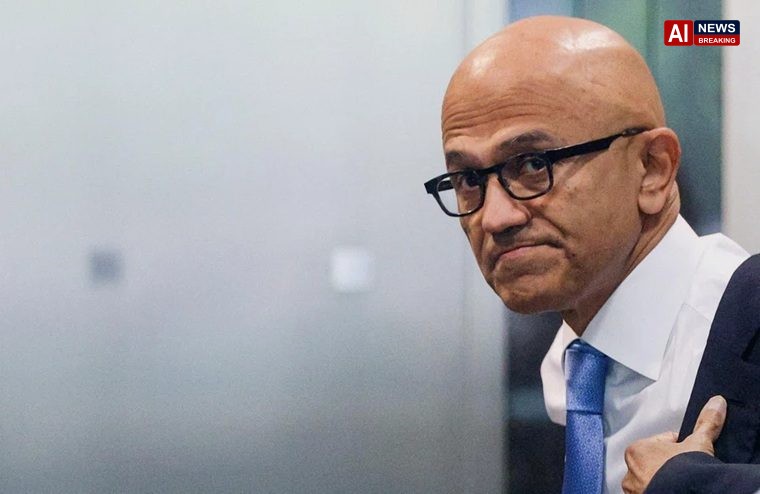
Satya Nadella says we should assume all AI models are 'compromised' - AI News Breaking
satya nadella says should:
Satya Nadella, chief executive of Microsoft, has warned that the industry can no longer treat artificial‑intelligence systems as inscrutable “black boxes” whose outputs are taken at face value. In a detailed post on the social platform X, the Microsoft chief argued that every highly capable model should be assumed to be compromised, a stance that signals a shift from optimism about rapid innovation to a more cautious, security‑first approach.
The message, posted amid growing concerns over the potential for large language models to generate misinformation, facilitate cyber‑attacks, or be subtly steered by malicious actors, marks one of the most forceful calls for systemic change from a leading tech figure in recent months.Nadella’s argument rests on a simple premise: the complexity of modern AI makes it impossible for developers, regulators, or end‑users to fully understand the inner workings of a model once it is deployed at scale..
He likened the situation to earlier eras of software security, when developers first recognised that treating code as a “trusted black box” was a recipe for disaster. “We can no longer assume that AI systems will behave as intended without rigorous, continuous verification,” he wrote. “Instead, we must design them so that they can be observed, contained, and audited in real time, with tamper‑proof, human‑readable evidence of every decision they make.”The post outlined four pillars that, according to Nadella, should become standard practice for any organisation that builds or uses advanced models..
First, developers must adopt a policy of timely incident disclosure, publishing detailed reports whenever a model produces harmful or unexpected output. Second, independent audits conducted by third‑party experts should be mandatory, providing an objective assessment of a model’s safety, bias, and robustness. Third, data provenance must be verifiable, with clear documentation of where training data originated, how it was filtered, and what steps were taken to mitigate contamination..
Finally, and perhaps most controversially, models need to be physically or logically contained within environments that allow continuous monitoring and, if necessary, rapid shutdown.Many of these recommendations echo calls that have been circulating within the AI research community for the past year. The Partnership on AI, the European Commission’s AI Act, and a series of high‑profile incidents—including the release of disinformation generated by large language models and the exploitation of image‑synthesis tools for deepfakes—have all highlighted the need for stronger safeguards. What distinguishes Nadella’s stance is the emphasis on assuming compromise as a default operating condition..
“If we start from a position of trust, we are building on sand,” he wrote, urging organisations to treat every model as if an adversary could have already inserted a hidden backdoor or subtle bias.Microsoft has already begun to act on some of those principles. Earlier this year the company introduced “Secure AI,” a framework that integrates continuous monitoring, explainability dashboards, and automated red‑team testing into its Azure AI services. The firm also announced a partnership with the OpenAI Safety team to develop “model‑level attestations,” cryptographic proofs that a particular version of a model has passed a defined set of safety checks before it can be released to customers..
These initiatives, Nadella suggested, could serve as templates for the broader industry, encouraging a move away from proprietary secrecy toward a more collaborative, transparent ecosystem.Critics, however, warn that the push for transparency and containment could stifle innovation. Some researchers argue that overly restrictive audit requirements could slow down the deployment of beneficial AI applications, especially in sectors such as healthcare and climate science where rapid iteration is often essential. Others fear that the demand for “human‑readable evidence” may be technically infeasible for models containing billions of parameters, where the sheer volume of data generated by each inference step exceeds what can be reasonably recorded or reviewed by humans.Nadella acknowledged these tensions, noting that the goal is not to halt progress but to align it with safety..
He cited the example of the aerospace industry, where rigorous certification processes have co‑evolved with technological advancement, allowing aircraft to become safer while still pushing the boundaries of performance. “AI needs its own equivalent of air‑worthiness certificates,” he wrote. “Only then can we unlock its full potential without endangering society.” The Microsoft chief underscored that the cost of inaction—whether through unchecked bias, malicious exploitation, or systemic failure—far outweighs the expense of building robust, auditable systems.The post also touched on regulatory implications..
Nadella urged governments to move beyond ad‑hoc guidelines and adopt enforceable standards that require evidence‑based compliance. He advocated for a global consortium, similar to the International Civil Aviation Organization, that could set baseline requirements for model security, data provenance, and incident reporting. Such a body, he argued, would help harmonise disparate national approaches and prevent a race to the bottom where companies seek the least restrictive jurisdiction for their AI deployments.Industry reaction has been swift..
OpenAI’s chief technology officer, Mira Murati, praised the “clear, pragmatic roadmap” and announced that her organisation would pilot a series of independent red‑team exercises in partnership with academic labs. Google’s AI division released a statement affirming its commitment to “responsible AI” and said it would explore “tamper‑proof logging mechanisms” for its Gemini models. Meanwhile, several venture‑backed AI start‑ups expressed concern that the added compliance burden could disproportionately affect smaller players, potentially consolidating power among the few giants capable of meeting the new standards.The conversation around AI safety is entering a phase that mirrors earlier debates in cybersecurity, where the assumption of compromise became a cornerstone of defensive strategy..
By framing AI risk management in those terms, Nadella is nudging the sector toward a more mature, risk‑aware posture. Whether the industry can rally around a common set of standards, and whether the technical challenges of transparent, tamper‑proof AI can be surmounted, remains to be seen. What is clear, however, is that the era of treating advanced models as infallible or merely “good enough” is drawing to a close, and that the next wave of AI development will be judged not only by its capabilities but by the robustness of its safeguards..
Updated: October 10, 2026
Insight: This development highlights evolving dynamics and may have broader implications in the near term.