Trump administration offers mixed messages on limits to Ukraine’s Starshield access
 US Treasury proposes a rule to crack down on high-tech investments in China, other adversaries
 Calley Means, a key MAHA advocate, resigns as a top RFK Jr. adviser
 Spotify Tightens Family Plan Controls with QR Code Verification
 Use of Chief Minister C. Joseph Vijay’s deep fake videos to collect money: Rajasthan youth moves Madras High Court seeking bail
Who Is Dhruv Rathee YouTuber Alleges ‘Kidnapping’ After Release Ahead of CEC Protest
**
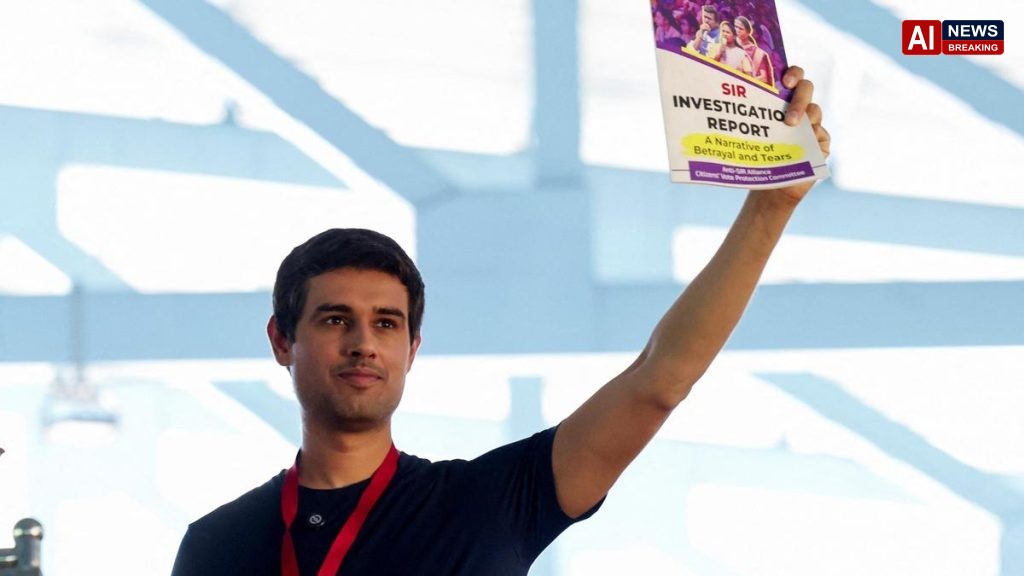
Delhi protest: YouTuber Dhruv Rathee released from detention - AI News Breaking
Dhruv Rathee, a prominent Indian YouTuber known for his political and social commentary, has recently claimed that he was abducted from his residence in Delhi by individuals in plain clothes. According to Rathee, the alleged kidnapping took place on a Saturday evening when he was reportedly taken from his home in the heart of the capital and transported to several police stations. The YouTuber’s account, which he shared through his own channels, details a harrowing experience in which he was held for more than twenty‑two hours, during which he was denied access to his phone, his lawyer and any form of communication with the outside world.The incident came at a time when the Election Commission of India (ECI) was holding a series of protests and public engagements across the city to raise awareness about the upcoming general elections..
Rathee has previously expressed support for electoral reforms and has used his platform to discuss issues ranging from voter education to campaign transparency. The YouTuber’s allegation of unlawful detention has raised questions about the safety of political commentators and the extent to which authorities might employ coercive tactics in a highly charged political environment.While the specifics of the encounter remain contested, Rathee insists that the men who seized him wore ordinary civilian clothing, yet his description of their demeanor and the manner in which they approached his home suggests a level of premeditation. He said that upon arrival, a group of approximately twenty individuals forced him to a vehicle and transported him to a police compound..
There, he claims he was interrogated and subsequently transferred to other police stations in the city, all without any clear justification or legal process. During this time, he was unable to contact his lawyer or reach out to friends and family. After approximately twenty‑two hours, Rathee was reportedly released and allowed to leave the police compound, although he reported that he was still physically and emotionally shaken by the ordeal.The claim has sparked a debate about the role of digital media personalities in India’s political landscape..
Dhruv Rathee has amassed a substantial following on YouTube, where he publishes videos that dissect government policies, electoral systems and societal issues. His content, which frequently critiques the actions of political parties, has drawn both praise for its analytical depth and criticism for perceived partisan leanings. The YouTuber’s allegations of kidnapping have consequently become a flashpoint for discussions about press freedom, the rights of political commentators and the mechanisms of accountability within law enforcement agencies.In the wake of Rathee’s statements, several political analysts have weighed in..
Some argue that the incident could be an example of the increasingly aggressive tactics used to silence dissenting voices ahead of elections. Others maintain that the lack of corroborating evidence and the absence of an official investigation make it difficult to ascertain the veracity of the claim. The Election Commission’s spokesperson has reiterated that the organisation has no knowledge of any unlawful activity against Rathee and has urged the public to await the results of any formal inquiry.The YouTuber’s background offers insight into how he has cultivated a significant online presence..
Rathee graduated from the University of Mumbai with a degree in economics before embarking on a career that blended academic research and digital content creation. He began uploading videos in 2013, initially focusing on financial literacy and gradually shifting to broader socio‑political topics. Over the years, his channel has grown to over one million subscribers, and his videos have generated tens of millions of views..
His style, often marked by a calm, data‑driven approach, has earned him recognition across India’s diverse media landscape, as well as a reputation for meticulous fact‑checking.Beyond his academic credentials, Rathee’s career has been shaped by his willingness to engage with contentious issues. He has been an outspoken critic of the ruling party’s approach to election campaigning, as well as an advocate for greater transparency in the electoral process. His videos have also tackled international matters, such as the policies of the United States and European Union, making him a global commentator on issues that transcend national borders..
This international perspective, combined with a robust understanding of local politics, has allowed Rathee to build a unique niche in the crowded field of political journalism.The alleged kidnapping incident has also highlighted the challenges faced by independent media voices in India. Over the past decade, the country has seen a rise in the number of online platforms that challenge mainstream narratives. However, many of these voices operate within an environment where regulatory frameworks are still developing, and the line between legitimate journalistic inquiry and perceived political opposition can be thin..
In such a context, any hint of state interference or intimidation can have far-reaching implications, not only for the individual targeted but also for the broader discourse on freedom of expression.In response to his ordeal, Rathee has called for a transparent investigation, urging authorities to release all records of the police stations involved and to provide a detailed account of the actions taken during his detention. He has also appealed to his followers to remain calm and to support his efforts to hold the state accountable. Whether the case will lead to formal legal proceedings remains to be seen..
Nonetheless, the incident has already prompted discussions about the need for clearer protocols regarding the treatment of individuals who engage in political commentary, particularly in the sensitive context of national elections.As the political calendar in India continues to accelerate, the scrutiny of media figures like Dhruv Rathee will likely intensify. The situation underscores the fragility of dissent in environments where public discourse is tightly regulated and where the boundaries between legal oversight and political pressure are often blurred. In the end, the resolution of Rathee’s allegations could serve as a litmus test for the robustness of India’s democratic institutions, especially regarding the protection of journalists and commentators who seek to illuminate complex political realities..
Updated: October 11, 2026
Summary: Indian YouTuber Dhruv Rathee claims he was forcibly taken from his Delhi home and held for over 22 hours by plain‑clothed men before being released by police, sparking debate over the safety of political commentators amid election‑period tensions. The incident has prompted calls for a transparent inquiry and raised questions about the extent to which authorities might use coercive tactics to silence dissenting voices.
If Rathee’s story is true, it signals a chilling escalation of pressure tactics aimed at digital dissenters, turning the police from watchdogs into potential intimidators. The episode underscores how election‑time paranoia can blur the line between lawful scrutiny and preemptive silencing, threatening the very openness of political