Trump administration offers mixed messages on limits to Ukraine’s Starshield access
 US Treasury proposes a rule to crack down on high-tech investments in China, other adversaries
 Calley Means, a key MAHA advocate, resigns as a top RFK Jr. adviser
 Spotify Tightens Family Plan Controls with QR Code Verification
 Use of Chief Minister C. Joseph Vijay’s deep fake videos to collect money: Rajasthan youth moves Madras High Court seeking bail
Diaspora protest outside UN
**
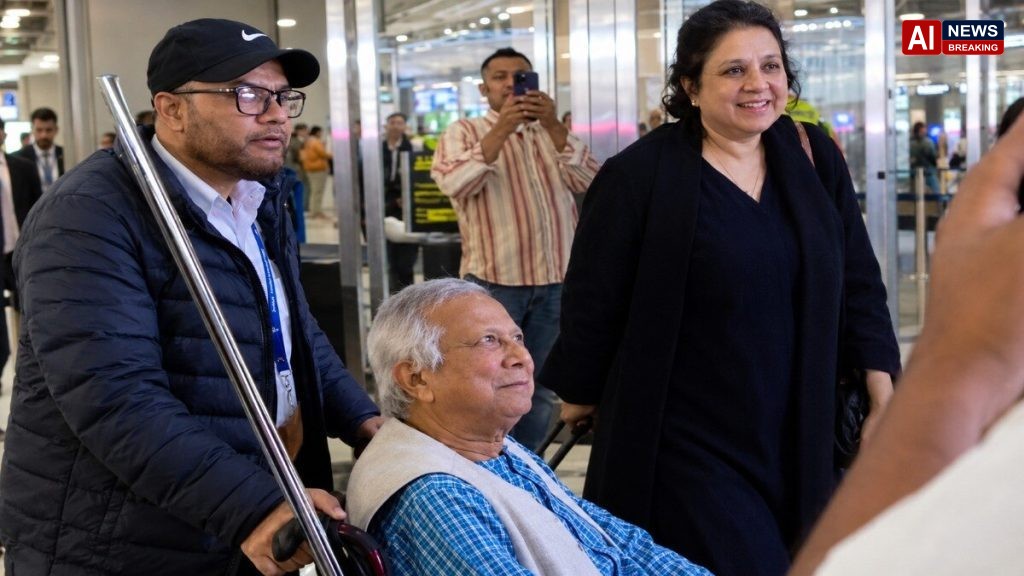
Diaspora protest outside UN - AI News Breaking
Muhammad Yunus, the Bangladeshi economist who won the Nobel Peace Prize in 2006 for pioneering micro‑credit through the Grameen Bank, has become the focus of a heated protest by members of the Bangladeshi diaspora in New York. The demonstration, organised by a coalition of expatriate groups, took place outside the United Nations headquarters on Thursday, where the Nobel laureate was scheduled to attend a panel on inclusive finance. Protesters brandished placards reading “Terrorist” and “Corrupt Banker”, demanding that Yunus be barred from speaking and that international bodies cease to endorse his work..
The episode marks a dramatic escalation in a dispute that has been simmering in Bangladesh for more than a decade, now spilling onto the global stage.The controversy stems from a series of legal battles that began in 2011 when the Bangladeshi government removed Yunus from the helm of Grameen Bank, alleging mismanagement and violations of banking regulations. Yunus’s supporters argue that the move was politically motivated, designed to curtail the influence of an independent civil‑society figure who had become a vocal critic of the ruling Awami League. Since then, a succession of court rulings has seen Yunus’s reputation oscillate between that of a visionary development pioneer and that of a rogue businessman..
The New York protest reflects the latter narrative, amplified by recent statements from senior officials in Dhaka who have labelled Yunus a “terrorist” for allegedly using his international profile to undermine national sovereignty.The protest was organised by the Bangladeshi American Association for Democracy (BAAD), a group that has previously staged demonstrations against what it describes as “political persecution” of Bangladeshi activists abroad. In a press release circulated before the event, BAAD said the gathering was intended to “expose the truth about Yunus’s alleged financial crimes and the dangerous precedent his continued endorsement sets for other authoritarian regimes”. The group also called on the United Nations to rescind its invitation to Yunus, arguing that his presence would lend legitimacy to an individual “who has repeatedly flouted the law and threatened national security”.Counter‑protesters, including members of the Bangladeshi expatriate community who have benefited from Grameen’s micro‑finance model, arrived later in the day..
They carried signs reading “Nobel Laureate, Not a Terrorist” and highlighted stories of women and small‑scale entrepreneurs whose lives were transformed by low‑interest loans. One participant, Ayesha Karim, a second‑generation Bangladeshi‑American who runs a nonprofit focused on financial literacy, said: “Yunus gave hope to people who were denied credit by traditional banks. To see him called a terrorist is an affront to the very idea of development that lifted millions out of poverty.” The divergent viewpoints underscored the deep split within the diaspora, mirroring the polarisation that exists in Bangladesh itself.The panel at the United Nations, which proceeded despite the protests, featured Yunus alongside academics and representatives from several development NGOs..
In his remarks, Yunus defended his record, stating that “the accusations against me are politically driven and aim to silence a voice that advocates for the poor”. He reiterated his commitment to the principles of “social business”, a concept he introduced in the early 2000s as a way to address market failures without relying on charity. The discussion touched on the role of micro‑finance in the post‑pandemic recovery, with Yunus urging governments to adopt “human‑centred” policies that prioritize inclusive growth over austerity.Bangladeshi officials have defended the government’s actions, citing a 2014 court ruling that declared Yunus ineligible to hold any managerial position in a private bank..
In a televised interview, Finance Minister A H M Mustafa Kamal asserted that “the law applies equally to everyone, regardless of their stature or international accolades”. He warned that continued international support for Yunus could be seen as interference in Bangladesh’s sovereign affairs. The minister’s comments were echoed by senior members of the ruling party, who have framed the issue as a test of the nation’s ability to enforce its legal framework without external pressure.International reaction has been mixed..
The World Bank issued a brief statement expressing “concern over the politicisation of development work” and reaffirmed its commitment to supporting micro‑finance initiatives worldwide. Human Rights Watch, meanwhile, called for an “independent investigation” into the allegations of financial misconduct, noting that “due process must be respected, and any criminal accusations should be examined transparently”. Scholars of development economics have highlighted that the debate over Yunus’s legacy is not new; similar disputes have arisen in the past when his model was scaled up or when governments attempted to regulate the sector more tightly.Analysts suggest that the New York protest may signal a broader trend of diaspora communities influencing political narratives in their home countries..
Farhana Hossain, a political scientist at Columbia University, observed that “the Bangladeshi diaspora has become a powerful lobbying force, able to project domestic conflicts onto the international arena”. She added that the intensity of the protest reflects “the growing frustration among expatriates who feel their voices are ignored by both the host country and the regime back home”. The incident also about the role of global institutions in navigating such disputes, especially when the individuals involved have both celebrated achievements and serious accusations against them.For many in the Bangladeshi community, the clash over Yunus’s reputation is personal..
Rajib Das, a New York‑based restaurateur, recounted how his parents received a loan from Grameen Bank in the early 2000s, which enabled them to open a small shop in Dhaka that later funded the family’s migration to the United States. “My mother used the loan to buy a sewing machine,” he said, “and that machine bought us a future. To hear his name dragged through the mud feels like an attack on my own story.” Conversely, others, like former Grameen employee Shafiqur Rahman, argue that the bank’s early successes do not excuse alleged breaches of financial regulation..
“No one is above the law,” Rahman told reporters. “If there were irregularities, they must be investigated, and if proven, addressed.”The episode is likely to have lasting implications for how development leaders are vetted and celebrated on the world stage. As the United Nations prepares for its upcoming Sustainable Development Goals summit, the question of whether Yunus.
Updated: October 13, 2026
The New York showdown reveals how diaspora mobilization can weaponize a Nobel laureate’s brand, turning a development success story into a diplomatic flashpoint that forces global institutions to reconsider the criteria for endorsing individual icons.
If the UN and multilateral donors bow to politically‑charged vilifications, they risk eroding the credibility of the very “human‑centred” development paradigm Yunus championed, emboldening authoritarian regimes to weaponize legal battles against civil‑society