 Tao Tokyo Spring 2027
 Karnataka SIR: Teaching on the back burner
 Trump administration offers mixed messages on limits to Ukraine’s Starshield access
 US Treasury proposes a rule to crack down on high-tech investments in China, other adversaries
 Calley Means, a key MAHA advocate, resigns as a top RFK Jr. adviser
Settlers attack Palestinian villagers during olive harvest in Hebron.
**
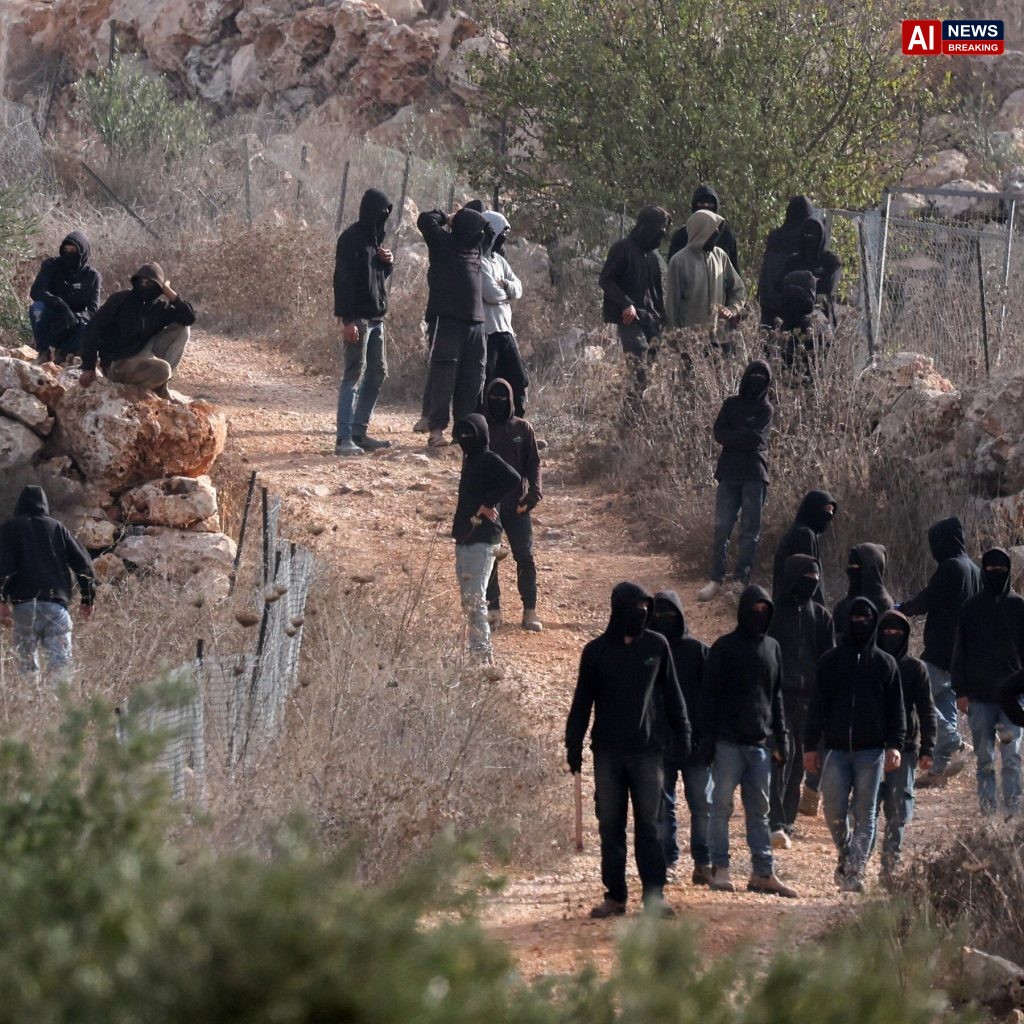
Israeli Settlers Attack Palestinians and Washington Post Journalist in West Bank - AI News Breaking
Violent clashes erupted in the West Bank’s Hebron district on Tuesday as a group of Israeli settlers entered a Palestinian village during the annual olive‑harvest season, an event that holds both cultural and economic significance for the local community. The incident, which culminated in the assault of several villagers and a journalist from The Washington Post, has reignited concerns over settler aggression and the capacity of the Israeli security forces to protect civilians in occupied territories.According to eyewitnesses, a contingent of settlers, estimated to number between twenty and thirty, arrived in a convoy of four vehicles shortly after dawn. They proceeded to the outskirts of the village of Khirbet al‑Urayy, where dozens of Palestinian families were gathering to pick olives from trees that have been cultivated for generations..
The settlers, some armed with clubs and knives, began shouting slogans that denounced the Palestinian presence and threatened to damage the orchards. Within minutes, the situation escalated into a physical confrontation.Palestinian villagers, many of whom were elderly men and women, attempted to resist the intrusion. Several were struck with blunt objects, while others sustained cuts from knives..
One 62‑year‑old man, identified by relatives as Mahmoud al‑Khatib, suffered a fractured forearm after being knocked to the ground. A 19‑year‑old woman, Leila Nassar, reported being pushed into a ditch and having her hands bound with a rope before being released after a short period. The violence disrupted the harvest, leaving dozens of olives uncollected and threatening the livelihood of families that depend on the seasonal crop for income.Among those present was a foreign journalist covering the harvest for The Washington Post..
The reporter, whose name has not been released pending verification, was approached by the settlers and ordered to leave the area. When the journalist refused, citing the need to document the incident, the group turned on him, striking him with a metal rod and confiscating his camera equipment. The journalist was later treated at a nearby clinic for a bruised rib and a concussion, and his equipment was reportedly damaged beyond repair.The Israeli Defense Forces (IDF) arrived at the scene approximately thirty minutes after the first reports of the disturbance were logged..
Military officials stated that a patrol unit was dispatched in response to calls from both Palestinian residents and an Israeli settler liaison office. Upon arrival, the IDF separated the two parties and conducted a brief investigation. In a statement released later that day, the spokesperson for the IDF’s Southern Command said: “We are deeply concerned about the reports of violence involving civilians in the West Bank..
Our forces are conducting a thorough inquiry and will hold accountable any individuals found to have broken the law.”Palestinian authorities, represented by the Ministry of Interior, condemned the attack as a “deliberate act of intimidation” aimed at undermining the Palestinians’ right to harvest their own produce. The ministry called for an independent international investigation, arguing that the current mechanisms for addressing settler violence are inadequate. “The pattern of settler aggression, coupled with insufficient protection from the occupying power, continues to erode any semblance of normalcy for our people,” the statement read.Human‑rights organisations have echoed these concerns..
B’Tselem, an Israeli NGO that monitors human‑rights violations in the occupied territories, released a brief note on Tuesday noting that the incident was “part of a broader trend of increasing settler hostility during harvest periods, when economic pressures are highest.” The group urged the Israeli authorities to enforce existing statutes that prohibit violence against civilians, regardless of ethnicity or nationality.The United States Embassy in Jerusalem expressed “serious concern” over the episode, emphasizing the need for “prompt and transparent investigations” and urging all parties to respect the rights of civilians and journalists. In a separate communication, the embassy reiterated its support for the continuation of the olive harvest, describing it as “a vital cultural practice that should be protected from intimidation and violence.”Local Palestinian leaders in Hebron have called for a day of protest, urging residents to gather peacefully near the site of the attack to demand justice. They have also appealed to the Palestinian Authority to increase security measures in the area, a request that has been complicated by the fragmented nature of security responsibilities in the West Bank, where the PA’s police forces operate alongside Israeli military units.The settlers involved have not yet been identified publicly, and no arrests have been reported as of the afternoon of the same day..
Some members of the settler community, speaking on condition of anonymity, defended the incursion as a “protective measure” intended to prevent what they described as “illegal Palestinian activity” on land they claim as part of the broader settlement enterprise. This narrative, which frequently surfaces in settler circles, is contested by international law experts who maintain that the settlements are illegal under the Fourth Geneva Convention, a stance reiterated by the United Nations and the European Union.Legal experts note that the assault on a journalist adds another layer of complexity to the case. International humanitarian law, as well as the protections afforded to members of the press under the Geneva Conventions, obliges occupying powers to safeguard journalists from harm..
The damage to the reporter’s equipment, coupled with the physical injuries sustained, could be interpreted as a violation of both domestic Israeli statutes and international norms governing the treatment of journalists in conflict zones.The incident comes amid a broader uptick in reports of settler violence across the West Bank over the past six months. Data compiled by the United Nations Office for the Coordination of Humanitarian Affairs (OCHA) indicates a 27 percent increase in recorded attacks on Palestinians since the start of the year, with incidents ranging from stone‑throwing and property damage to more lethal confrontations. The timing of the current assault, occurring during the olive harvest, underscores the strategic nature of many of these attacks, which often target economic activities that are essential for Palestinian communities.International observers have called for renewed diplomatic engagement to address the underlying causes of the violence..
A spokesperson for the European Union’s delegation in Jerusalem warned that “continued settler aggression, if left unchecked, threatens to destabilise an already fragile situation and undermines any prospects for a negotiated settlement.” The EU reiterated its commitment to supporting Palestinian civil society initiatives that promote non‑violent resistance and economic resilience.As the investigation proceeds, families of the victims are gathering in makeshift clinics set up by local NGOs to assess the extent of injuries and to document the damage for potential legal action. A number of residents have already filed complaints with the Israeli civil police, seeking compensation for lost produce and medical expenses. Meanwhile, the Washington Post journalist, who has returned to Washington for treatment, is expected to file a formal grievance with both the Israeli authorities and his newspaper.
Updated: October 16, 2026
The attack shows how settler groups weaponize cultural moments to assert dominance, turning a peaceful harvest into a flashpoint that feeds the cycle of mistrust.
If Israel fails to hold perpetrators accountable, the narrative of “protective” violence will grow, eroding any remaining confidence in its ability to safeguard