Karnataka SIR: Teaching on the back burner
 Trump administration offers mixed messages on limits to Ukraine’s Starshield access
 US Treasury proposes a rule to crack down on high-tech investments in China, other adversaries
 Calley Means, a key MAHA advocate, resigns as a top RFK Jr. adviser
 Spotify Tightens Family Plan Controls with QR Code Verification
JNTUA Vice-Chancellor calls for radical changes in higher education system
**
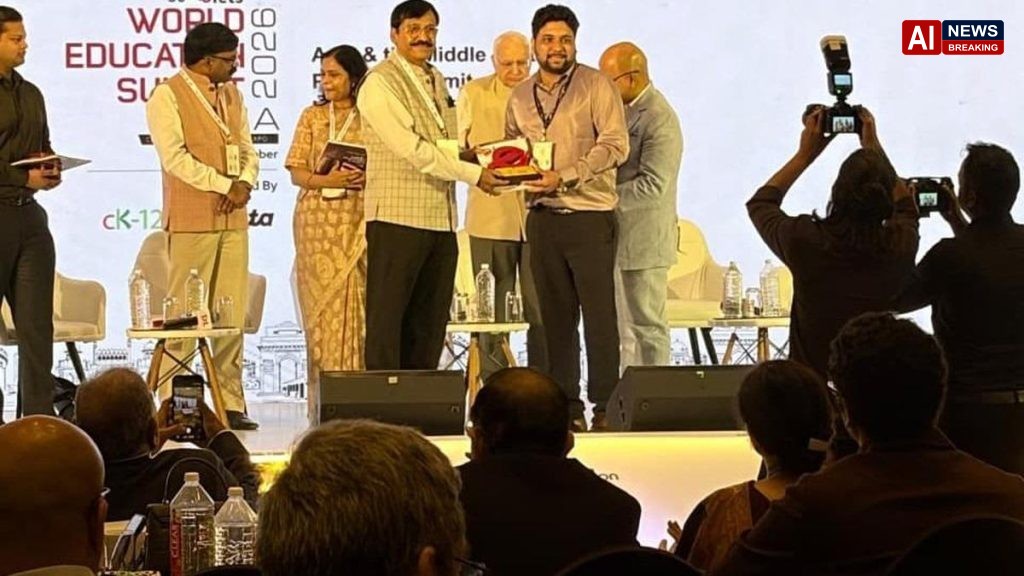
JNTUA Vice-Chancellor calls for radical changes in higher education system - AI News Breaking
jntua vicechancellor calls radical:
The Vice‑Chancellor of Jawaharlal Nehru Technological University, Anantapur (JNTUA), Sudarsana Rao used his platform as a panel speaker at the World Education Summit to urge a sweeping overhaul of India’s higher education system, arguing that universities must evolve from traditional lecture‑driven institutions into dynamic hubs that nurture creativity, research, problem‑solving and lifelong learning. Addressing a gathering of academics, policy makers and industry leaders, Rao warned that the current model, he said, “produces graduates who are technically competent but often lack the adaptive thinking required by a rapidly changing global economy.” His remarks came amid growing concerns that India’s universities, despite a massive enrolment base, lag behind their international peers in innovation output and graduate employability.Rao outlined a three‑tiered vision for the transformation. The first tier calls for a fundamental shift in curricula, moving away from rote memorisation toward interdisciplinary modules that blend engineering, humanities and social sciences..
He cited examples from European and Asian institutions where students engage in project‑based learning from the first year, allowing them to apply theoretical concepts to real‑world challenges. “When students see the relevance of their studies to societal problems, they develop a sense of purpose that fuels curiosity,” he said, highlighting a pilot programme at JNTUA where civil engineering students collaborated with local authorities to design flood‑resilient infrastructure for nearby villages.The second tier emphasises research as a core undergraduate activity rather than a postgraduate afterthought. Rao argued that exposing students to research methodologies early on cultivates a mindset of inquiry and equips them with skills to evaluate evidence critically..
He announced the university’s intention to establish a network of “research incubators” across its campuses, each linked to industry partners and government labs. Funding, he noted, would be sourced through a blend of central grants, private philanthropy and competitive grants awarded to faculty‑student teams that propose solutions to pressing national issues such as renewable energy storage and digital agriculture.A third and equally crucial tier focuses on lifelong learning pathways that extend beyond graduation. Rao pointed out that the rapid pace of technological change renders a static degree insufficient for career progression..
To address this, JNTUA plans to launch a modular credential system, enabling alumni to upskill through short‑term courses, micro‑master’s programmes and online certifications. He underscored the importance of a seamless credit‑transfer mechanism, which would allow learners to stack qualifications from different institutions without bureaucratic hurdles. “Education should be a continuum, not a one‑off event,” he said, urging the Ministry of Education to recognise and support such flexible frameworks.While advocating for these reforms, Rao acknowledged the systemic challenges that have long plagued Indian higher education..
He identified chronic underfunding, outdated governance structures and a lack of accountability as barriers to progress. According to him, many universities still operate under a “command‑and‑control” model where administrative decisions are made in isolation from academic staff and students. This, he argued, stifles innovation and hampers the ability to respond swiftly to emerging trends..
Rao called for a decentralised governance model that grants greater autonomy to individual institutions, coupled with robust performance metrics linked to research output, graduate outcomes and industry collaboration.The panel discussion also touched on the role of technology in reshaping pedagogy. Rao highlighted the potential of artificial intelligence and data analytics to personalise learning experiences, track student engagement and provide early warnings of academic distress. He cautioned, however, that technology must be employed judiciously, with safeguards to protect data privacy and to avoid widening the digital divide..
“We must ensure that every student, whether in a metropolitan campus or a remote rural centre, has equitable access to high‑quality digital resources,” he warned.Industry representatives at the summit echoed Rao’s concerns, noting a growing skills gap that hampers competitiveness. A senior executive from a leading Indian IT firm remarked that employers increasingly seek graduates who can think critically, communicate across disciplines and adapt to ambiguous problem spaces. The executive praised Rao’s proposal for research incubators, suggesting that co‑development of projects between academia and industry could accelerate the translation of lab‑based discoveries into marketable solutions..
He also advocated for stronger internship programmes that embed students in real‑world work environments, thereby bridging the gap between theory and practice.Rao’s call for change resonated with several state and central education officials present at the summit. A spokesperson from the Ministry of Education acknowledged the urgency of reform, noting that the government’s recent National Education Policy 2020 already envisages a more holistic, multidisciplinary approach. The official indicated that the ministry is exploring policy levers to incentivise universities to adopt research‑intensive curricula and to reward institutions that demonstrate measurable improvements in graduate employability..
However, the spokesperson cautioned that policy shifts alone would be insufficient without concerted effort from university leadership, faculty, industry and civil society.In response to questions about implementation timelines, Rao admitted that the envisioned overhaul would not occur overnight. He proposed a phased rollout over the next five to ten years, beginning with pilot programmes at select JNTUA campuses, followed by scaling successful models to other state universities. He stressed the need for continuous monitoring and iterative refinement, drawing on feedback from students, faculty and external stakeholders..
“We must treat this as an experiment in national importance, learning from both successes and setbacks,” he said, urging a culture of evidence‑based decision‑making.The summit concluded with a consensus that higher education in India stands at a crossroads, and that decisive, collaborative action is required to reposition universities as engines of innovation and social progress. Rao’s articulation of a comprehensive, research‑centric, lifelong learning framework offers a roadmap that, if embraced, could reshape the educational landscape for millions of students. As India strives to cement its status as a knowledge economy, the onus now lies on policymakers, university administrators and the private sector to translate the summit’s aspirations into concrete, scalable reforms that will equip future generations with the skills and mindset needed to navigate an increasingly complex world..
Updated: October 17, 2026
India’s universities risk becoming relics unless they abandon rote curricula for interdisciplinary, research‑driven learning that mirrors the fluid demands of a global knowledge economy. The success of Rao’s blueprint will hinge on dismantling entrenched bureaucracies and forging a genuine partnership between academia, industry, and the state—a daring experiment that could redefine India’s economic trajectory.