 Tao Tokyo Spring 2027
 Karnataka SIR: Teaching on the back burner
 Trump administration offers mixed messages on limits to Ukraine’s Starshield access
 US Treasury proposes a rule to crack down on high-tech investments in China, other adversaries
 Calley Means, a key MAHA advocate, resigns as a top RFK Jr. adviser
Indian Navy commissions offshore patrol vessel INS Samarthak at Karwar base.
**
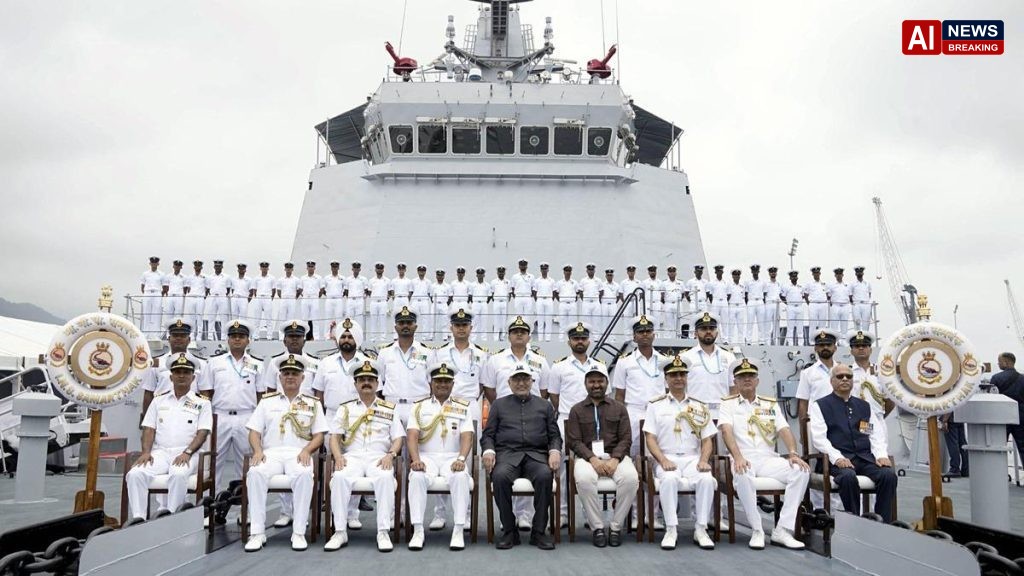
INS Samarthak commissioned at Karwar, Vice President C.P. Radhakrishan terms it a milestone in self-reliant defence manufacturing - AI News Breaking
INS Samarthak commissioned at Karwar, Vice President C.P. Radhakrishnan terms it a milestone in self‑reliant defence manufacturing The Indian Navy formally commissioned the offshore patrol vessel INS Samarthak at the naval base in Karwar on Tuesday, marking the culmination of a three‑year construction programme led by Hindustan Shipyard Ltd. The ceremony, attended by senior naval officers, defence ministry officials and representatives of the domestic industrial consortium, underscored the strategic importance of expanding indigenous shipbuilding capacity in a region where maritime security challenges are intensifying..
Vice‑President C.P. Radhakrishnan, who presided over the event, hailed the launch as a “milestone in self‑reliant defence manufacturing”, emphasizing that the vessel embodies the nation’s ambition to reduce dependence on foreign suppliers. In his remarks, Radhakrishnan highlighted that INS Samarthak incorporates more than 75 percent indigenous content, a figure that reflects the rapid maturation of India’s defence industrial base over the past decade. The new patrol ship, displacing around 2,200 tonnes and measuring 105 metres in length, is equipped with state‑of‑the‑art navigation, communication and surveillance systems sourced primarily from Indian firms..
Its primary roles include maritime patrol, anti‑piracy operations, search and rescue, and protection of India’s exclusive economic zone. Defence analysts note that the vessel’s multi‑role capability aligns with the navy’s broader doctrinal shift towards flexible, littoral‑focused assets. Construction of INS Samarthak began in 2020 under the Ministry of Defence’s “Make in India” initiative, which seeks to foster domestic research, development and production across the defence sector..
The ship’s hull and propulsion system were manufactured by Hindustan Shipyard, while its radar suite, electronic warfare suite and integrated bridge system were supplied by Bharat Electronics and Larsen & Toubro, among others. The collaborative effort has been cited as a template for future projects aiming for high indigenisation rates. Industry insiders point out that the vessel’s indigenisation exceeds the 65‑percent benchmark that the government set for major warship programmes in 2022..
Achieving a 75‑percent indigenous content required extensive coordination between the navy’s technical specifications and the capabilities of Indian suppliers, often involving co‑development arrangements and technology transfer agreements. This synergy, they argue, signals a turning point in the nation’s ability to field complex platforms without reliance on foreign partners. The commissioning ceremony also featured a symbolic “sea‑go” where the ship’s chief engineer, Captain Arvind Singh, formally handed over the vessel’s logbook to the commanding officer, Commander Rohan Mehta..
The ritual, steeped in naval tradition, was accompanied by a fly‑past of Indian Air Force Jaguar aircraft and a salute from the base’s coastal artillery units, underscoring the integrated nature of India’s maritime defence posture. In a detailed statement released after the event, the Ministry of Defence lauded the project as “a testament to India’s resolve to achieve strategic autonomy”. The document noted that the successful delivery of INS Samarthak would accelerate the Navy’s plan to induct an additional twelve offshore patrol vessels by 2029, all of which are slated to meet or exceed the current indigenisation thresholds..
Analysts at the Center for Strategic Studies in New Delhi noted that the vessel’s capabilities will enhance maritime domain awareness in the Arabian Sea, a theatre where increasing traffic and geopolitical rivalries have heightened the risk of incidents. By deploying a domestically built platform equipped with advanced sensors and a modern combat management system, the navy can conduct persistent surveillance and rapid response missions without the logistical constraints often associated with foreign‑made ships. The commissioning also carries economic implications for the coastal state of Karnataka, where Hindustan Shipyard is headquartered..
The shipyard’s workforce, numbering over 3,000, benefitted from skill‑upgrading programmes tied to the project, and local suppliers reported a surge in orders for high‑grade steel, precision machining and electronic components. Regional industry bodies anticipate that the success of INS Samarthak will catalyse further investment in ancillary sectors, thereby creating a multiplier effect on employment and technological expertise. While the navy celebrates the achievement, experts caution that sustaining high indigenisation levels will require continued policy support, particularly in areas such as advanced propulsion technology and stealth materials, where India still leans on imported solutions..
They argue that a balanced approach—combining domestic innovation with selective foreign collaboration—will be essential to maintain pace with rapid advancements in naval warfare and to avoid capability gaps. Looking ahead, the government has signalled its intention to expand the “Make in India” framework to include more sophisticated platforms such as guided‑missile destroyers and submarines. The successful delivery of INS Samarthak, according to defence officials, provides a proof‑of‑concept that could be replicated across these larger programmes, potentially shortening development cycles and reducing acquisition costs..
As INS Samarthak prepares for its maiden deployment, the Indian Navy expects the vessel to join the Western Naval Command’s fleet within weeks, bolstering patrols along the western seaboard. The commissioning ceremony, attended by the nation’s top civilian and military leaders, thus stands.
Updated: October 18, 2026
India’s new INS Samarthak proves that home‑grown shipbuilding can keep pace with the navy’s evolving littoral focus, turning “Make‑in‑India” rhetoric into a tangible force multiplier. If the 75 % indigenisation benchmark holds, it could reshape procurement‑timelines