Spotify Tightens Family Plan Controls with QR Code Verification
 Use of Chief Minister C. Joseph Vijay’s deep fake videos to collect money: Rajasthan youth moves Madras High Court seeking bail
 Florida officer took possession of man’s home after finding him dead 4 years ago, police say
 Jury weighs fate of US woman who says father forced her into Syria’s war zone when she was a teen
CM Satheesan announces blue economy hub in Keralam’s Aroor, inaugurates bridge
**
CM Satheesan announces blue economy hub in Keralam’s Aroor, inaugurates bridge - AI News Breaking
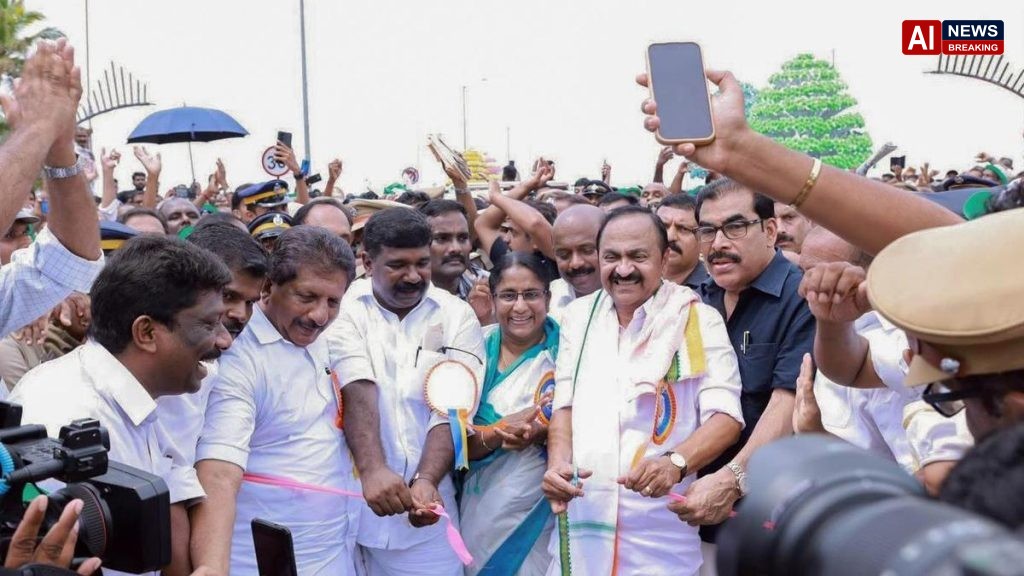
CM Satheesan announces blue economy hub in Keralam’s Aroor, inaugurates bridge Kochi – Kerala’s chief minister, C. M. Satheesan, unveiled a new blue‑economy hub at Aroor on Thursday, marking a strategic push to develop the state’s coastal and marine sectors. The project, spanning 120 hectares of reclaimed land along the Periyar River, is expected to house research institutes, aquaculture farms, and a logistics centre aimed at boosting sustainable fishing, marine tourism and renewable energy. Officials say the hub will create up to 15,000 jobs over the next five years, positioning Kerala as a model for coastal development in South‑Asia..
The ceremony also featured the inauguration of a 1.2‑kilometre bridge linking Aroor’s industrial zone with the proposed hub. The structure, built under the Public Works Department’s (PWD) accelerated programme, is designed to ease traffic congestion on the National Highway 66 corridor and improve freight movement for the region’s burgeoning export market. State engineers highlighted the bridge’s modern design, incorporating corrosion‑resistant steel and a pedestrian walkway to encourage mixed‑use mobility..
Government sources said the blue‑economy hub aligns with the national “Blue Economy Initiative” launched in 2023, which seeks to harness ocean resources for growth while preserving marine ecosystems. Kerala’s plan focuses on integrated aquaculture, marine biotechnology, and clean energy generation from tidal and wave power. Funding will be sourced from a blend of state allocations, central grants, and private‑sector investment, with an estimated total cost of ₹2,800 crore..
The announcement follows a series of policy moves by the Satheesan administration to diversify Kerala’s largely service‑oriented economy. Last year, the state launched a coastal‑fisheries cluster in Kozhikode and signed memoranda of understanding with Japanese and Norwegian firms for technology transfer. Analysts view the Aroor hub as the next logical step, potentially attracting foreign direct investment and enhancing the state’s export basket of marine products, which grew by 12 percent in the 2023‑24 fiscal year..
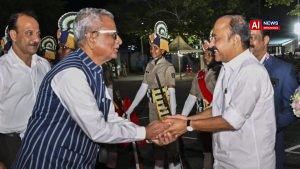
Despite the celebratory atmosphere, the inauguration was marred by a heated exchange between senior politicians. Public Works Department Minister P. K. Basheer and former CPI(M) MP A. M. Ariff were observed arguing over credit for the bridge project, each asserting that their respective departments had driven the initiative. Witnesses reported raised voices and gesturing, though security quickly intervened to restore order..
The spat highlighted underlying tensions within the ruling coalition regarding the allocation of high‑profile infrastructure credits. Adding to the discord, former Vaikom MLA C. K. Asha left the venue in protest after being denied a turn to address the chief minister. Sources close to Asha said she sought to raise concerns about the environmental impact assessment of the reclaimed land, arguing that local fisherfolk had not been adequately consulted..
Her departure was met with murmurs from a segment of the audience, underscoring growing civil‑society scrutiny of rapid coastal development projects. In response to the controversy, the chief minister’s office issued a statement emphasizing that all procedural clearances had been obtained in accordance with the Coastal Regulation Zone (CRZ) guidelines. The statement also pledged to set up a stakeholder committee comprising fisherfolk representatives, environmental experts and local administrators to monitor the hub’s implementation..
Officials assured that the project would incorporate green infrastructure, including mangrove restoration and waste‑water treatment plants. Environmental NGOs, however, remain cautious. The Centre for Oceanic Studies released a brief critique, warning that large‑scale land reclamation could disrupt tidal patterns and affect the breeding grounds of native fish species..
The group called for an independent impact audit before further phases commence. In contrast, the Kerala State Biodiversity Board welcomed the inclusion of marine research institutions, noting that scientific study could mitigate potential ecological risks. Economists at the Institute for Development Studies projected that the hub could contribute an additional ₹3,500 crore to the state’s gross domestic product by 2030, provided that ancillary industries such as packaging, cold‑storage and logistics develop in tandem..
They also highlighted the need for robust skill‑development programmes to ensure that the local workforce can meet the technical demands of advanced aquaculture and marine biotechnology. The bridge inauguration was attended by senior officials from the Ministry of Shipping and the Ministry of Fisheries, reflecting the central government’s support for Kerala’s coastal agenda. A delegation from the Ministry of Environment and Forests also inspected the site, noting the presence of a newly planted mangrove belt designed to act as a natural buffer against erosion..
The officials praised the collaborative model of state‑central partnership, citing it as a template for similar projects in other Indian states. Local business owners expressed optimism that the improved connectivity will reduce transport costs and open new markets for their products. “The bridge cuts travel time to the port by half,” said Ramesh Nair, proprietor of a small-scale spice exporter in Aroor..
“We anticipate faster shipments to the Middle East and Europe, which could significantly boost our margins.” The sentiment was echoed by representatives of the Kerala Handloom Development Corporation, who see opportunities for coastal artisans to showcase their work to tourists visiting the hub’s planned eco‑tourism zone. As the day concluded, the chief minister urged all parties to focus on the collective goal of sustainable development..
Updated: October 18, 2026
Kerala’s chief minister inaugurated a 120‑hectare blue‑economy hub at Aroor, featuring research labs, aquaculture farms and a logistics centre, alongside a new 1.2‑km bridge to streamline freight and traffic. The project, backed by state, central and private funds, aims to generate up to 15,000 jobs and position the state as a South‑Asian model for sustainable coastal development, despite concerns over environmental impact and intra‑government credit disputes.
Kerala’s blue‑economy gambit signals a pivot from service‑dominated growth to a maritime high‑tech corridor, but the political squabbles over credit betray a fragile coalition that may stall the very innovation it seeks. If the state can coalesce its diverse stakeholders and deliver transparent environmental safeguards, Aroor could become a South‑Asian lighthouse of sustainable coastal prosperity; otherwise, it risks becoming another flash‑in‑the‑pan project that erodes local