Spotify Tightens Family Plan Controls with QR Code Verification
 Use of Chief Minister C. Joseph Vijay’s deep fake videos to collect money: Rajasthan youth moves Madras High Court seeking bail
 Florida officer took possession of man’s home after finding him dead 4 years ago, police say
 Jury weighs fate of US woman who says father forced her into Syria’s war zone when she was a teen
Delhi High Court summons CJP leaders over barricade removal at Jantar Mantar.
**
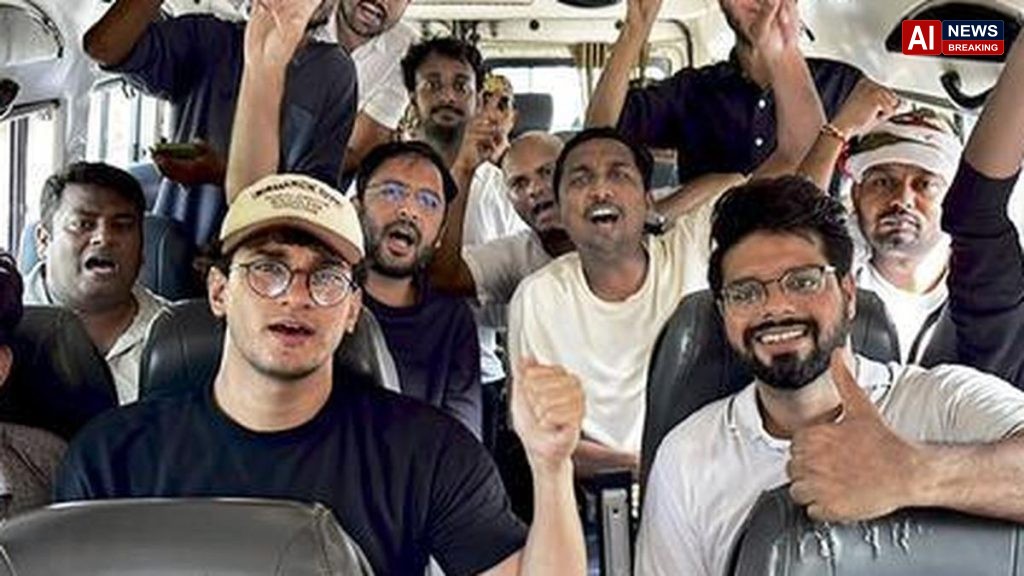
Delhi High Court questions CJP leaders over breaking barricades to enter Jantar Mantar - AI News Breaking
Delhi High Court questions CJP leaders over breaking barricades to enter Jantar Mantar The Delhi High Court on Tuesday summoned senior figures from the Confederation of Joint Protestors (CJP) after video footage showed them forcefully dismantling police barricades at Jantar Mantar, the capital’s historic protest arena. The incident, which unfolded in the early hours of the morning, sparked a fresh legal battle over the right to peaceful assembly versus public order. Judge Justice Anil Kumar, presiding over the case, questioned the leaders about the decision to breach security measures that had been put in place following a series of violent clashes earlier in the week..
In a tightly‑controlled courtroom, the CJP’s spokesperson, Arvind Sharma, defended the action as a “necessary step to protect democratic space.” He argued that the barricades were an “unlawful impediment” designed to stifle dissent and that the protestors had a moral duty to dismantle them. The court, however, emphasized that any infringement of police‑mandated restrictions must be examined within the framework of the Constitution, which balances freedom of speech with the state’s duty to maintain public safety. Legal experts present at the hearing noted that the High Court’s intervention is rare in matters of street protest, which are typically handled by the police and lower courts..
Professor Meera Singh of Delhi University’s law faculty warned that the case could set a precedent affecting future demonstrations across the nation. “If the judiciary begins to micromanage protest tactics, it may erode the very liberties it is meant to safeguard,” she said, adding that the outcome could influence ongoing debates about the use of “no‑go zones” in urban centers. The background to the controversy lies in a months‑long standoff between the CJP and the central government over proposed agricultural reforms..
While the reforms were rolled back last month after nationwide agitation, the CJP maintained that the broader agenda of economic liberalisation remained unaddressed. Their decision to occupy Jantar Mantar was meant to keep pressure on the administration, even as other opposition parties began to shift focus towards upcoming state elections. Police reports indicate that the barricades were erected at 5 a.m..
on Tuesday, following intelligence warnings of a possible breach. Officers were instructed to maintain a “minimum distance” of ten metres from the protestors, a standard protocol intended to prevent escalation. When the CJP leaders arrived in a convoy of three trucks, they allegedly used steel rods to pry open the wooden planks, an act captured by several by‑standers and quickly circulated on social media platforms..
The footage sparked an immediate backlash on Twitter, where users tagged the High Court and demanded accountability. Hashtags such as #JantarMantarGate and #RuleOfLawDelhi trended for several hours, with commentators split between praising the protestors’ resolve and condemning the perceived lawlessness. The Ministry of Home Affairs released a statement asserting that “any violation of lawful orders will be dealt with firmly,” while also urging citizens to respect democratic institutions..
During the court proceedings, the judges probed the CJP’s internal decision‑making hierarchy. They asked whether the leaders had consulted the police before attempting to remove the barricades, and if any alternative methods—such as legal petitions or dialogue—had been explored. Sharma replied that multiple attempts at negotiation had failed, citing “repeated non‑responses” from the authorities..
The bench, however, reminded him that “the courts are not a venue for vigilante justice,” underscoring the need for lawful channels. In a surprising turn, the CJP leaders subsequently withdrew their petition after the court advised them to await the outcome of the hearing scheduled before the Special Enforcement Magistrate (SEM) later in the day. The withdrawal was submitted in writing, with Sharma stating that the group respected the court’s directive and would “co‑operate fully with the upcoming SEM hearing.” The decision was welcomed by the bench, which noted that the withdrawal demonstrated a “willingness to engage with due process,” albeit after a contentious episode..
The SEM hearing, slated for 4 p.m. the same day, will focus on whether the barricade removal constituted an unlawful act punishable under the Indian Penal Code, or whether it fell within a broader context of civil disobedience protected by constitutional rights. Legal analysts predict that the magistrate will consider precedents such as the 2019 Delhi protest case, where the Supreme Court upheld the right to peaceful assembly but also sanctioned limited restrictions in the interest of public order..
Outside the courtroom, protestors gathered at Jantar Mantar to voice solidarity with the CJP leaders, chanting slogans and unfurling banners that read “Democracy is not a barricade.” The atmosphere remained tense, with police maintaining a cordon around the site. Human Rights Watch released a brief urging the Indian authorities to ensure that any punitive measures do not infringe upon fundamental freedoms, highlighting the delicate balance between security and dissent in a democratic society. The incident has reignited a broader national conversation about the role of public spaces in political expression..
Jantar Mantar, a historic monument turned symbolic protest hub, has previously been the stage for high‑profile demonstrations, ranging from anti‑corruption rallies to environmental campaigns. City officials have been grappling with how to preserve the site’s heritage while accommodating the growing demand for civic engagement, a challenge that now appears more urgent than ever. As Delhi braces for the upcoming state elections, political parties are keenly watching the legal saga unfold..
The ruling party’s spokesperson, Priya Mehta, cautioned against “politicising the judiciary,” emphasizing that “law and order must prevail.
Updated: October 21, 2026
The court’s rare intervention signals a tipping point: if the judiciary starts policing protest tactics, the very space for dissent may shrink, leaving civil society to negotiate between fear of reprisal and the right to be heard. Meanwhile, the CJP’s retreat to legal channels could be read as a pragmatic concession, but it also underscores how protest movements increasingly depend on the courts to validate their legitimacy, even as they risk being co-opted into state‑controlled narratives.