Indonesia denies foreign claim to rescued orangutans
 Turkey hosts COP31 climate talks in Antalya.
 Pope meets Argentine bishops.
 APOD: 2026 November 8 – Major Fireball Meteor
 Indonesian Horror Hit ‘Pabrik Gula’ Gets 2028 Sequel as MD Entertainment Lines Up Three Imax Films
Rahul Gandhi acquitted in 2018 defamation case by Sultanpur MP-MLA court
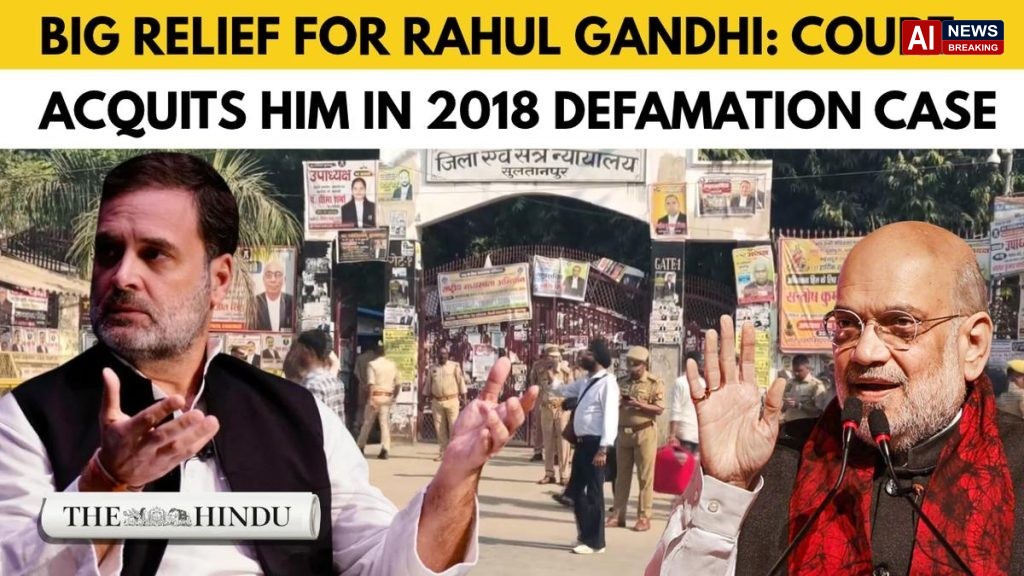
Rahul Gandhi acquitted in 2018 defamation case by Sultanpur MP-MLA court - AI News Breaking
rahul gandhi acquitted 2018:
Rahul Gandhi acquitted in 2018 defamation case by Sultanpur MP‑MLA court Congress leader and Leader of the Opposition Rahul Gandhi was cleared of all charges on Thursday by an MP‑MLA court in Sultanpur, Uttar Pradesh, bringing to an end a defamation case that had lingered for almost eight years. The court’s verdict, delivered after hearing arguments from both sides, found the accusations unsubstantiated and dismissed the petition filed by a senior Bharatiya Janata Party (BJP) leader. The decision marks a rare judicial victory for the opposition figure, whose political fortunes have been repeatedly challenged by legal battles since the 2019 general elections..
The case stemmed from remarks made by Gandhi during the 2018 Karnataka Assembly election campaign, when he addressed a rally in Bangalore and allegedly referred to Union Home Minister Amit Shah as a “murder accused”. The BJP argued that the comment was a direct defamation of Shah’s character, prompting a criminal complaint under Section 500 of the Indian Penal Code. The complaint was lodged in the Sultanpur district court, which has jurisdiction over MP‑MLA cases, and the matter was assigned to a bench presided over by Justice Anil Kumar Sharma..
During the trial, the prosecution presented a video clip of Gandhi’s speech, asserting that the words “murder accused” were spoken in reference to Shah. The defence countered that the clip was edited, that the phrase was taken out of context, and that Gandhi’s broader speech was a critique of the BJP’s governance model rather than a personal attack. They also argued that the term was used metaphorically, a common rhetorical device in Indian political discourse, and therefore did not meet the legal threshold for criminal defamation..
The judge’s written order highlighted the importance of intent in defamation cases. He noted that the prosecution had failed to prove that Gandhi deliberately intended to harm Shah’s reputation or that he possessed knowledge that his statements were false. The court also pointed out inconsistencies in the evidence, such as discrepancies between the original broadcast and the edited clip presented by the BJP..
In light of these gaps, the magistrate concluded that the case did not satisfy the statutory requirements for a conviction. Legal experts observed that the verdict underscores the high burden of proof required in criminal defamation suits in India. “Defamation is a serious offence, but it is not a tool for political vendetta,” said Prof..
Meera Sinha of Delhi University’s Law Faculty. “The court’s emphasis on intent and factual accuracy reflects a mature application of the law, especially in a politically charged environment where opposition figures are often targeted.” She added that the decision could set a precedent for future cases involving political speech. The BJP, however, expressed disappointment, accusing the judiciary of bias..
Party spokesperson Nitin Gadkari called the ruling “a miscarriage of justice” and pledged to appeal the decision at a higher court. He argued that the acquittal sends a dangerous signal that public figures can make unverified allegations without consequence. The party’s legal team indicated they would file a criminal revision petition within the stipulated timeframe, aiming to keep the matter alive in the appellate system..
Rahul Gandhi’s camp welcomed the outcome, describing it as a vindication of democratic speech. In a brief statement, the Congress party’s national spokesperson, Randeep Sarai, said the acquittal “reaffirms the fundamental right to free expression and highlights the need for the courts to protect political discourse from frivolous lawsuits.” He also hinted that the party might consider filing a counter‑complaint against those who attempted to weaponise the legal system for political gain. The case has broader implications for the ongoing debate over criminal defamation laws in India..
Critics have long argued that Sections 499 and 500 of the IPC are overly punitive and stifle free speech, particularly in the political arena. The Supreme Court, in a 2020 judgment, called for a review of these provisions, but legislative reform has remained stalled. Observers see Gandhi’s acquittal as a possible catalyst for renewed calls to amend or repeal criminal defamation statutes..
Political analysts suggest that the timing of the verdict may influence the upcoming Uttar Pradesh assembly elections, where the BJP is seeking to consolidate its dominance. The acquittal could bolster the opposition’s narrative of a government that uses the judiciary to intimidate dissent. Conversely, the BJP may double down on its legal strategy, filing multiple suits against opposition leaders to create a climate of caution..
The electoral impact remains uncertain, but the legal battle is now a notable facet of the state’s political calculus. Human rights organisations, including the National Human Rights Commission, issued statements emphasizing the need for a balanced approach that protects reputations without curbing legitimate criticism. In a press release, the commission urged lawmakers to consider de‑criminalising defamation, arguing that civil remedies are sufficient to address genuine grievances..
The commission also called for training judges on the nuances of political speech, to avoid inadvertent suppression of democratic debate. International observers took note of the case, with several foreign diplomats remarking on the health of India’s democratic institutions. The United Kingdom’s embassy in New Delhi highlighted the importance of an independent judiciary that can adjudicate high‑profile political cases impartially..
While the diplomatic community refrained from commenting on the specifics of the verdict, their statements reflect a broader concern for the rule of law in the world’s largest democracy. As the legal saga draws to a close, Rahul Gandhi is expected to return to his parliamentary duties with renewed vigor. Sources close to the Congress party say the leader plans to use the acquittal as a platform to champion reforms in defamation law and to call for greater protection of free speech..
Updated: October 26, 2026
Summary: Rahul Gandhi has been cleared of criminal defamation charges after a Sultanpur court found his 2018 remarks against BJP leader Amit Shah unsubstantiated and lacking intent. The verdict, seen as a win for free speech, may prompt renewed debate over India’s harsh defamation laws and influence the state’s political dynamics.
The judge’s insistence on intent signals that India’s courts are finally willing to separate political rhetoric from criminal liability—a win for free speech that could loosen the BJP’s habitual use of defamation suits to silence dissent. If the ruling sets a precedent, it may embolden opposition leaders to challenge the