Indonesia denies foreign claim to rescued orangutans
 Turkey hosts COP31 climate talks in Antalya.
 Pope meets Argentine bishops.
 APOD: 2026 November 8 – Major Fireball Meteor
 Indonesian Horror Hit ‘Pabrik Gula’ Gets 2028 Sequel as MD Entertainment Lines Up Three Imax Films
NASA Awards Moon Base Transportation, Technology, Science Projects
**
NASA Awards Moon Base Transportation, Technology, Science Projects - AI News Breaking
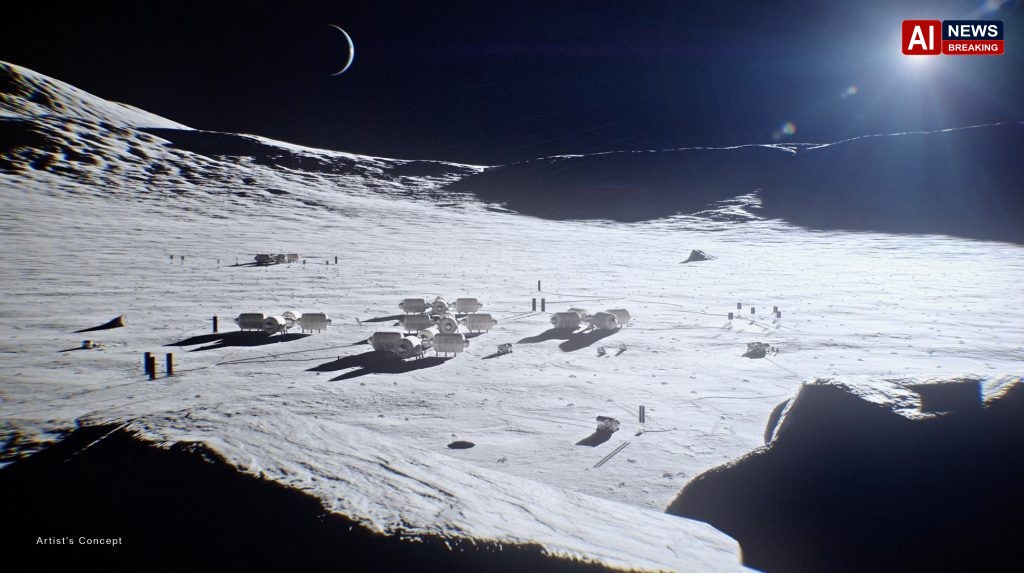
NASA Awards Moon Base Transportation, Technology, Science Projects Artist’s concept of living and working at Moon Base. Credit: NASA NASA announced a suite of awards and mission updates on Saturday to expand the agency’s Moon Base exploration, science, and infrastructure capabilities. The investments will advance commercial robotic deliveries, a nuclear‑powered rover named PROMISE, launch and orbital transfer services, and surface infrastructure as the agency works with American industry to establish a sustained presence on the Moon’s South Pole..
The agency shared the news at the MAX POWER aerospace expo and air show at NASA’s Kennedy Space Center in Florida, a venue that has long served as a staging ground for the nation’s space ambitions. The event, which attracts industry leaders and government officials, provided an ideal platform to showcase the next phase of lunar exploration. “We are building the Moon Base mission by mission,” said NASA Administrator Jared Isaacman..
“Today’s announcements expand nearly every part of that campaign, using the playbook that carried NASA through its greatest eras: fly often, learn, apply those lessons, and get more, better, and more capable.” Isaacman’s remarks echoed the agency’s long‑term strategy of incremental progress, mirroring the modular approach that made the Apollo program possible. The first award, announced at the expo, went to a consortium led by SpaceX for the delivery of robotic cargo to the lunar surface. The contract, valued at $1.4 billion, will fund the launch of a specialised cargo module on the Starship system..
The module will carry scientific instruments and supplies required for the initial habitat and power modules. The award is part of NASA’s Commercial Lunar Payload Services (CLPS) initiative, which has already seen successful deliveries by United Launch Alliance and Astrobotic. SpaceX’s contract includes the development of a lightweight, reusable delivery vehicle that can carry up to 4 metric tonnes to the Moon’s surface..
The company will also provide ground support and telemetry services, ensuring a smooth transfer from Earth to the lunar south pole. The partnership reflects NASA’s commitment to commercialising lunar logistics, allowing private firms to shoulder significant risk and cost. The second award went to a partnership between Northrop Grumman and its subsidiary, Aerojet Rocketdyne..
They will develop a nuclear‑powered rover, named PROMISE (Powered by Radioisotope Mission for Exploration). The rover will operate autonomously, using a radioisotope thermoelectric generator to provide a continuous power supply, enabling extended surface missions beyond the reach of solar power. PROMISE will be the first lunar rover to be powered by a nuclear source, a technology that NASA has considered for decades but has not yet deployed in space..
The rover’s design includes a modular payload bay and a robotic arm capable of sample collection and deployment of scientific instruments. NASA plans to launch PROMISE on a commercial launch vehicle in 2027, with a surface operational timeline of 2029. The third award, announced by NASA’s Commercial Crew and Commercial Lunar Payload Services office, was granted to United Launch Alliance (ULA) for launch and orbital transfer services..
ULA will provide a heavy‑lift launch vehicle, the Vulcan Centaur, to ferry both robotic and crewed missions to the lunar orbit. The contract will cover launch vehicle development, flight integration, and mission assurance services. With ULA’s involvement, NASA intends to secure a dedicated launch cadence that will support both cargo resupply missions and future crewed flights to the Moon’s surface..
The agency’s strategy hinges on establishing a reliable launch cadence, as it aims to sustain a continuous presence at the lunar south pole by 2030. The fourth award went to the American company Astrobotic, which will construct surface infrastructure for the Moon Base. The award is worth $700 million and will finance the development of a habitat module, a power generation system, and a communications hub..
Astrobotic’s design is modular, allowing incremental expansion as new payloads arrive. The habitat module will provide a 500‑square‑foot living space for a crew of two to three astronauts. It will include a greenhouse unit that uses hydroponic systems to grow fresh produce, and an advanced waste‑management system that recycles water and carbon dioxide..
The power generation system will incorporate a hybrid solar‑thermal array capable of storing excess energy for use during the lunar night. In addition to the awards, NASA outlined a comprehensive timeline for the Moon Base mission. The first robotic cargo launch is expected in 2024, followed by the deployment of the first habitat module in 2026..
Crewed landings are slated for 2028, with the first sustained lunar habitation occurring by 2030. The agency’s strategy also emphasizes international cooperation, with plans to engage European Space Agency and Japanese Aerospace Exploration Agency partners. NASA hopes to incorporate international payloads into the lunar surface infrastructure, allowing a broader scientific community to benefit from the Moon Base..
While the awards signal a significant investment in lunar infrastructure, NASA acknowledges the technical challenges ahead. The lunar south pole’s extreme temperature swings, low solar irradiance, and rugged terrain require robust engineering solutions. The agency is working closely with the industry partners to mitigate risks through rigorous testing and simulation..
“We are at the threshold of a new era in lunar exploration,” said Isaacman. “The awards we’ve made today represent a collective commitment to building a sustainable human presence on the Moon, and ultimately, to extending humanity’s reach to Mars and beyond.” His remarks underscored the long‑term vision that drives NASA’s lunar programme and reaffirmed the agency’s role as a catalyst for space exploration..
Updated: November 7, 2026
NASA unveiled a new funding package to accelerate its Moon Base plan, awarding multimillion‑dollar contracts for robotic cargo, a nuclear‑powered rover, launch services and surface infrastructure. The awards aim to deliver the first habitat and rover by 2026‑27, paving the way for crewed landings and a sustained lunar presence by 2030.