Europe warns of Russia’s hybrid attacks but struggles to counter them
  Former chief election commissioner calls SIR scheme illegal.
  A Corruption Scandal Is Reshaping Brazil’s Presidential Election
  US citizen injured in Illinois after ICE agents mistook him for fugitive, tried to arrest him
  At 10 years old, Smithsonian’s Black museum is undaunted amid pressure from Trump administration
 BJP MP Sparks Controversy with “Surrender Nehru” Remark, Criticizing Congress’s 1959 Apology to China
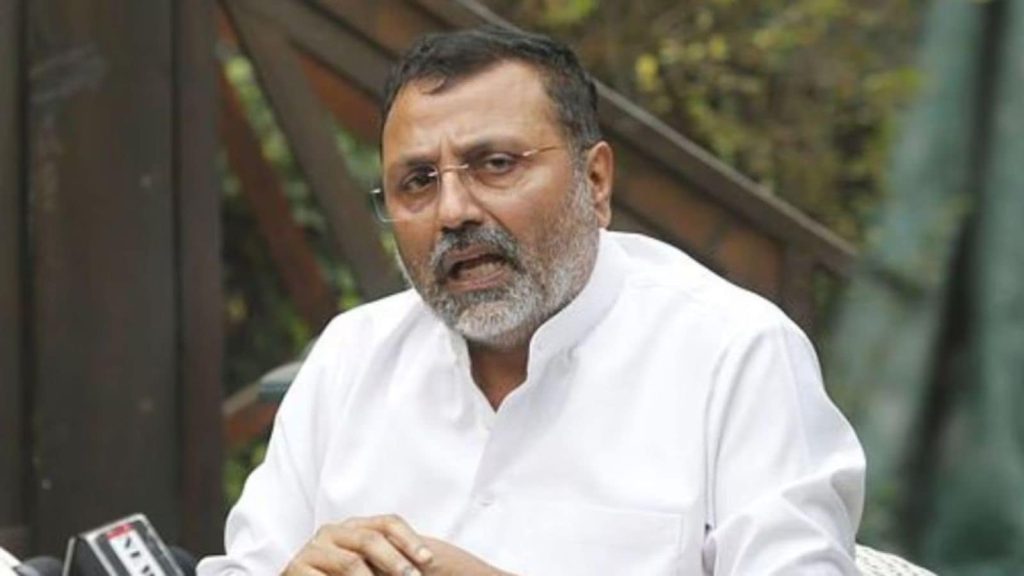
sparks controversy surrender nehru:
BJP MP Nishikant Dubey has sparked controversy by referring to former Prime Minister Jawaharlal Nehru as “Surrender Nehru” over Congress’s apology to China in 1959. The remark has ignited a heated debate about India’s historical relations with China.
In a recent statement, BJP MP Nishikant Dubey criticized the Congress party for apologizing to China in 1959, sparking a controversy that has drawn attention to India’s historical relations with its neighboring country. Dubey referred to former Prime Minister Jawaharlal Nehru as “Surrender Nehru,” implying that Nehru’s government had taken a weak stance against China. The comment has been met with widespread criticism from the Congress party, which has accused Dubey of distorting history for political gain.
The incident in question dates back to 1959, when India and China were involved in a border dispute that led to a deterioration in relations between the two countries. At the time, the Indian government, led by Prime Minister Nehru, had apologized to China in an effort to ease tensions and improve relations. However, Dubey’s remark suggests that this apology was a sign of weakness and a surrender of India’s interests.
The Congress party has strongly condemned Dubey’s remark, arguing that it is a blatant attempt to rewrite history and undermine the legacy of one of India’s most revered leaders. Congress leaders have pointed out that Nehru’s government had taken a principled stance on the border dispute, and that the apology was a diplomatic effort to prevent further escalation.
The controversy has also sparked a larger debate about India’s relations with China, with many experts arguing that the country needs to take a more assertive stance in defending its interests. Others have cautioned that inflammatory rhetoric and historical revisionism can be counterproductive, and that a more nuanced approach is needed to address the complex issues at play.
The remark has also drawn attention to the ongoing tensions between India and China, which have been exacerbated by recent border clashes and trade disputes. As the two countries continue to navigate their complex relationship, the controversy surrounding Dubey’s remark serves as a reminder of the deep-seated historical tensions that underlie their interactions.
The BJP MP’s comment has also been criticized for its timing, coming at a moment when India is seeking to strengthen its relations with other countries in the region. Many have argued that such inflammatory rhetoric can undermine India’s diplomatic efforts and create unnecessary tensions with its neighbors.
In conclusion, the controversy surrounding Dubey’s “Surrender Nehru” remark highlights the ongoing challenges in India’s relations with China, and the need for a more nuanced and informed approach to addressing these complex issues. As the debate continues to unfold, it remains to be seen how the incident will impact India’s diplomatic efforts and its relations with China in the long term.
AI_INSIGHT:
The controversy surrounding Nishikant Dubey’s “Surrender Nehru” remark reflects a broader trend in Indian politics, where historical events are being reinterpreted and recontextualized to serve contemporary political agendas. This trend is likely to continue, as politicians seek to leverage historical narratives to mobilize support and shape public opinion. However, such revisionism can have unintended consequences, including the erosion of trust in institutions and the polarization of public discourse. As India navigates its complex relationships with neighboring countries, it is essential to approach historical events with nuance and accuracy, rather than resorting to simplistic or inflammatory rhetoric.