Europe warns of Russia’s hybrid attacks but struggles to counter them
  Former chief election commissioner calls SIR scheme illegal.
  A Corruption Scandal Is Reshaping Brazil’s Presidential Election
  US citizen injured in Illinois after ICE agents mistook him for fugitive, tried to arrest him
  At 10 years old, Smithsonian’s Black museum is undaunted amid pressure from Trump administration
 AIADMK Split Crisis Deepens: 36 Pro-Vijay MLAs Revolt Against EPS in Tamil Nadu
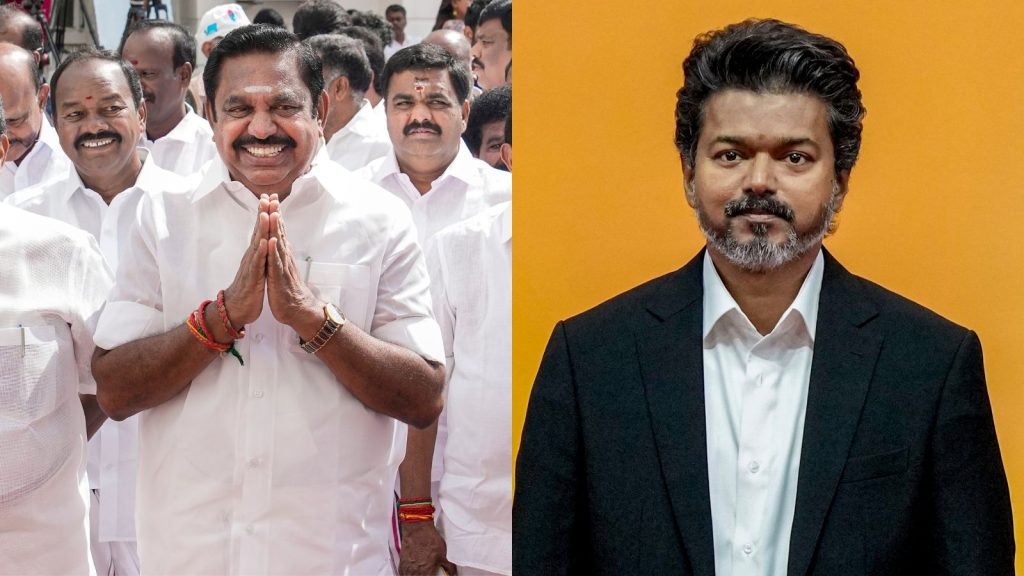
Tamil Nadu politics has entered a fresh phase of instability, with the AIADMK facing what could become its biggest internal crisis since the death of former Chief Minister J. Jayalalithaa. A powerful rebel faction within the party has openly challenged AIADMK general secretary Edappadi K. Palaniswami (EPS), with nearly 30 to 36 MLAs and senior leaders reportedly favouring support to Vijay’s Tamilaga Vettri Kazhagam (TVK) government.
The developments come just days after actor-turned-politician Vijay successfully moved closer to power in Tamil Nadu following the fractured 2026 Assembly mandate. TVK emerged as the single largest force in the election but initially fell short of the majority mark, triggering intense political negotiations across party lines.
Now, the AIADMK — once one of Tamil Nadu’s two dominant Dravidian giants — appears deeply divided over its future political direction. At the heart of the conflict lies a fundamental question: should the party continue under EPS’s leadership in opposition, or should it align with Vijay’s rising political movement and share power in the new government?
Rebel Camp Challenges EPS Leadership
According to multiple reports, the dissident bloc includes influential AIADMK leaders such as former ministers S P Velumani, C Vijayabaskar, and senior leader C Ve Shanmugham. The group is believed to command the support of between 30 and 36 MLAs out of AIADMK’s total tally of 47 seats in the Assembly.
The rebel leaders reportedly want AIADMK to extend formal support to Vijay’s TVK government and possibly even participate in the administration. EPS, however, is said to be strongly opposed to the idea, fearing that such a move could weaken the AIADMK’s independent identity and accelerate the erosion of his authority within the party.
One senior AIADMK leader quoted in reports said that while EPS remains general secretary “officially,” many of the party’s real power centres are no longer aligned with him.
This growing revolt has triggered speculation that AIADMK could formally split if negotiations between the factions fail in the coming days.
How the Crisis Began
The current turmoil is rooted in the dramatic aftermath of the 2026 Tamil Nadu Assembly election.
The election delivered a hung Assembly, ending decades of bipolar dominance between the DMK and AIADMK. Vijay’s TVK stunned political observers by winning 108 seats in its electoral debut, while the DMK alliance was reduced sharply and the AIADMK-led alliance managed only 53 seats, including 47 for AIADMK itself.
Though TVK emerged as the largest party, it initially lacked the numbers needed to form a government. This triggered days of frantic political activity involving backchannel negotiations, alliance talks, and fears of defections.
During this phase, reports emerged that sections within AIADMK were willing to support Vijay to prevent political isolation. Sources indicated that nearly 30 MLAs favoured backing TVK even earlier in the post-poll negotiations, but EPS resisted the move.
At the same time, there were also reports of unusual discussions between the DMK and AIADMK regarding a possible power-sharing arrangement to block Vijay’s rise — an idea that ultimately collapsed.
The failure of those talks appears to have intensified factional tensions inside AIADMK.
Vijay’s Rapid Political Rise Changes Tamil Nadu Equations
The emergence of Vijay as a major political force has fundamentally altered Tamil Nadu’s political landscape.
For decades, politics in the state revolved around the DMK and AIADMK. But the 2026 election broke that pattern dramatically. TVK’s success demonstrated that a large section of voters — particularly younger voters and urban constituencies — were willing to move away from traditional Dravidian parties.
Vijay’s image as a clean, outsider figure helped him attract anti-establishment sentiment. His campaign projected TVK as a fresh alternative to both the DMK and AIADMK, while also distancing itself from the BJP.
This has created panic within sections of AIADMK, especially among leaders who believe the party risks long-term decline if it remains isolated under EPS.
Several leaders reportedly see greater political survival in aligning with Vijay rather than continuing as a weakened opposition force.
Resort Politics Returns
The crisis has also revived memories of Tamil Nadu’s infamous “resort politics.”
As rumours of defections intensified after the election, AIADMK MLAs were shifted to resorts in Puducherry, echoing the dramatic Koovathur resort episode of 2017 that followed Jayalalithaa’s death.
EPS personally travelled to Puducherry to meet MLAs amid fears that legislators could cross over or openly rebel.
Reports later suggested that dissident AIADMK leaders had begun holding separate meetings away from the official party structure.
The parallel meetings exposed the extent of internal distrust and signalled that the rebellion had moved beyond routine factionalism.
Why Many AIADMK Leaders Prefer Vijay
The pro-Vijay faction inside AIADMK appears driven by both political survival and ideological calculation.
First, Vijay’s government now appears stable after securing outside support from Congress, Left parties, VCK, and other anti-BJP forces.
Second, many AIADMK leaders reportedly believe EPS has failed to revive the party after successive electoral defeats. AIADMK has struggled since Jayalalithaa’s death to maintain its traditional support base, organisational unity, and charismatic appeal.
Third, Vijay’s anti-BJP positioning complicates AIADMK’s earlier alignment with the BJP-led NDA. Some rebels reportedly fear that staying too close to the BJP could further damage the party’s prospects in Tamil Nadu, where anti-BJP sentiment remains politically significant.
Supporting TVK could therefore allow dissident AIADMK leaders to reposition themselves within Tamil Nadu’s emerging political order.
EPS Faces Biggest Test Since Becoming AIADMK Chief
For EPS, the rebellion represents perhaps the most serious challenge of his political career.
After Jayalalithaa’s death, EPS managed to consolidate power within AIADMK by outmanoeuvring rival factions led by O Panneerselvam and others. He eventually emerged as the undisputed organisational leader of the party. But the 2026 election setback has weakened his authority significantly.
Critics within the party accuse him of strategic miscalculations, including the alliance with the BJP and the inability to counter Vijay’s momentum.
Some rebels also reportedly believe EPS missed an opportunity to negotiate a stronger role in a TVK-led arrangement earlier, before Vijay consolidated support from other parties.
Now, EPS faces the difficult task of preventing defections while trying to preserve party unity.
Can AIADMK Officially Split?
While no formal split has yet occurred, the possibility appears increasingly real.
Under India’s anti-defection law, a substantial number of MLAs would need to move together to avoid disqualification risks. If the reported figure of 30–36 MLAs backing the rebel camp is accurate, the dissidents could potentially claim legitimacy as a major faction within the legislature party.
Political observers note that Tamil Nadu has witnessed several party fractures in the past, especially during periods of leadership transition.
AIADMK itself has repeatedly experienced factional battles after Jayalalithaa’s death, though none previously threatened the party’s existence at this scale.
The current crisis is different because it coincides with the rise of an entirely new political pole in the form of TVK.
What Happens Next?
Several scenarios are now being discussed in Tamil Nadu political circles:
- The rebel faction could formally break away and support Vijay’s government.
- EPS could attempt reconciliation by negotiating conditional support to TVK.
- AIADMK may remain united temporarily but continue functioning with deep internal divisions.
- Further defections could weaken EPS’s control over the organisation.
Much may depend on the upcoming Assembly confidence vote and the political rewards offered by the new government.
For Vijay, attracting AIADMK rebels would strengthen his government and further weaken a traditional rival. For EPS, losing a large bloc of MLAs could reduce AIADMK to a marginal force in state politics.
A Defining Moment in Tamil Nadu Politics
The crisis inside AIADMK reflects a broader transformation underway in Tamil Nadu politics.
The 2026 election has disrupted the state’s long-standing Dravidian political order. Vijay’s rise has opened space for new alliances, ideological realignments, and leadership struggles across parties.
For AIADMK, the challenge is existential. The party must decide whether it can reinvent itself under EPS or whether sections of its leadership will migrate toward Vijay’s expanding political project.
The coming days could determine not only the future of AIADMK, but also the shape of opposition politics in Tamil Nadu for years to come.
AI Insights
The rebellion brewing inside AIADMK is more than a routine faction fight — it signals a structural shift in Tamil Nadu politics after decades of DMK-AIADMK dominance. Vijay’s rapid emergence as a viable power centre has exposed deep insecurities within the AIADMK, particularly among leaders who fear the party may not recover under EPS after repeated electoral setbacks. The willingness of nearly three dozen MLAs to consider backing TVK shows that political survival is now outweighing traditional party loyalty. If the split deepens, AIADMK could face the same erosion that once weakened Congress in Tamil Nadu, while Vijay positions himself as the new focal point of anti-DMK politics. The next few weeks will likely decide whether AIADMK survives as a unified regional force or fragments into competing camps aligned around Tamil Nadu’s changing political order.