 Keralam’s multiplex pricing debate: SC order in 2023 permits cinema hall owners to fix food prices
  DMK chief Stalin accuses Tamil Nadu CM Vijay of using ‘reels’ to cover up administrative failures
  High Court pauses data centre lease dispute.
  CSD urges govt to drop Gram Sabha consent rule for projects
  Misery at Heathrow: ‘Never Seen Chaos Like That’
 Bhupesh Baghel Alleges ‘Loot in Ram’s Name’, Slams Government Over Schools and Farmers
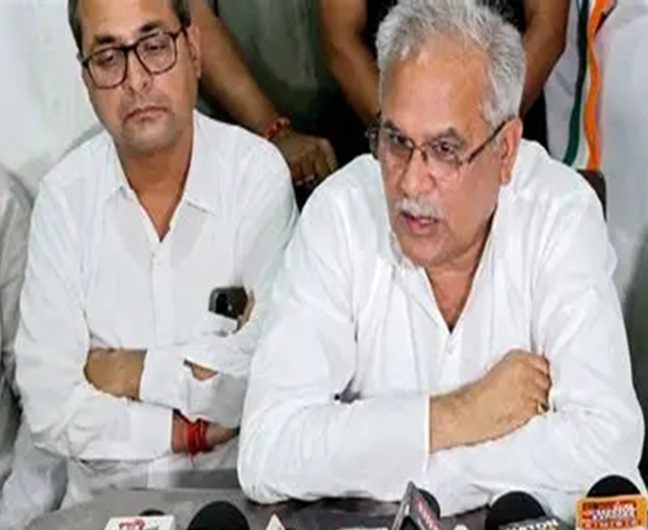
bhupesh baghel alleges loot:
Senior Congress leader and former Chhattisgarh Chief Minister Bhupesh Baghel launched a sharp attack on the government, accusing it of exploiting the name of Lord Ram for political and financial gains. He alleged that while donations were being collected for temples and religious projects, farmers, students, and public welfare institutions were being neglected.
Former Chhattisgarh Chief Minister and senior Congress leader Bhupesh Baghel has intensified his criticism of the government, alleging that public resources and religious sentiments are being misused while pressing issues affecting farmers, students, and ordinary citizens remain unresolved.
Speaking at a public gathering, Baghel accused the ruling establishment of carrying out what he described as “looting in the name of Ram.” He claimed that while the government highlights religious projects and seeks donations associated with Lord Ram, it has failed to address the challenges faced by the agricultural sector and the education system.
Criticism Over School Closures: Baghel expressed concern over the condition of government schools and alleged that educational institutions in rural areas were being shut down or merged without considering the impact on students. According to him, such decisions disproportionately affect children from economically weaker sections who depend on nearby government schools for education.
He argued that access to quality education should be a priority for any government and questioned why resources were being directed toward high-profile projects while basic educational infrastructure continued to face challenges. Baghel stated that school closures could force students to travel longer distances, increasing dropout rates, particularly among girls and children from remote regions.
The Congress leader maintained that education is one of the most important pillars of social development and warned that neglecting it could have long-term consequences for the state’s future.
Farmers’ Issues Raised: The former chief minister also highlighted the difficulties being faced by farmers. He alleged that agricultural producers were struggling with rising input costs, delayed payments, and inadequate support mechanisms.
Baghel said farmers continue to face uncertainty regarding crop prices and procurement policies. He accused the government of failing to provide sufficient relief despite repeated demands from farmer organizations.
“Farmers are the backbone of the economy, but their concerns are being ignored,” he said. According to Baghel, governments should focus on ensuring fair prices, timely procurement, and financial assistance for cultivators instead of prioritizing political campaigns centered on religious symbolism.
He further claimed that promises made to the farming community had not been fully implemented, leading to growing dissatisfaction in rural areas.
Ram Temple Donations and Political Messaging: A significant portion of Baghel’s criticism focused on the collection and use of donations linked to Ram temple initiatives and other religious activities. He questioned the transparency surrounding such fundraising efforts and accused the ruling party of using Lord Ram’s name for political advantage.
Baghel argued that faith and religion should not be used as tools for electoral gain. He said that while millions of people contribute to religious causes with devotion, governments must ensure accountability and focus equally on public welfare programs.
The Congress leader emphasized that Lord Ram symbolizes justice, truth, and service to society. He alleged that invoking Ram’s name while ignoring the struggles of common citizens contradicts those values.
Political Reactions: Baghel’s remarks have added to the ongoing political debate between the Congress and the ruling party over governance, welfare policies, and the role of religion in politics.
Leaders from the ruling party have rejected such allegations in the past, maintaining that religious and cultural projects reflect public sentiment and national heritage. They argue that development initiatives and welfare programs are being implemented alongside these projects.
However, the Congress has consistently accused the government of focusing more on symbolic issues than on addressing economic concerns such as unemployment, inflation, agricultural distress, and public education.
Broader Political Context: The comments come at a time when political parties are increasingly focusing on issues affecting rural communities and social welfare ahead of upcoming elections. Farmers’ concerns, educational infrastructure, and government spending priorities have emerged as key themes in political discourse across several states.
Baghel’s remarks are likely to resonate with sections of the opposition that have been seeking to challenge the government’s narrative on development and governance. By linking issues related to education and agriculture with questions of accountability and public spending, the Congress leader attempted to shift attention toward bread-and-butter concerns facing ordinary citizens.
Bhupesh Baghel’s latest attack on the government reflects the continuing political battle over development priorities, welfare policies, and the use of religious symbolism in public life. By raising concerns about school closures, farmers’ hardships, and the handling of Ram temple donations, the former chief minister sought to portray the government as being more focused on religious and political messaging than on addressing everyday challenges faced by citizens.
The controversy highlights a broader debate in Indian politics: balancing cultural and religious initiatives with investments in essential public services such as education and agriculture. While religious projects often attract widespread public support, opposition leaders argue that governments must simultaneously demonstrate measurable progress in improving livelihoods, strengthening schools, and supporting farmers. As elections approach, issues affecting rural communities and public welfare are expected to remain central to the political narrative.