Europe warns of Russia’s hybrid attacks but struggles to counter them
  Former chief election commissioner calls SIR scheme illegal.
  A Corruption Scandal Is Reshaping Brazil’s Presidential Election
  US citizen injured in Illinois after ICE agents mistook him for fugitive, tried to arrest him
  At 10 years old, Smithsonian’s Black museum is undaunted amid pressure from Trump administration
 Trump Returns to White House Correspondents’ Dinner, Unleashes on Media During Hour-Long Speech
** President Trump returned to the White House Correspondents’ Dinner, using the occasion to criticize news organizations and defend his administration’s policies in a characteristically combative and unconventional address.
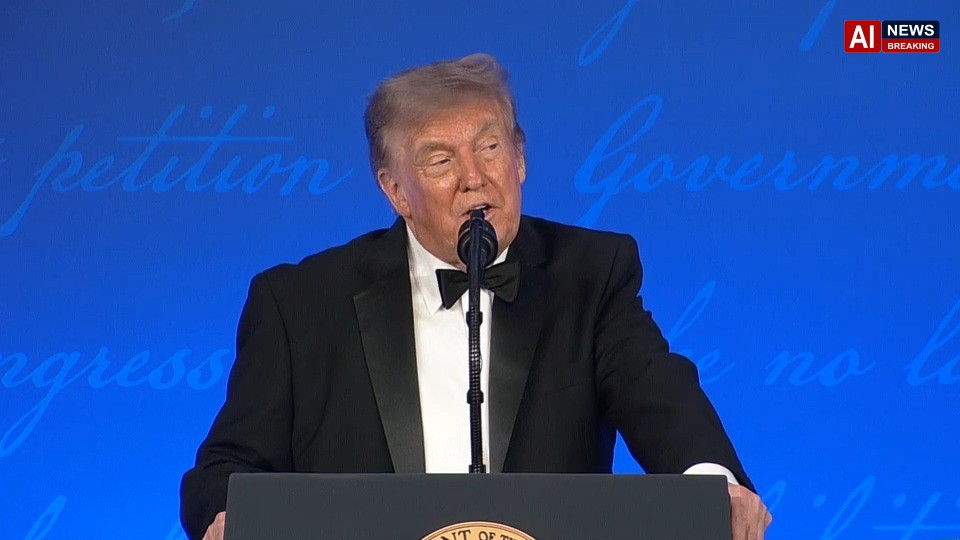
Trump Returns to White House Correspondents' Dinner, Unleashes on Media During Hour-Long Speech - AI News Breaking
trump returns white house:
President Donald Trump returned to the White House Correspondents’ Dinner on Friday night with a characteristically combative and unconventional address, using the occasion to criticize news organizations, defend his administration’s policies and reaffirm his long-standing grievances with the American media.
Key Highlights of Event
- Donald Trump attended the White House Correspondents’ Dinner after years of avoiding the event.
- The president delivered a lengthy speech criticizing major media organizations.
- CNN journalist Kaitlan Collins was among those mentioned during his remarks.
- Trump described media coverage of his administration as unfair and biased.
- The event highlighted the continuing tensions between the White House and the American press.
The annual event, traditionally viewed as a celebration of press freedom and an opportunity for presidents to engage in light-hearted exchanges with journalists, took on a markedly different tone as Trump delivered a lengthy speech that mixed humor, political attacks and unscripted commentary.
Speaking before an audience of journalists, administration officials and invited guests, Trump declared, “The show must go on,” emphasizing his willingness to attend despite years of tensions between his political movement and major news outlets.
A Rare Presidential Appearance
Trump’s appearance was notable given his history with the White House Correspondents’ Association (WHCA). During his first term, he famously skipped every Correspondents’ Dinner, frequently describing parts of the mainstream media as “fake news.”
His return to the event therefore represented a significant moment in the relationship between the presidency and the Washington press corps.
Political analysts noted that the appearance offered Trump an opportunity to speak directly to journalists while also energizing supporters who have long embraced his criticism of major media institutions.
Trump Targets Major News Organizations
Throughout his speech, Trump repeatedly criticized several prominent media organizations and journalists, including CNN’s Kaitlan Collins, while also referencing coverage from networks and newspapers that he claimed had treated his administration unfairly.
Among the topics raised during his remarks were:
- Media bias allegations.
- Coverage of his administration.
- Immigration policy.
- Economic performance.
- International affairs.
- The upcoming political agenda.
The president accused portions of the media of prioritizing political narratives over factual reporting and suggested that public trust in traditional news organizations continues to decline.
The comments drew a mixed reaction from attendees, with some applauding specific remarks while others remained noticeably reserved.
Event Highlights Trump’s Media Strategy
Trump’s speech underscored a defining characteristic of his political career: his ability to transform media confrontations into political messaging opportunities.
For nearly a decade, his relationship with the press has been marked by:
- Frequent public criticism.
- Extensive media coverage.
- Direct communication through social media.
- Contentious press conferences.
- Ongoing disputes with journalists.
Despite the tensions, Trump’s interactions with the media have remained central to his political identity and public image.
Observers noted that the White House Correspondents’ Dinner provided another platform for the president to reinforce his message that traditional media institutions remain disconnected from many American voters.
A Different Kind of Correspondents’ Dinner
Historically, the White House Correspondents’ Dinner has served as a bipartisan event featuring humor, celebrity appearances and speeches from both journalists and political leaders.
Past presidents have typically used the occasion to deliver self-deprecating jokes and emphasize the importance of a free press.
Trump’s appearance diverged from that tradition in several respects.
Rather than focusing primarily on humor, the president delivered an extended address that combined political commentary with criticism of his perceived opponents in the media landscape.
The result was an evening that reflected the increasingly polarized nature of American politics and the evolving relationship between political leaders and news organizations.
Media Reaction Divided
Reaction to Trump’s speech was swift and divided.
Supporters praised the president for confronting media organizations directly and argued that his remarks reflected concerns shared by millions of Americans regarding journalistic objectivity.
Critics, meanwhile, expressed concern that the tone of the speech further strained relations between the White House and the press.
Political commentators noted that the event highlighted broader questions about:
- Press freedom.
- Public trust in media.
- Political polarization.
- The role of journalism in democracy.
- The changing dynamics of presidential communication.
Trump’s Relationship With the Press
Trump’s presidency has consistently challenged traditional norms surrounding media engagement.
Since entering national politics, he has frequently argued that major news organizations exhibit institutional bias against conservative viewpoints.
At the same time, his political success has been closely intertwined with media coverage, making the relationship both adversarial and mutually influential.
Communication experts have observed that Trump’s media strategy often relies on:
- Generating sustained news cycles.
- Directly challenging critics.
- Utilizing unconventional messaging.
- Maintaining high public visibility.
Friday night’s speech largely followed that familiar pattern.
Political Implications
The timing of Trump’s appearance is particularly noteworthy as his administration continues to navigate domestic and international challenges.
By using the White House Correspondents’ Dinner as a platform for broader political messaging, the president demonstrated his continued willingness to reshape traditional political events around his personal style of communication.
Analysts suggest that the speech may further energize his political base while simultaneously reinforcing existing divisions among voters regarding the role of the media in American society.
Trump’s appearance at the White House Correspondents’ Dinner reflects a broader shift in political communication. Traditional institutions increasingly serve as platforms for partisan messaging rather than bipartisan engagement. The event highlighted how modern political leaders can simultaneously criticize and leverage media attention, illustrating the complex and evolving relationship between journalism, public trust and presidential power in the digital age.