Europe warns of Russia’s hybrid attacks but struggles to counter them
  Former chief election commissioner calls SIR scheme illegal.
  A Corruption Scandal Is Reshaping Brazil’s Presidential Election
  US citizen injured in Illinois after ICE agents mistook him for fugitive, tried to arrest him
  At 10 years old, Smithsonian’s Black museum is undaunted amid pressure from Trump administration
 Editorial: Dharmendra Pradhan’s Resignation Is More Than a Political Exit – It Is a Test of BJP’s Accountability
The resignation of Union Education Minister Dharmendra Pradhan ahead of Parliament’s Monday session is a major political moment for the BJP, as the party faces pressure to demonstrate accountability and address public concerns over exam paper leaks and education reforms, setting the stage for a crucial parliamentary session.
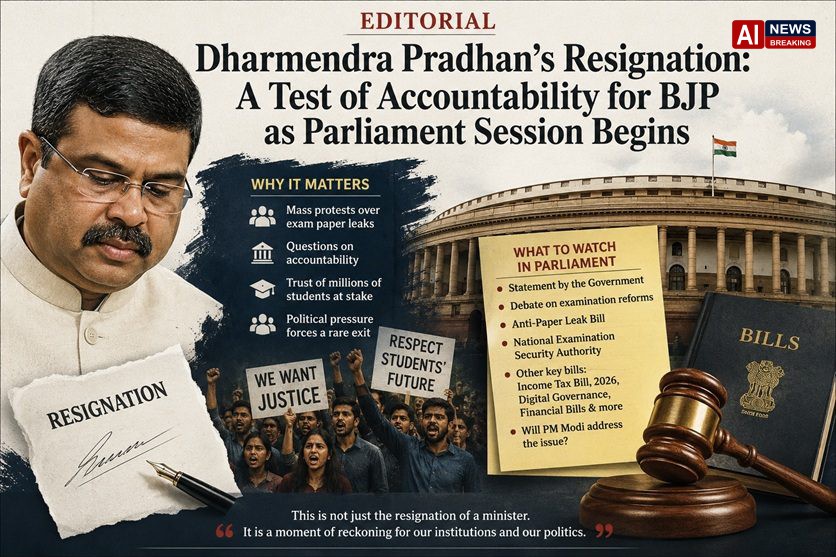
editorial dharmendra pradhans resignation:
Union Education Minister Dharmendra Pradhan’s resignation ahead of Parliament’s Monday session marks a major political moment for the BJP. Here’s what it means for the Modi government and Indian politics.
Indian politics rarely witnesses a Union Cabinet minister resigning under sustained public pressure. When it does happen, it is usually because the political cost of retaining a leader exceeds the cost of letting them go.
That moment arrived on Saturday when Union Education Minister Dharmendra Pradhan submitted his resignation following weeks of nationwide protests over exam paper leaks and mounting pressure from opposition parties.
The resignation comes less than 48 hours before Parliament reconvenes on Monday, setting the stage for what could become one of the most consequential parliamentary sessions of Prime Minister Narendra Modi’s third term.
But this story is no longer just about one minister.
It is about accountability, political messaging, and whether the Bharatiya Janata Party (BJP) can turn a moment of crisis into an opportunity to reinforce its image as a government willing to act when public sentiment reaches a tipping point.
Why Dharmendra Pradhan Had to Go
Dharmendra Pradhan was not an ordinary cabinet minister.
For more than a decade, he has been among the BJP’s most influential leaders, serving in key portfolios including Petroleum, Skill Development, and Education. He has been a trusted lieutenant of Prime Minister Modi and an important face of the party in eastern India.
However, politics ultimately rewards perception as much as performance.
The recurring allegations of examination irregularities, combined with weeks of protests led largely by students and young voters, created a political challenge the government could no longer ignore. Parliament witnessed repeated disruptions, while opposition parties made Pradhan’s resignation their primary demand.
By Saturday, the BJP faced two choices:
- Continue defending the minister and risk prolonged unrest.
- Accept his resignation and attempt to reset the political narrative.
The party chose the latter.
In doing so, it sent a clear message: no individual is bigger than the government.
BJP’s Political Calculation
The BJP has built much of its political brand around decisive leadership.
Historically, the party has been reluctant to appear as though it is yielding to opposition pressure. That is why Dharmendra Pradhan’s resignation is politically significant. It represents a rare acknowledgment that public anger—particularly among young voters—cannot always be countered through messaging alone.
The BJP’s calculation appears straightforward.
By accepting the resignation before Monday’s Parliament session, the government hopes to:
- Remove the opposition’s principal rallying point.
- Restore normal parliamentary proceedings.
- Shift the conversation toward education reforms.
- Demonstrate political accountability ahead of future elections.
Home Minister Amit Shah’s statement that “the country, youth and students are far more important than any post” reflects the government’s effort to frame the resignation as an act of responsibility rather than political defeat.
Whether voters accept that argument remains to be seen.
Monday’s Parliament Session Will Be Crucial
Monday’s Parliament session is now about much more than legislative business.
The opposition is expected to argue that the resignation validates its criticism of the government. Congress leaders are likely to demand a broader discussion on unemployment, examination reforms, and administrative accountability. Meanwhile, the Treasury benches will seek to highlight the government’s willingness to act decisively.
Several key questions will dominate proceedings:
- Will the opposition continue disruptions despite the resignation?
- Will the government announce additional education reforms?
- Can Parliament return to normal functioning?
- Will Prime Minister Modi address the issue directly?
The answers could shape the political narrative for the remainder of the Monsoon Session.
If Parliament functions smoothly, the BJP may successfully argue that it resolved the crisis. If disruptions continue, the opposition could claim that the resignation was merely the first step toward broader accountability.
The opposition INDIA bloc is likely to demand a detailed discussion on:
- Examination paper leaks.
- Recruitment irregularities.
- Youth unemployment.
- Accountability within government institutions.
- Long-term education reforms.
Congress leaders and other opposition parties are expected to argue that the resignation validates their criticism of the government’s handling of the issue.
Bills and Reforms to Watch
Beyond the political drama, Parliament still faces an extensive legislative agenda.
The resignation may increase pressure on the government to introduce or accelerate reforms related to education and public examinations.
Among the proposals likely to receive attention are:
1. Anti-Paper Leak Legislation
There is growing support for strengthening laws aimed at preventing examination fraud.
Possible provisions could include:
- Harsher penalties for paper leaks.
- Faster prosecution of offenders.
- Greater accountability for examination agencies.
- Enhanced digital security measures.
2. National Examination Security Authority
Several policymakers have suggested establishing a dedicated authority responsible for overseeing the security and transparency of major examinations across India.
Such a body could:
- Monitor examination processes.
- Conduct independent audits.
- Coordinate investigations.
- Establish national security standards.
3. Education Sector Reforms
The government may also use the opportunity to announce broader reforms, including:
- Modernization of examination systems.
- Expansion of digital testing infrastructure.
- Improved grievance redressal mechanisms.
- Greater transparency in recruitment examinations.
4. Other Key Bills Expected During the Session
In addition to education-related matters, Parliament is expected to consider:
- The Income Tax Bill, 2026.
- Financial and supplementary appropriation bills.
- Digital governance and cybersecurity legislation.
- Administrative reforms.
- Public service recruitment transparency measures.
While the resignation may temporarily dominate headlines, the government’s legislative agenda remains extensive.
The Youth Factor Cannot Be Ignored
Perhaps the most important lesson from this episode is the emergence of youth politics as a major force.
Millions of students directly or indirectly affected by examination controversies represent a significant political constituency. Unlike traditional voting blocs, young voters are often less attached to party loyalties and more responsive to issues affecting their daily lives.
For years, Indian elections have revolved around caste equations, welfare programs, and leadership personalities.
This episode suggests another factor is becoming increasingly important: trust in institutions.
Young Indians want assurances that:
- Competitive examinations are fair.
- Merit will be rewarded.
- Government institutions are accountable.
- Their voices can influence public policy.
The resignation of a senior Union minister demonstrates that public pressure remains one of democracy’s most powerful instruments.
A Challenge and an Opportunity for Modi
Prime Minister Modi now faces a dual challenge.
First, he must ensure that the education ministry regains public confidence under its new leadership. Senior BJP leader Pralhad Joshi has already been given additional charge of the ministry, but restoring trust will require more than administrative changes.
Second, the government must prevent the issue from evolving into a broader political debate about governance and accountability.
At the same time, there is an opportunity.
If the BJP introduces meaningful reforms—including stronger anti-paper leak laws, faster investigations, and improved examination security—it could ultimately present this moment as evidence that democratic institutions remain responsive.
In politics, crises are often remembered not for how they began, but for how they ended.
Editorial Conclusion
Dharmendra Pradhan’s resignation marks the end of one political chapter and the beginning of another. For the opposition, it is a symbolic victory. For the BJP, it is a reminder that even the most powerful governments must remain attentive to public sentiment. And for Parliament, Monday represents an opportunity to move beyond slogans and confront the larger questions raised by this controversy.
Can India guarantee fairness in its education system?
Can political accountability coexist with strong leadership?
And can Parliament rise above partisan divisions to address issues affecting millions of young Indians?
The answers may define not only this parliamentary session, but also the future relationship between India’s youth and its political class. One thing is certain: when Parliament meets on Monday, the resignation of Dharmendra Pradhan will not be the end of the story.
It will be the beginning of a much larger political debate.