 Australia probes AI‑driven breach of My Health Record portal
  Engineering student’s ‘suicide’ turns out to be murder; two arrested
  Canada’s Capital Bids Good Riddance to Trump Avenue as Tensions With U.S. Rise
  Pentagon investigates after China obtains parts from F-35 stealth fighter jet
 The New World Disorder: Trump’s Tariffs, Iran Crisis, and AI Regulation Are Redefining Global Power in 2026
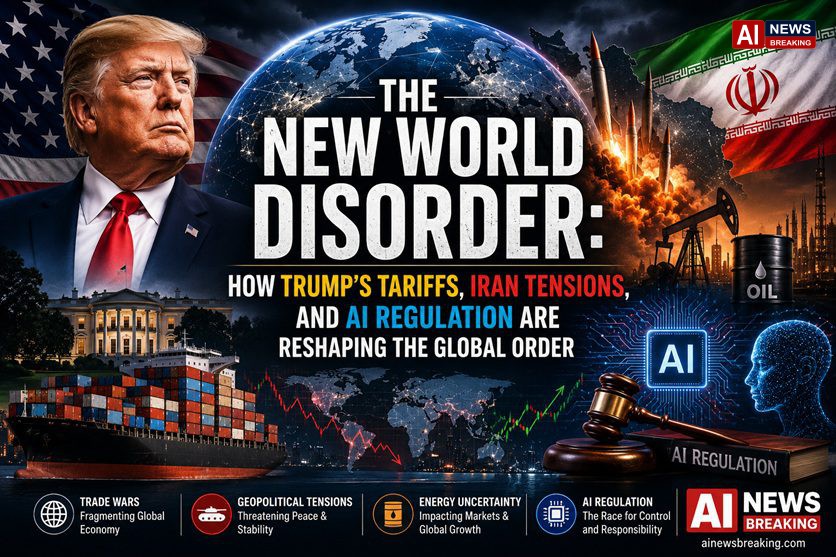
The New World Disorder: Trump's Tariffs, Iran Crisis, and AI Regulation Are Redefining Global Power in 2026 - AI News Breaking
world disorder trumps tariffs:
The post-Cold War world was built on a simple premise: economic integration would reduce conflict, technology would drive prosperity, and international institutions would provide stability. That consensus is now unraveling.
In July 2026, the world finds itself confronting a new reality. The United States has imposed fresh tariffs on dozens of trading partners, tensions with Iran continue to threaten global energy markets despite renewed diplomatic contacts, and governments are increasingly debating how to regulate artificial intelligence before it outpaces political institutions. These are not isolated developments. Together, they signal the emergence of what may be called a “New World Disorder.”
President Donald Trump’s latest trade measures—targeting more than 60 countries with tariffs ranging from 10% to 12.5%—represent one of the most significant shifts in U.S. economic policy since the trade wars of his first presidency. The administration argues that the tariffs are necessary to combat forced labor and protect American manufacturing. Critics, however, see them as another step toward a fragmented global economy in which nations increasingly prioritize strategic interests over international cooperation.
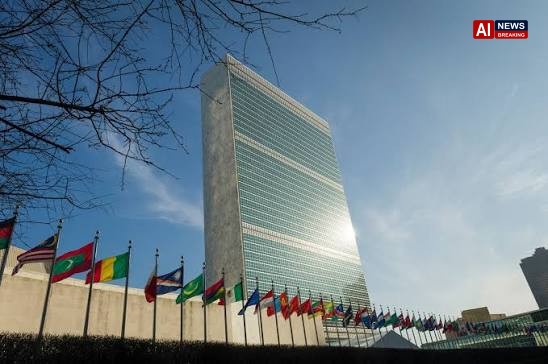
The implications extend far beyond Washington. Europe is reassessing its economic dependence on the United States. China continues to position itself as an alternative center of influence. India finds itself balancing relationships with both East and West while attempting to maintain its strategic autonomy. The World Trade Organization, once considered the cornerstone of global commerce, appears increasingly sidelined.
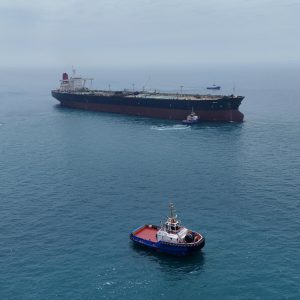
At the same time, geopolitical tensions remain dangerously high in the Middle East. Despite recent statements from President Trump indicating that Washington is engaged in “good talks” with Tehran, the possibility of renewed military escalation remains very real. The administration has repeatedly warned that military action could resume if diplomatic efforts fail. Every headline involving Iran now carries consequences far beyond the region, affecting shipping routes, energy prices, insurance markets, and investor confidence worldwide.
History offers a warning. The 1973 oil embargo demonstrated how quickly a regional conflict can trigger a global economic crisis. Today, the stakes are arguably higher. Global supply chains remain fragile after years of disruption from pandemics, wars, and inflation. Any sustained instability around key maritime routes could once again send energy prices soaring and place additional pressure on economies already struggling with rising costs.
Yet perhaps the most consequential battle of the decade is not taking place on a battlefield or in a trade negotiation room. It is unfolding in data centers and legislative chambers.
Artificial intelligence has moved from being a technological curiosity to becoming a strategic national asset. Governments are increasingly recognizing that AI will influence everything from economic productivity and military capabilities to election security and public services. Recent discussions in Washington about introducing emergency mechanisms—including proposals informally described as AI “kill switches”—reflect growing concerns about how rapidly advanced systems are evolving.
The debate raises difficult questions.
Who should control artificial intelligence? Should governments have the authority to shut down systems deemed dangerous? Can regulators keep pace with technology companies investing billions of dollars into increasingly powerful models? And perhaps most importantly, what happens if rival nations adopt fundamentally different approaches to AI governance?
The United States currently favors maintaining technological leadership. The European Union continues to pursue a regulation-first model. China emphasizes state oversight and strategic deployment. The result is an emerging AI arms race that could define international relations for decades.
For businesses, the convergence of trade disputes, geopolitical instability, and technological disruption presents unprecedented challenges. Companies must now consider not only labor costs and consumer demand, but also tariff exposure, geopolitical risks, cybersecurity threats, and regulatory uncertainty surrounding AI. Strategic planning that once looked five years ahead may now need revision every quarter.
Financial markets are already reflecting this uncertainty. Investors increasingly respond not merely to earnings reports but to diplomatic developments, sanctions announcements, and regulatory proposals. In the modern economy, geopolitics has become a market variable.
For India, the changing global order presents both risks and opportunities.
India’s expanding economy, growing technology sector, and diplomatic flexibility position it uniquely in this environment. New tariffs could disrupt exports, while AI investments could accelerate economic growth. Simultaneously, India must navigate relationships with the United States, Europe, Russia, and emerging powers without becoming overly dependent on any single bloc.
This balancing act may ultimately define India’s role in the twenty-first century. If managed effectively, New Delhi could emerge not merely as a participant in the new world order but as one of its principal architects.
The broader question remains whether the world is entering a temporary period of turbulence or witnessing a fundamental transformation of international relations.
The institutions built after World War II were designed for an era in which economic interdependence was expected to reduce conflict. Today’s reality suggests something different: economic tools are increasingly being used as instruments of competition. Tariffs function as geopolitical leverage. Energy supplies have become strategic assets. Artificial intelligence is rapidly becoming a measure of national power.
This does not necessarily mean globalization is ending. It does, however, suggest that globalization is evolving into something more fragmented, competitive, and unpredictable.
The phrase “New World Disorder” captures this moment because it reflects a growing absence of certainty. Nations are reconsidering alliances. Markets are reacting to geopolitical events in real time. Technological advances are outpacing regulation. And political leaders are making decisions with consequences that extend far beyond their borders.
Future historians may look back on 2026 as a pivotal year—not because of any single tariff announcement, diplomatic crisis, or AI breakthrough, but because it marked the point at which the assumptions of the post-Cold War era finally gave way to a new geopolitical reality.
The challenge for policymakers is no longer preserving the world as it was. It is preparing for the world that is emerging.
And that world is arriving faster than anyone expected.
Editorial Insight: The defining struggle of the next decade may not be between individual nations, but between competing visions of how the world should be governed—through trade, through technology, or through power itself. The countries that successfully adapt to this transition will shape the future. Those that fail may find themselves reacting to it.