Europe warns of Russia’s hybrid attacks but struggles to counter them
  Former chief election commissioner calls SIR scheme illegal.
  A Corruption Scandal Is Reshaping Brazil’s Presidential Election
  US citizen injured in Illinois after ICE agents mistook him for fugitive, tried to arrest him
  At 10 years old, Smithsonian’s Black museum is undaunted amid pressure from Trump administration
 Oil as a Weapon: The Energy Battle Reshaping the World
“The world’s most strategic waterway, the Strait of Hormuz, has become a flashpoint in the global energy battle, with oil prices and supplies hanging in the balance. As tensions rise, the consequences for the global economy, energy security, and international relations are far-reaching, with India and other major oil consumers facing particular challenges.”
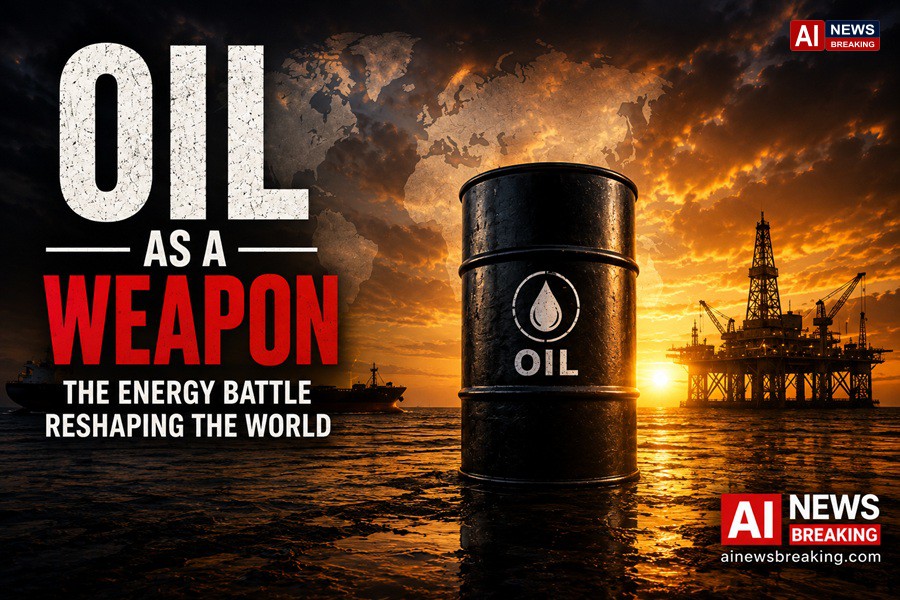
Oil as a Weapon: The Energy Battle Reshaping the World - AI News Breaking
weapon energy battle reshaping:
Editor’s News | AI News Breaking
Oil has always been more than a commodity.
It powers cars, trucks, aircraft, factories and power systems, but it also finances governments, influences currencies, shapes foreign policy and can determine how much economic pressure one country can place on another.
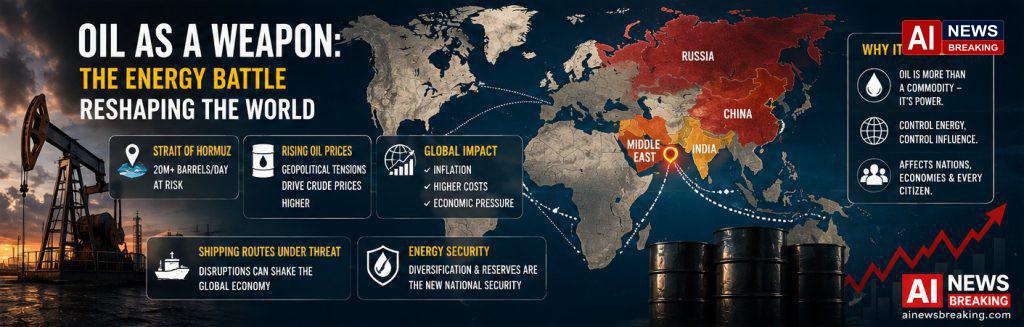
In 2026, that geopolitical reality has become particularly visible. The conflict involving Iran and the wider Middle East has demonstrated how quickly a disruption around one strategic waterway can send shockwaves through the global energy system. The Strait of Hormuz, through which roughly 20 million barrels of oil per day normally move, has once again become one of the world’s most consequential geopolitical pressure points.
The lesson is straightforward: control energy, and you can influence the global economy.
The Strait of Hormuz: The World’s Energy Chokepoint
Few places illustrate the connection between energy and geopolitics better than the Strait of Hormuz.
The narrow waterway connects the Persian Gulf with the Gulf of Oman and the Arabian Sea. Oil from Saudi Arabia, Iraq, Kuwait, the United Arab Emirates, Qatar, Bahrain and Iran relies heavily on this route.
The International Energy Agency estimates that around 20 million barrels per day, approximately a quarter of global seaborne oil trade, normally passes through the Strait. About 80% of those flows are destined for Asia.
That makes Hormuz particularly important for China, India, Japan and South Korea.
There is another vulnerability: alternative pipelines can redirect only a fraction of the volumes normally passing through the waterway. The IEA estimates available alternative crude-export capacity at roughly 3.5–5.5 million barrels per day.
In other words, there is no simple replacement for Hormuz.
And that is precisely why the Strait has such enormous strategic importance.
When a Regional Conflict Becomes a Global Energy Crisis
The most important feature of an oil shock is that physical disruption does not need to last indefinitely to cause economic damage.
Markets react to expectations.
If traders believe that supplies could be interrupted, oil prices can rise before a shortage actually reaches consumers. Airlines, shipping companies, refineries and manufacturers begin adjusting their costs and inventories.
The 2026 Middle East conflict demonstrated the scale of this vulnerability.
The IEA reported that Gulf production affected by the disruption fell dramatically, while global oil supply declined by millions of barrels per day. At one point, benchmark North Sea crude prices experienced an extraordinary increase, with the April average reaching more than $120 a barrel.
The International Monetary Fund later noted that the global market absorbed much of the initial shock through lower demand, additional production and inventory drawdowns—but warned that those buffers were being depleted.
That distinction matters.
The world can survive a temporary supply shock more easily than a prolonged one.
Oil Prices Are Only the Beginning
When crude becomes expensive, the impact does not stop at petrol stations.
Oil is embedded in almost every modern supply chain.
Higher energy costs can mean:
- More expensive petrol and diesel
- Higher airline and shipping costs
- Increased freight charges
- More expensive manufactured goods
- Higher agricultural and fertiliser costs
- Greater inflationary pressure
- Reduced household purchasing power
- Higher operating costs for businesses
This creates a chain reaction:
Geopolitical conflict → supply disruption → higher crude prices → higher transport costs → higher production costs → inflation → pressure on central banks.
That is why an oil crisis can become an economic crisis.
India Faces a Particular Challenge
For India, energy security is inseparable from economic security.
India is one of the world’s largest oil consumers and relies heavily on imported crude. Much of the country’s energy supply is therefore exposed to global prices and maritime trade routes.
A sustained oil shock could place pressure on India’s import bill, inflation, the rupee and corporate costs.
India’s geographical position also makes developments in the Persian Gulf particularly important. The IEA says China and India together received 44% of crude exports passing through Hormuz in 2025.
This means that what happens thousands of kilometres away in the Gulf can eventually affect Indian households.
The effect may appear first in fuel, transport and logistics costs and then spread throughout the broader economy.
For New Delhi, the challenge is therefore not simply securing cheap oil. It is ensuring that energy supplies remain available, affordable and diversified during geopolitical crises.
Russia Shows Another Side of the Oil Weapon
The relationship between oil and geopolitical power is not limited to the Middle East.
Russia’s experience following its invasion of Ukraine demonstrated how energy exports can become both a source of economic power and a target of economic warfare.
Western governments have used sanctions and other restrictions to reduce Russia’s energy revenues, while Russia has sought alternative buyers and markets.
But the global oil market creates a difficult dilemma.
Remove too much Russian oil from international markets and global prices can rise. That can increase revenues from the barrels that Russia continues to sell.
This creates a strategic paradox:
Sanctions can reduce a producer’s access to markets while simultaneously making its remaining exports more valuable.
The 2026 energy crisis has again highlighted this problem, with governments weighing energy-market stability against geopolitical objectives.
OPEC+ Has Power—But Not Unlimited Power
Another major player in the oil equation is OPEC+.
Production decisions by major oil-producing countries can influence the balance between supply and demand. In early August, OPEC+ agreed to raise production quotas by around 188,000 barrels per day from September, completing the planned rollback of a layer of voluntary production cuts.
But quota increases cannot automatically solve geopolitical disruptions.
If infrastructure is damaged, shipping routes are blocked or insurance and security risks prevent tankers from operating normally, additional production capacity on paper may not translate into additional oil reaching consumers.
That is one of the central lessons of the current crisis:
Oil supply is not simply about how much is produced. It is also about whether that oil can safely reach the market.
China and the New Energy Power Equation
China is at the centre of the global energy story.
It is one of the world’s largest oil importers and a major consumer of energy, making secure access to crude strategically important.
But China’s position is evolving.
The country has invested heavily in electric vehicles, renewable energy, batteries and domestic energy infrastructure. Those investments can reduce its exposure to some oil-market shocks over time.
At the same time, China remains deeply connected to global oil markets.
This creates a larger geopolitical contest: whoever can reduce dependence on imported energy gains strategic flexibility.
That principle applies to China, India, Europe and the United States alike.
America Has a Different Position
The United States occupies a unique position in the global energy system.
Unlike many major economies, it is both a huge energy producer and a major consumer. During the 2026 disruption, increased US exports helped provide some relief to international markets. The US Energy Information Administration said US crude and petroleum-product net exports reached a record 5.8 million barrels per day in April, driven partly by increased demand for American supplies after the Hormuz disruption.
This gives Washington a degree of resilience that many oil-importing economies do not possess.
Energy production has therefore become part of America’s broader geopolitical leverage.
The Hidden Weapon: Shipping
Oil cannot influence the global economy if it cannot move.
That makes tankers, ports, pipelines, insurance and maritime security almost as important as oil wells themselves.
The latest disruptions have demonstrated that pipelines and shipping infrastructure can become strategic targets.
The vulnerability is not confined to the Middle East. In July 2026, disruptions linked to drone attacks reduced oil loadings through the Caspian Pipeline Consortium by more than 20%, affecting roughly 400,000 barrels per day of shipments.
The message for governments is becoming increasingly clear:
Energy security requires protecting infrastructure as much as producing energy.
The World Is Building an Energy Insurance Policy
The long-term response to oil vulnerability is diversification.
Countries are investing in:
- Strategic petroleum reserves
- Alternative pipelines
- Renewable energy
- Nuclear power
- Electric vehicles
- Domestic energy production
- LNG infrastructure
- Energy-efficiency measures
- Alternative shipping routes
The objective is not necessarily to eliminate oil immediately.
It is to ensure that one geopolitical event cannot bring an economy to its knees.
That is a much more realistic definition of energy independence.
Can Oil Still Be Used as a Weapon?
Yes—but its effectiveness depends on the circumstances.
A producer can attempt to restrict supply.
A government can impose sanctions.
A military power can threaten shipping routes.
A producer group can adjust output.
A country can redirect exports toward politically friendly buyers.
But every action creates consequences.
Higher oil prices can hurt consumers, but they can also encourage new production. Sanctions can restrict supply, but they can encourage alternative trading networks. Shipping disruptions can raise prices, but they can accelerate investment in alternative routes and energy sources.
The oil weapon therefore has a built-in limitation:
The more aggressively it is used, the stronger the incentive for the rest of the world to find alternatives.
The Bigger Battle Is Already Underway
The most important energy battle of the 21st century may not ultimately be about who has the largest oil reserves.
It may be about who can operate an economy without being held hostage by energy disruption.
That is why the global transition toward electric vehicles, renewable power, nuclear energy, batteries and alternative fuels is not only an environmental story.
It is also a geopolitical story.
Every barrel of oil that an economy no longer needs is one less barrel vulnerable to a blockade, sanctions regime, pipeline disruption or geopolitical crisis.
But the transition will take time.
Until then, oil will remain one of the most powerful instruments in international politics.
What Happens Next?
The immediate question is whether Middle East energy flows can stabilise and whether geopolitical tensions around the Strait of Hormuz can ease.
If shipping normalises and disrupted production returns, the pressure on prices could gradually decline. The IEA and IMF have both highlighted the importance of restoring supply and rebuilding depleted inventories.
But even if the current crisis ends, the strategic lesson will remain.
Governments have seen how quickly an energy chokepoint can become a global economic fault line.
The next crisis could come from the Middle East, Russia, another shipping route, a pipeline or even a cyberattack against energy infrastructure.
The vulnerability is global.
Editor’s View
The era when oil was treated simply as a commodity is disappearing.
Oil is now simultaneously an economic resource, strategic asset, diplomatic tool and national-security concern.
The countries that dominate the next phase of global energy politics will not necessarily be those with the most oil.
They will be the countries capable of keeping their economies functioning when oil becomes scarce, expensive or politically inaccessible.
For India and other major importers, that means diversification cannot remain a long-term slogan. It has to become a strategic priority.
Because in a world of geopolitical rivalry, energy security is national security.
And when oil becomes a weapon, the real battle is not only over the price of a barrel.
It is over who controls the ability of the world economy to keep moving.
Key Takeaways
- The Strait of Hormuz remains one of the world’s most important energy chokepoints. Around 20 million barrels of oil per day normally transit the waterway.
- Geopolitical risks can push oil prices higher even before a physical shortage develops.
- India and other Asian importers are particularly exposed to disruptions in Gulf energy supplies.
- Russia’s experience shows how oil exports can become both an economic lifeline and a geopolitical pressure point.
- OPEC+ can influence supply, but production increases cannot fully compensate for blocked shipping routes or damaged infrastructure.
- The future of energy security will increasingly depend on diversification, reserves, alternative routes and non-oil energy sources.
- The strategic battle is shifting from controlling oil reserves to controlling vulnerability to oil.