 Pentagon directive bans troops from using nonpublic info to bet in prediction markets
  Plaintiffs in Trump arch project seek injunction to stop administration from beginning work Nov. 5
  Trump says he ‘heard something about’ Justice Department probe into longtime ally Corey Lewandowski
  Trump administration stopped sharing evidence in Good and Pretti killings, Minnesota officials say
 JSSC-CGL exam cancellation triggers another protest by 2,000 candidates who cleared it demand for CBI probe continues
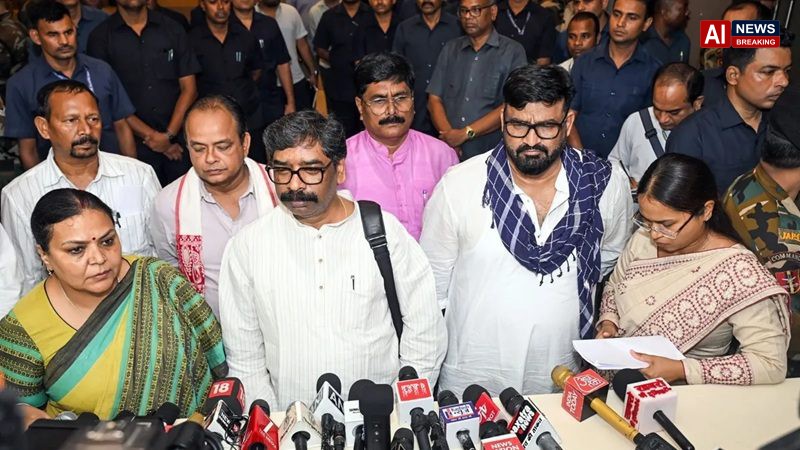
JSSC-CGL exam cancellation triggers another protest by 2,000 candidates who cleared it demand for CBI probe continues - AI News Breaking
jssccgl exam cancellation triggers:
Thousands of aspirants who had successfully cleared the Jharkhand Staff Selection Commission Combined Graduate Level examination gathered outside the state ariat in Ranchi on Tuesday, erupting in fresh waves of agitation following the controversial cancellation of the exam results issued earlier this week. The protest, which saw approximately two thousand participants block major arteries and stage sit-ins near administrative buildings, marks an escalation in a dispute that has cast a long shadow over Jharkhand’s public recruitment processes. The candidates, many of whom had dedicated years of rigorous study to preparing for the competitive examination, expressed profound disappointment and anxiety over the sudden nullification of their hard-earned rankings, arguing that the decision has effectively stalled their professional careers and future prospects indefinitely.The atmosphere at the protest site was charged with a mixture of desperation and defiant resolve, as demonstrators chanted slogans demanding immediate transparency and a thorough investigation into the alleged malpractices that prompted the government to cancel the results..
Participants carried banners listing specific grievances, including purported irregularities in the evaluation process and concerns regarding the integrity of question papers that circulated online prior to the exam. Many of the protesters, hailing from various districts across the state, described the cancellation not as a measure of administrative diligence, but as a punitive action that disproportionately affects honest candidates who had no recourse to influence the alleged irregularities.Central to the unrest is the ongoing demand for a Central Bureau of Investigation probe, a stance firmly maintained by leader of the JPSC-JSSC Reform Manch, who has been at the forefront of coordinating the agitation. The reform group argues that internal administrative inquiries have historically failed to instill public trust or deliver justice in previous instances of recruitment controversy..
They contend that only an independent, central agency possesses the requisite autonomy and investigative power to thoroughly examine the complex web of allegations surrounding the JSSC-CGL exam, including potential collusion between exam officials, private agencies, and other stakeholders involved in the examination lifecycle.Tensions further heightened when Higher and Technical Education Minister addressed the gathering, stating that the successful candidates could seek legal recourse if they were dissatisfied with the government’s decision. This remark, intended to chart a constitutional path for resolution, was met with skepticism and audible dissent from the crowd, who viewed the suggestion as a bureaucratic delay tactic rather than a genuine offer of redress. Critics argue that approaching the judiciary is a protracted and expensive process, often unsuitable for young aspirants from middle-income backgrounds who require immediate employment to support their families, thereby exacerbating the social and economic disparities inherent in the current dispute.The cancellation of the JSSC-CGL results follows a series of turbulent months in Jharkhand’s recruitment landscape, reminiscent of the massive uproar surrounding the Jharkhand Police Constable exam results in early 2023..
That incident, which involved violent protests and significant political fallout, had already necessitated a wholesale restructuring of the state’s staff selection mechanisms. The current controversy threatens to reignite those tensions, placing renewed pressure on the state administration to demonstrate decisive leadership and accountability. Political observers note that the failure to resolve these issues swiftly could erode public confidence in the state government’s commitment to merit-based recruitment and fair administrative practices.Detailed accounts from the ground reveal that the protesting students are currently mulling over whether to intensify their agitation through indefinite hunger strikes or highway blockades, or to temporarily call off the current phase to consolidate their legal strategy..
This internal deliberation highlights the strategic challenge faced by the protest organizers, who must balance the need for visible pressure with the practical realities of sustaining a large-scale movement. Leaders within the Reform Manch have cautioned against rash actions that might lead to confrontation with law enforcement, emphasizing instead the need for sustained, peaceful pressure through media engagement and parliamentary interventions.The core of the allegation against the JSSC involves claims that the question paper for the General Studies section was leaked, allowing certain individuals to gain an unfair advantage. While the commission has initiated its own inquiry, the speed and scope of this internal review have been heavily criticized by legal experts and civil society groups..
They argue that an internal probe lacks the necessary independence to thoroughly scrutinize the digital footprints and communication records that could expose the source of the leak. Consequently, the demand for a CBI investigation remains non-negotiable for the majority of the aspirants, who see it as the only viable path to restoring faith in the selection process.State police forces have maintained a heavy presence around the ariat and other key locations to prevent the protests from turning violent or disrupting essential civic functions. Law enforcement officials have engaged in dialogue with protest leaders, attempting to de-escalate tensions while ensuring that public order is preserved..
However, the sheer number of participants and their determination to have their voices heard have made containment difficult. Police spokespeople have stated that they will act only if the protesters cross the line into lawlessness, but the proximity of the demonstrators to sensitive government infrastructure remains a point of persistent concern.Family members of the aspirants have also begun joining the protests, adding an emotional and human dimension to the political dispute. Parents and relatives have expressed their distress over the uncertainty facing their children, describing the psychological toll of having professional aspirations shattered by administrative decisions that feel arbitrary and unaccountable..
This broadening of the support base complicates the narrative, transforming what began as a grievance of exam candidates into a wider social movement questioning the state’s governance capabilities. The involvement of families underscores the high stakes involved, as each cancelled result represents not just a lost job, but a destabilized household economy.Legal analysts involved in monitoring the situation suggest that while the government’s directive to seek judicial remedy is technically valid, the courts are likely to examine the proportionality of the cancellation decision. Courts in India have previously upheld the principle that collective punishment via mass cancellation is a last resort, to be used only when irregularity is so pervasive that the merit of the entire exam is compromised..
If the irregularities were found to be limited to specific sections or candidates, judicial bodies may rule that cancelling the entire batch is excessive, potentially paving the way for a partial reversal or re-evaluation rather than a complete scrap.The political implications of the unrest are significant for the ruling alliance in Jharkhand, which faces scrutiny over its management of public services and recruitment. Opposition parties have seized upon the incident to criticize the government’s handling of the crisis, accusing officials of negligence and a lack of foresight in securing the examination process. As the protest continues to draw media attention and public sympathy, the administration is under increasing pressure to clarify the timeline for a potential re-examination or to provide concrete evidence of malpractice that justifies the drastic measure of cancellation.As the day wore on, the protesters remained camped outside the ariat, refusing to disperse until a formal commitment to a CBI probe was made..
The standoff illustrates the deep-seated frustration within Jharkhand.
Thousands of cleared candidates staged a two‑thousand‑strong protest in Ranchi after Jharkhand’s staff commission abruptly annulled their CGL results, demanding a CBI probe into alleged paper leaks and evaluation fraud. State officials urged legal recourse, but demonstrators warned the move jeopardises careers and erodes public trust in merit‑based recruitment.
The abrupt nullification of the JSSC‑CGL results is turning a bureaucratic misstep into a broader legitimacy crisis, exposing how fragile merit‑based recruitment is when transparency collapses.
If the state cannot secure an independent probe, the unrest will likely evolve from a single‑exam grievance into a sustained