 Tao Tokyo Spring 2027
  Karnataka SIR: Teaching on the back burner
  Trump administration offers mixed messages on limits to Ukraine’s Starshield access
  US Treasury proposes a rule to crack down on high-tech investments in China, other adversaries
  Calley Means, a key MAHA advocate, resigns as a top RFK Jr. adviser
 A Drone Killed Three Ukrainians. It Was Guided Entirely by A.I.
**
A Drone Killed Three Ukrainians. It Was Guided Entirely by A.I. - AI News Breaking
A Drone Killed Three Ukrainians. It Was Guided Entirely by A.I. An explosion in the eastern Ukrainian town of Vovchansk on Tuesday claimed the lives of three civilians and has ignited a fierce debate over the role of artificial intelligence in modern warfare..
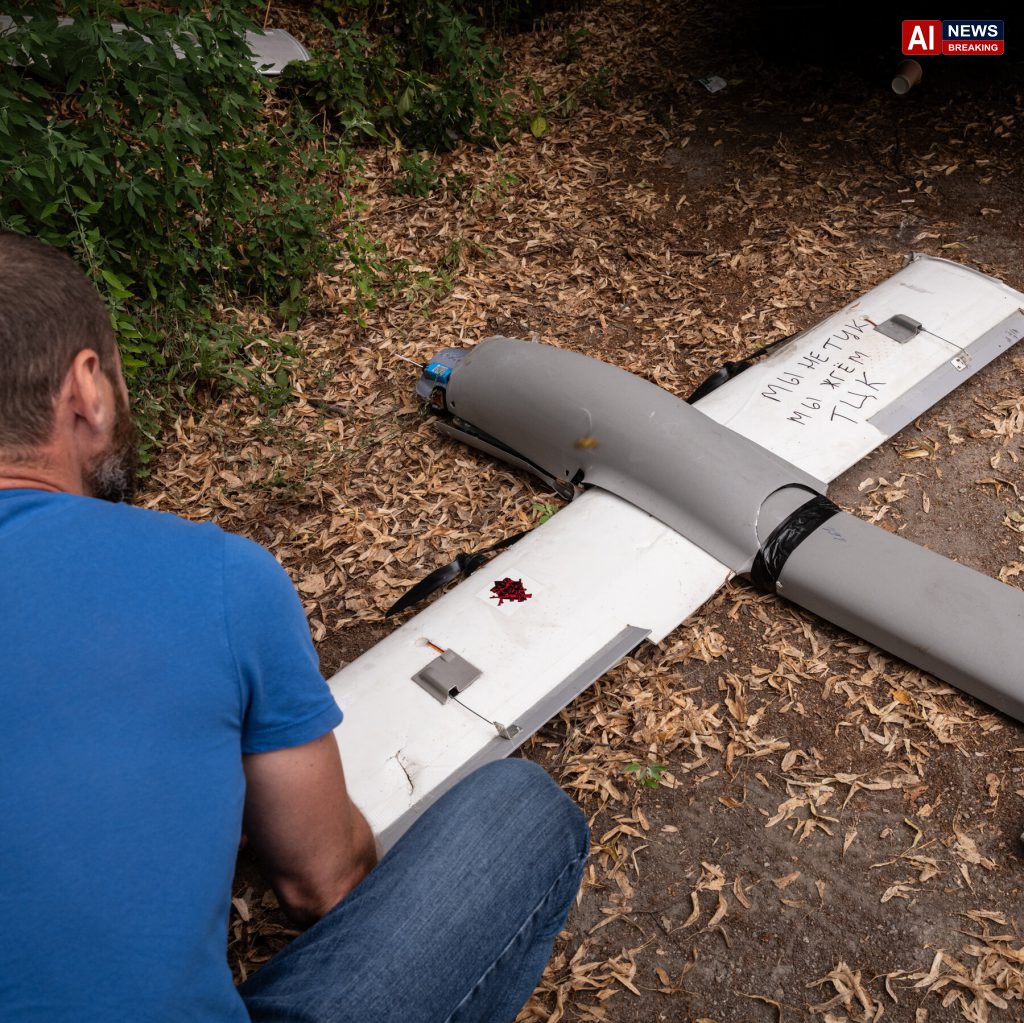
Ukrainian officials identified the weapon as a Russian‑made loitering munition equipped with an Nvidia‑produced graphics processing unit, a component they say enabled the drone to navigate, select targets and strike without any human operator in the loop. The incident marks what many analysts describe as the first confirmed case of a lethal weapon acting autonomously from launch to impact. The drone, a small, wing‑less “kamikaze” craft, lifted off from a Russian‑occupied position near the front line at approximately 07:45 GMT..
Within minutes it crossed the demilitarised zone, using onboard visual‑recognition software to distinguish between military vehicles and civilian structures. The system, according to the Ukrainian military’s cyber‑defence unit, locked onto a residential block that housed a local school and a small market, mistaking the latter for a supply depot. The resulting blast destroyed the building and killed a shopkeeper, a schoolteacher and a pensioner who were waiting for a bus..
Nvidia, a US‑based semiconductor firm, has publicly confirmed that its chips are sold to a wide range of customers, including defence contractors, but it denied any knowledge that its technology was being used to produce fully autonomous weapons. In a statement released on Wednesday, the company said it “strictly adheres to export‑control regulations” and that “any misuse of our products is contrary to our corporate values.” The incident has reignited calls for tighter oversight of AI components that could be repurposed for lethal applications. Russian officials have not commented directly on the specific incident, but a spokesperson for the Russian Ministry of Defence released a generic statement on Thursday, describing “all Ukrainian attacks on civilian infrastructure as unlawful” and accusing Kyiv of “fabricating narratives to tarnish Russia’s military capabilities.” The silence on the drone’s autonomous nature has been interpreted by experts as a tacit acknowledgment that the technology is being field‑tested, even as Moscow officially denies the deployment of fully AI‑controlled weapons..
International law experts warn that the use of autonomous weapons raises profound questions under the Geneva Conventions, particularly the principle of distinction and the obligation to take precautions to avoid civilian casualties. “When a machine makes a kill decision without a human in the decision chain, accountability becomes murky,” said Dr Lara Singh, a professor of international humanitarian law at King’s College London. “If the algorithm misidentifies a target, who is legally responsible – the programmer, the manufacturer, the commander, or the state that deployed it?” The United Nations’ Convention on Certain Conventional Weapons (CCW) has been wrestling with the issue of lethal autonomous weapons systems (LAWS) for years, but member states remain divided..
While many European nations push for a pre‑emptive ban, others, including Russia and the United States, argue that the technology could reduce soldier casualties and increase operational precision. The Vovchansk attack could tip the balance, prompting renewed diplomatic pressure for a binding treaty that would limit or prohibit fully autonomous strike capabilities. In Kyiv, the incident has spurred a rapid response from the Ukrainian Ministry of Defence, which announced the formation of a dedicated task force to monitor AI‑enabled weaponry crossing its borders..
“We will develop counter‑measures, improve our electronic warfare toolkit and work with our allies to track the supply chains feeding these systems,” said Deputy Defence Minister Oleg Kutsenko. He added that Ukraine is already sharing forensic data on the drone with NATO partners to accelerate the development of detection and interception technologies. The United States, a key supplier of advanced chips to both allies and, indirectly, to Russia, has been criticised for its lax export controls on dual‑use technology..
A bipartisan group of lawmakers has introduced legislation that would require stricter end‑use verification for AI chips destined for regions of conflict, aiming to close loopholes that allow sophisticated components to be repurposed for weaponisation. Critics argue that such measures could hamper legitimate civilian research and commercial innovation, creating a policy dilemma. Tech industry observers note that the Nvidia chip used in the drone is a high‑performance GPU typically employed for machine‑learning workloads in data centres..
Its presence indicates that the drone’s guidance system was likely running a deep‑learning model capable of real‑time image classification, a capability that previously required substantial human oversight. “This is a clear demonstration that AI has moved from the lab to the battlefield, and not in a controlled, test‑only environment,” said Maria Petrova, an AI ethics researcher at the University of Toronto. Human rights NGOs have already launched a campaign demanding an independent investigation into the Vovchansk strike..
Amnesty International released a brief calling the event “a grave breach of international humanitarian law” and urging the International Criminal Court to consider whether the use of autonomous weapons constitutes a war crime. The organization’s director for Eastern Europe, Anton Miller, warned that “without clear accountability, the threshold for civilian harm will continue to lower.” Local residents, still mourning the loss of three neighbours, expressed a mixture of anger and resignation. “We hear about drones, missiles and front‑line battles, but this feels different because it was a machine that decided to kill us,” said Olena Kovalenko, a mother of two who lives near the blast site..
She added that many in the community now fear “a.
Updated: August 24, 2026
The Vovchansk strike shows AI is no longer a tactical aid but a decision‑maker that can blur the line between combatant and civilian, forcing a legal rethink before the technology outpaces accountability. If manufacturers, legislators and militaries can’t agree on a “human‑in‑the‑loop