 Tao Tokyo Spring 2027
  Karnataka SIR: Teaching on the back burner
  Trump administration offers mixed messages on limits to Ukraine’s Starshield access
  US Treasury proposes a rule to crack down on high-tech investments in China, other adversaries
  Calley Means, a key MAHA advocate, resigns as a top RFK Jr. adviser
 Volunteers Relocate Hirosaki Castle Stone Wall Using Traditional Method
**
The People of Hirosaki, Japan, Try to Move a Castle by Hand - AI News Breaking
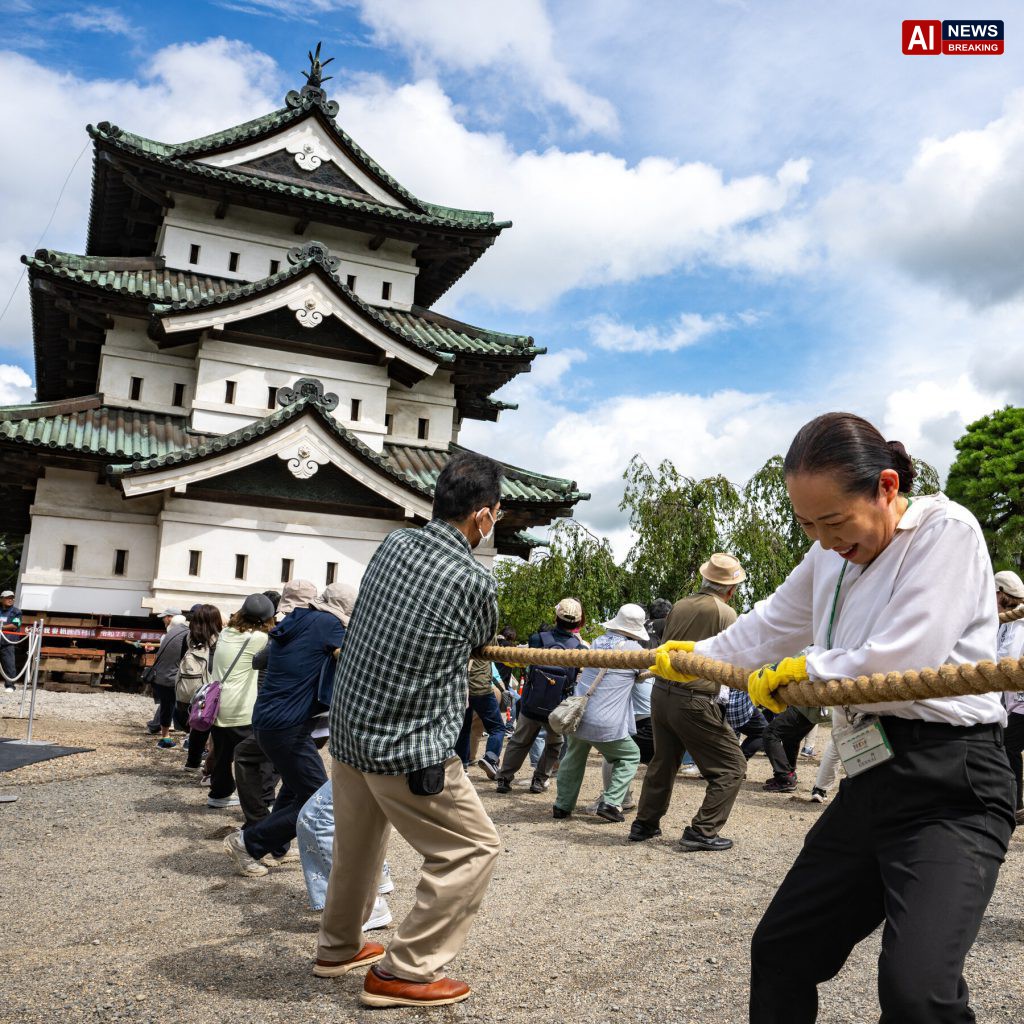
Under the crisp autumn sky of Aomori Prefecture, the historic grounds of Hirosaki Castle became the stage for a spectacle that bridged centuries of Japanese engineering and communal spirit. Thousands of residents, volunteers, and tourists gathered on the cobblestone paths and grassy terraces, united by a singular and monumental objective: to physically relocate a section of the castle’s iconic stone walls. This was not merely a ceremonial reenactment or a staged performance for tourists, but a genuine, grueling test of manpower and ancient technique known as hikiya..
The air was thick with anticipation and the scent of damp earth, as the community prepared to challenge the immovable weight of history using only ropes, wooden rollers, and sheer human determination.The tradition of hikiya, or dragging, dates back to the Edo period when skilled carpenters and laborers moved heavy wooden structures and stone foundations across uneven terrain without the benefit of modern machinery. It is a method rooted in patience, precision, and profound physical coordination. Typically, large wooden rollers are placed beneath the object to be moved, and teams of people pull on thick hemp or synthetic ropes attached to the structure..
The success of the operation depends entirely on the rhythm of the pullers and the quickness of the workers who replace the rollers as they emerge from the back. If the timing is off, the structure can settle, crush fingers, or become hopelessly stuck, making the endeavor as much a test of discipline as it is of strength.Hirosaki Castle, a designated Special National Historic Site, has long been revered for its defensive moats, towering walls, and its relationship with the pink blossoms of the surrounding park. While the main keep is a modern reconstruction, the stone bases and wall sections are original artifacts from the seventeenth century..
The decision to attempt a manual move was driven by a desire to preserve the living memory of these techniques. In an age where cranes and hydraulic lifts dominate construction, the physical act of moving stone by hand serves as a tangible connection to the artisans who built Japan’s feudal landscape. Local historians argue that this physical engagement fosters a deeper appreciation for the heritage, transforming passive observation into active participation.On the day of the event, approximately four thousand individuals assembled in designated zones around a specific twelve-ton granite wall segment..
The scene was organized chaos, with safety officials directing traffic and medical teams standing by. The participants were not professional laborers but ordinary citizens, ranging from elderly retirees to high school students, all united by a pride in their local heritage. They were divided into distinct teams, each assigned a specific length of rope or a role in the roller-handling crew..
The atmosphere was serious yet celebratory, underscored by the rhythmic chanting that would soon guide their movements. The sheer number of people required highlighted the immense weight they were attempting to displace, a weight that had remained stationary for over three hundred years.The mechanics of the operation were simple in theory but complex in execution. Beneath the massive stone block, workers laid down rounded timber logs that had been seasoned to reduce friction..
These rollers were positioned at precise intervals to ensure the weight was distributed evenly across the surface. Thick ropes were lashed securely to iron loops embedded in the stone, and these ropes were then fanned out to allow hundreds of people to pull in unison. The key to success lay in the collective breath of the crowd..
When a lead person shouted the command, every participant pulled with their full body weight, driving the stone forward just enough to allow the rear team to retrieve a roller and place it at the front.As the first pull commenced, the ground seemed to tremble. The stone resisted, anchored by gravity and the friction of the earth beneath the rollers. But as the teams found their rhythm, the massive block began to inch forward..
It was a agonizingly slow process, measuring progress in centimeters rather than meters. The strain was visible on the faces of the workers, their muscles tense and their shoes skidding slightly on the damp ground. Despite the effort, there was a sense of shared triumph with every minor advancement..
The stones did not jump or race; they glided with a terrifying grace, suspended momentarily on the wooden spines that carried them.Critics of such large-scale volunteer events often raise concerns regarding safety and the potential for distraction from more urgent cultural preservation issues. Some argued that the resources spent on organizing thousands of volunteers could be better utilized for structural repairs or digital archiving. However, proponents countered that intangible cultural heritage is just as vital as the physical structure..
The skills involved in hikiya are nearly extinct, and without such high-profile demonstrations, the knowledge of how these ancient structures were assembled and maintained risks vanishing with the last generation of master craftsmen. The event was framed not as a replacement for modern engineering, but as a complementary act of cultural remembrance.Local businesses and vendors capitalized on the communal gathering, setting up stalls selling hot soup, rice balls, and traditional sweets. The castle grounds, usually serene and contemplative, buzzed with the energy of a festival..
Children ran between the safety barriers, fascinated by the sight of so many people working together for a single purpose. For many attendees, the event was a rare opportunity to engage with their neighbors in a meaningful way. In Japan, where individualism is often balanced by a strong sense of community, such events reinforce social bonds..
The shared physical exertion created a camaraderie that transcended age, profession, and social status, uniting everyone under the banner of local pride.The weather played a significant role in the day’s proceedings. A light drizzle began to fall in the afternoon, slicking the wooden rollers and making the ropes treacherous to hold. This introduced a new element of danger, requiring workers to grip the ropes more tightly and move with greater caution..
The cold rain added to the physical discomfort, but it also tested the resilience of the participants. Few left their posts, driven by the momentum of the group and the desire to see the task completed. The gray sky seemed to enhance the historic atmosphere, casting a somber yet majestic light on the ancient stones and the determined faces of the volunteers.By late afternoon, the stone section had been moved a distance of several meters, far exceeding the initial targets set by the organizers..
While the distance may seem modest to an outsider, the logistical challenges of maintaining synchronization among four thousand people make every centimeter a victory. The team leaders signaled a halt as the light began to fade, ensuring that the equipment was secured and the participants could safely disperse. The stone rested on its new position, slightly displaced from its centuries-old foundation, having been moved by the collective hands of its modern descendants.The success of the operation has sparked debate about the future of such traditions in a mechanized world..
Some experts suggest that h.
Updated: August 30, 2026
Summary: Thousands of Aomori residents manually relocated a 12-ton historic stone wall at Hirosaki Castle using centuries-old rope-and-roller techniques. This grueling communal effort aimed to preserve traditional engineering skills and strengthen local social bonds amidst modern skepticism.
This ritualistic exertion transforms passive heritage into embodied knowledge, proving that preserving intangible skills requires physical sacrifice rather than mere digital archiving. The collective struggle to move history underscores a profound societal truth: true cultural continuity is forged through shared labor, not just observation.