
 Trump administration offers mixed messages on limits to Ukraine’s Starshield access
  US Treasury proposes a rule to crack down on high-tech investments in China, other adversaries
  Calley Means, a key MAHA advocate, resigns as a top RFK Jr. adviser
  Spotify Tightens Family Plan Controls with QR Code Verification
  Use of Chief Minister C. Joseph Vijay’s deep fake videos to collect money: Rajasthan youth moves Madras High Court seeking bail
 Two workers rescued from collapsed Nepal tunnel nine days after flood
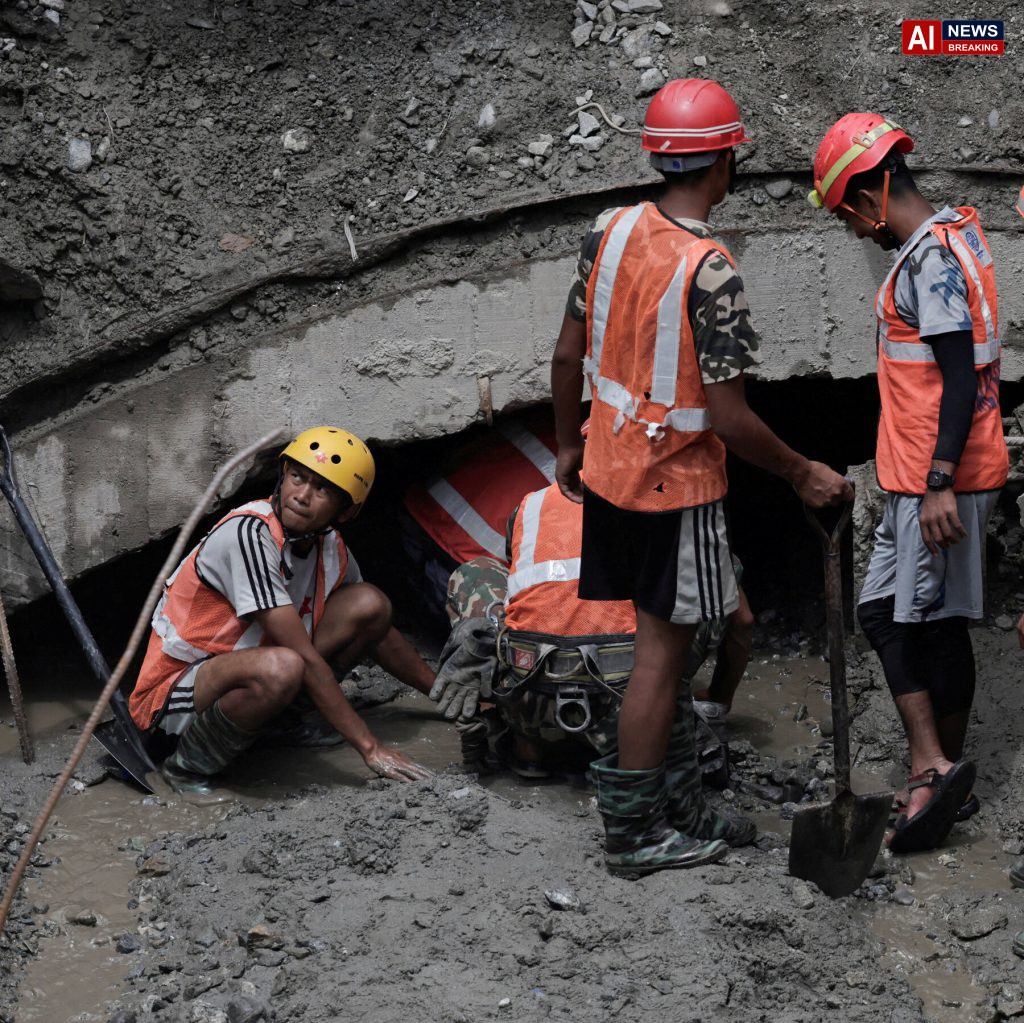
Two workers rescued from collapsed Nepal tunnel nine days after flood - AI News Breaking
workers rescued collapsed nepal:
KATHMANDU — A fragile glimmer of hope emerged from the devastation in central Nepal on Tuesday as rescue teams pulled two workers from the depths of a collapsed tunnel, marking the first recoveries since a catastrophic flood swept through the region nine days ago. The survivors, both industrial laborers, were found curled together in a small air pocket within the debris-choked infrastructure, having subsisted on minimal amounts of water and their own resilience against the crushing weight of mud, rock, and flooding waters. Their extraction, a delicate operation involving heavy machinery and painstaking manual digging, signaled that life may yet persist in the labyrinth of destruction left in the wake of the monsoon-driven disaster that has claimed hundreds of lives and left thousands more missing across the affected districts.The flashpoint of the tragedy occurred last week when unprecedented rainfall overwhelmed the fragile infrastructure of the region, causing rivers to burst their banks and tunnels to collapse under the sheer pressure of shifting earth..
Among the hardest hit was a major transportation corridor under construction, where dozens of vehicles and workers were trapped as the ceiling gave way. Since the initial collapse, search and rescue efforts have been hampered by continued heavy rains, landslides, and the sheer scale of the debris field, which spans hundreds of meters and consists of tons of concrete and heavy machinery mixed with liquefied soil. Despite these formidable challenges, teams from the army, the Nepal Police, and international aid organizations have worked around the clock, driven by the faint but persistent signals of life detected through acoustic sensors and thermal imaging equipment.The two rescues on Tuesday were the first confirmed survivors pulled from the specific tunnel site, though earlier reports had mentioned individuals saved from nearby residential areas that were also submerged by the raging waters..
The medical teams immediately attending to the rescued workers reported that they were in critical but stable condition, suffering from dehydration, hypothermia, and minor trauma. They were quickly airlifted to a nearby field hospital for urgent treatment, where specialists worked to rehydrate them slowly to prevent shock. For their families, who had gathered at the edge of the devastation in a state of suspended grief and desperate hope, the news provided a temporary respite from the overwhelming despair that has settled over the community..
Emotional scenes unfolded as relatives shed tears of joy and disbelief, clutching photographs and personal belongings of the missing, praying that their loved ones might also be found alive in the coming days.However, the mood of cautious optimism is tempered by the grim reality facing the remaining search operations. More than three hundred people are still listed as missing from the incident, including construction workers, truck drivers, and local residents who were caught in the path of the flood. The survival window for such mass-casuary entrapments is typically measured in days, not weeks, and experts warn that the probability of finding more survivors decreases significantly with each passing hour..
Nevertheless, commanders have vowed to continue the search until every entry point has been thoroughly excavated and every possible air pocket has been explored. The operation now relies heavily on specialized equipment, including ground-penetrating radar and life-detection dogs, to navigate the unstable terrain where human rescuers cannot safely tread.The logistical complexities of the rescue mission are profound. The area surrounding the collapsed tunnel remains hazardous, with the risk of secondary landslides and structural collapse threatening the safety of the rescue teams themselves..
Heavy machinery has been deployed to carefully remove layers of debris, but the process is slow and methodical to avoid causing further damage to the fragile pockets where survivors might be hiding. Volunteering teams from across Nepal and neighboring countries have poured into the region, offering manpower and expertise, but the coordination required to manage such a large influx of helpers has strained local resources. The government has appealed for calm and order, urging volunteers to comply with official directives to ensure that the rescue efforts remain efficient and safe.Beyond the immediate horror of the tunnel collapse, the broader humanitarian crisis in Nepal is escalating..
The floods have destroyed homes, bridges, and agricultural land across multiple districts, displacing tens of thousands of people. Many families have lost everything, from their livelihoods to their historical records, leaving them vulnerable to disease and destitution. Relief agencies are struggling to distribute food, clean water, and medical supplies to remote areas where roads have been washed away..
The monsoon season, which is typically underway, has turned from a life-giving force into a destructive agent, exacerbating the vulnerability of a nation already grappling with the aftershocks of previous natural disasters. The speed at which the waters rose last week left little time for evacuation, resulting in a chaos that has left scars on the landscape and the collective psyche of the nation.International attention has also turned to Nepal, with several nations offering assistance and sending specialized rescue teams to aid in the recovery efforts. These teams bring advanced technology and experience in complex urbans rescue operations, which are crucial given the nature of the tunnel collapse..
The collaboration between local and international responders has been largely effective, though cultural and linguistic differences occasionally pose minor hurdles in coordination. The presence of foreign aid has provided a boost to morale among the local workforce, who have been working tirelessly in harsh conditions. Diplomatic channels have been active, with appeals for financial aid to support not only the immediate rescue but also the long-term reconstruction efforts that will define the region’s future for decades.The psychological toll on the communities affected by the disaster is difficult to quantify..
For weeks, families have lived in limbo, unsure of the fate of their loved ones. Local temples and community centers have become makeshift memorials and support hubs, where people share stories, pray, and comfort one another. The trauma of losing family members in such a sudden and violent manner is compounding the stress of displacement and uncertainty..
Mental health professionals have begun setting up counseling services, recognizing that the emotional recovery will take much longer than the physical reconstruction. The resilience of the Nepali people is evident in their communal support systems, but the sheer scale of the loss threatens to overwhelm these traditional coping mechanisms.Government officials have faced intense scrutiny over the safety regulations and oversight of construction projects in the region. Questions are being raised about whether adequate measures were in place to protect workers and travelers during the monsoon season..
Investigations have already begun, focusing on the structural integrity of the tunnel and the response plan for extreme weather events. While it is too early to assign blame, the public is demanding transparency and accountability. The tragedy has sparked a national conversation about infrastructure safety, climate change adaptation, and disaster preparedness, highlighting the need for robust systems to protect vulnerable populations..
The authorities have promised a thorough inquiry, but the pressure to provide answers is mounting as the death toll rises and the stories of negligence emerge.Looking ahead, the focus is shifting from immediate rescue to rehabilitation and rebuilding. The process will be long and arduous, requiring significant financial resources and technical expertise. The government has announced emergency funding packages.
Updated: September 4, 2026
Two laborers were rescued from a collapsed Nepalese tunnel nine days after catastrophic monsoon floods, offering vital hope amid the tragedy.
Despite the grim reality of dwindling survival chances for over 300 missing persons, international and local teams persist in the hazardous search.
Insight: This miracle isn’t just a survival story; it’s a testament to human willpower defying the cold math of rescue timelines. It shifts the narrative from inevitable loss to gritty perseverance during Nepal’s crisis.