Is U.S. Democracy Declining? Global Study Reveals Alarming Trends Amid Rising Political Polarization
The health of democracy in the United States, long considered a global benchmark, is increasingly under scrutiny. A growing body of international research and political analysis suggests that American democracy may be experiencing a measurable decline, raising concerns not only domestically but also across the global political landscape. Recent global democracy indices, academic studies, and institutional reports point to a combination of rising political polarization, institutional distrust, electoral disputes, and weakening democratic norms as key drivers behind this trend.
This comprehensive analysis explores the data, underlying causes, and potential consequences of what experts are calling a “democratic backslide” in the United States.
Global Rankings Reflect a Downward Trend
Over the past decade, multiple global institutions have tracked democratic performance worldwide using metrics such as electoral integrity, civil liberties, political participation, and functioning of government. The United States, once firmly positioned among the world’s leading democracies, has seen its ranking slip in several of these indices.
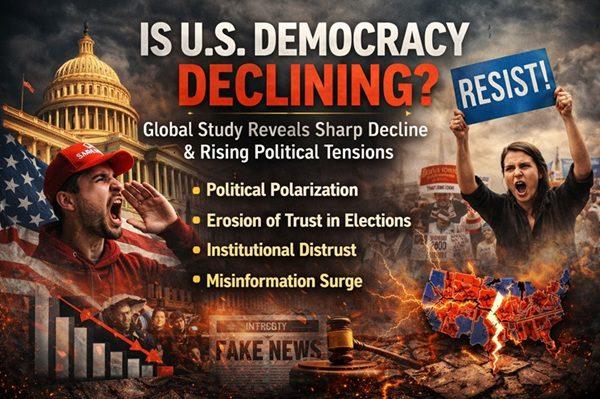
For instance, widely cited democracy assessments have reclassified the U.S. from a “full democracy” to a “flawed democracy” in recent years. The decline is attributed to several measurable factors:
- Erosion of trust in elections
- Increased political polarization
- Declining confidence in public institutions
- Concerns over media independence and misinformation
Data suggests that public trust in federal institutions has reached historic lows. Surveys indicate that a significant portion of Americans question the fairness of elections—an issue that strikes at the core of democratic legitimacy.
Polarization: The Central Driver of Democratic Stress
Political polarization in the United States has intensified dramatically, creating deep ideological divides between major parties and their supporters. Analysts point to polarization as the most significant factor contributing to democratic decline.
Key Indicators of Polarization:
- Growing ideological distance between political parties
- Increased partisan hostility among citizens
- Decline in bipartisan policymaking
- Rise of identity-based politics
This polarization has led to legislative gridlock, making it increasingly difficult for governments to pass major reforms. It has also fueled misinformation and reduced the willingness of political actors to accept electoral outcomes, further weakening democratic norms.
Election Integrity and Public Confidence
One of the most concerning findings from recent studies is the declining public confidence in election systems. While the United States maintains robust electoral infrastructure, perceptions of fraud and irregularities have grown, particularly following highly contested elections.
Data Highlights:
- A significant percentage of voters express doubts about election fairness
- Legal challenges to election results have increased
- State-level voting laws have become more contentious
Experts warn that even if electoral systems remain technically sound, declining public trust can undermine democratic legitimacy. Democracy relies not only on fair processes but also on widespread belief in those processes.
Institutional Trust at Historic Lows
Trust in key democratic institutions—including Congress, the judiciary, and the executive branch—has seen a steady decline over the years.
Survey Data Indicates:
- Congress consistently ranks among the least trusted institutions
- Trust in the Supreme Court has fluctuated amid politically sensitive rulings
- Confidence in the presidency varies sharply along partisan lines
Low institutional trust reduces public engagement and increases the likelihood of political instability. It also creates fertile ground for populist narratives that challenge established democratic frameworks.
Media Landscape and Misinformation
The role of media in shaping democratic discourse has come under increasing scrutiny. The fragmentation of media ecosystems and the rise of social media platforms have fundamentally altered how information is consumed.
Challenges Identified:
- Spread of misinformation and disinformation
- Decline of local journalism
- Echo chambers reinforcing partisan views
- Reduced trust in mainstream media
Studies show that misinformation can significantly influence public opinion and voter behavior, further exacerbating political divisions.
Civil Liberties and Rule of Law
While the United States continues to maintain strong legal protections for civil liberties, some reports highlight areas of concern:
- Increased use of executive powers
- Legal battles over voting rights
- Debates over freedom of speech and content moderation
- Concerns about unequal application of justice
These issues contribute to perceptions that democratic principles are being inconsistently applied.
Comparative Global Perspective
The perceived decline of U.S. democracy is part of a broader global trend. Many countries have experienced democratic backsliding in recent years, often characterized by:
- Rise of authoritarian-leaning leadership
- Weakening of democratic institutions
- Curtailment of civil liberties
However, the U.S. case is particularly significant due to its historical role as a global advocate for democratic governance. A decline in American democratic standards could influence global norms and reduce the country’s ability to promote democracy internationally.
Economic Inequality and Political Influence
Economic factors also play a crucial role in shaping democratic health. Rising income inequality in the United States has led to concerns about unequal political influence.
Key Observations:
- Wealth concentration affects campaign financing
- Lobbying power is often skewed toward large corporations
- Economic disparities influence voter participation
Analysts argue that when large segments of the population feel economically marginalized, their trust in democratic systems diminishes.
Youth Disengagement and Political Participation
Another worrying trend is the level of political engagement among younger generations. While youth activism has surged in certain areas, overall voter participation among young people remains inconsistent.
Key Trends:
- Lower voter turnout compared to older demographics
- Growing disillusionment with traditional political systems
- Increased preference for alternative forms of political engagement
This disengagement could have long-term implications for democratic sustainability.
Potential Consequences of Democratic Decline
If current trends continue, the consequences for the United States could be far-reaching:
Domestic Impacts:
- Increased political instability
- Policy paralysis
- Declining economic confidence
- Social unrest
Global Impacts:
- Reduced influence in international affairs
- Weakening of global democratic norms
- Increased geopolitical competition from authoritarian states
Is the Decline Reversible?
Despite the challenges, experts emphasize that democratic decline is not inevitable or irreversible. The United States retains strong institutional frameworks and a long history of democratic governance.
Potential Solutions Include:
- Electoral reforms to enhance transparency and trust
- Measures to reduce political polarization
- Strengthening civic education
- Promoting media literacy to combat misinformation
- Addressing economic inequality
Rebuilding trust in democratic institutions will require coordinated efforts from political leaders, civil society, and citizens alike.
Expert Opinions and Academic Insights
Political scientists and analysts offer varied perspectives on the severity of the situation. While some view the current trends as part of a cyclical pattern in democratic evolution, others warn of a more structural decline.
Many agree that the combination of polarization, misinformation, and institutional distrust represents an unprecedented challenge in modern American history.
Conclusion: A Critical Moment for U.S. Democracy
The question of whether U.S. democracy is slipping does not have a simple answer. Data and global studies clearly indicate areas of concern, but they also highlight the resilience of democratic institutions.
The coming years will be crucial in determining whether the United States can address these challenges and reaffirm its democratic foundations—or whether the current trajectory will lead to deeper systemic issues.
What remains clear is that the health of American democracy is not just a domestic issue—it is a matter of global significance. As political tensions continue to rise, the world is watching closely to see how one of its most influential democracies navigates this pivotal moment.
This article may be prepared with the assistance of artificial intelligence (AI) and is reviewed before publication. While we aim for accuracy and timeliness, readers should verify important facts from official or primary sources. If you believe any information is inaccurate or that any content infringes your rights, please contact ainewsbreaking.com for review and appropriate action.