 Keralam’s multiplex pricing debate: SC order in 2023 permits cinema hall owners to fix food prices
  DMK chief Stalin accuses Tamil Nadu CM Vijay of using ‘reels’ to cover up administrative failures
  High Court pauses data centre lease dispute.
  CSD urges govt to drop Gram Sabha consent rule for projects
  Misery at Heathrow: ‘Never Seen Chaos Like That’
 Southwest Monsoon Covers Entire Telangana, El Nino Warning Issued
** The southwest monsoon has finally arrived in Telangana, covering the entire state and bringing much-needed relief to farmers, but an El Nino warning has raised concerns about the sustainability of the monsoon rains, with a 70% probability of a drought-like situation during the southwest monsoon.
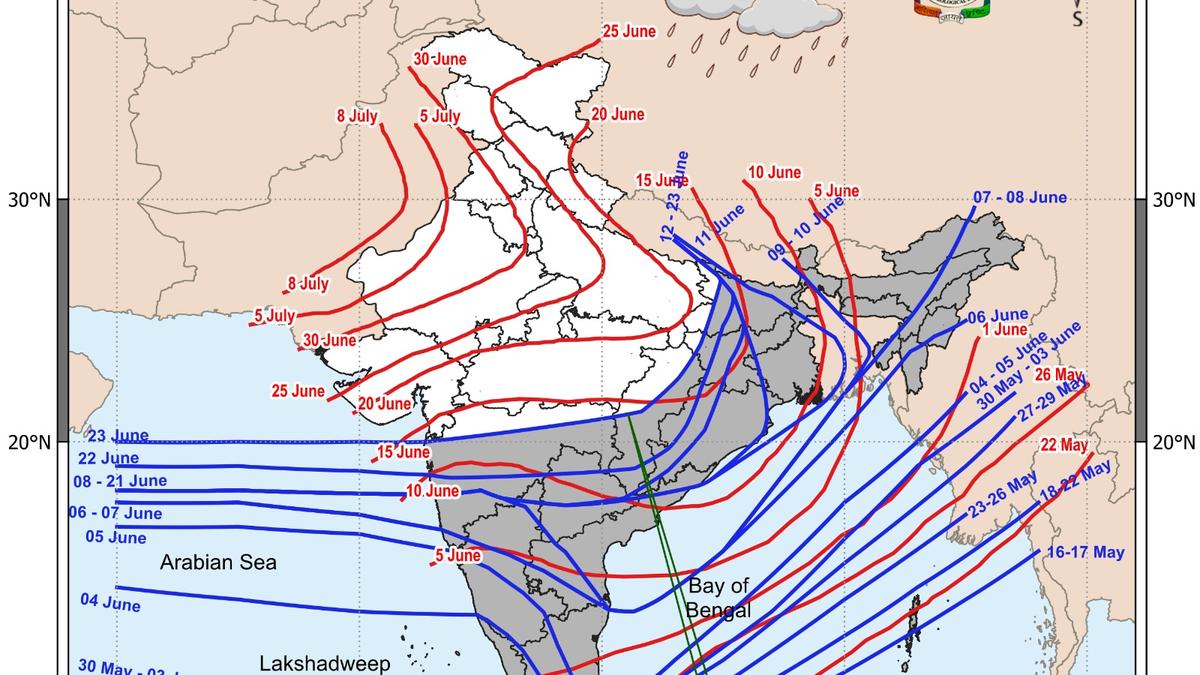
Southwest Monsoon Covers Entire Telangana, but El Nino Warning Casts a Shadow The southwest monsoon has made a much-awaited comeback to Telangana, covering the entire state on June 23 after a prolonged pause. According to the India Meteorological Department (IMD) in Hyderabad, the rain-bearing clouds reached the region earlier than forecast, bringing much-needed relief to the parched land. The revival of the monsoon has raised hopes among farmers, who had been bracing themselves for a below-average crop yield due to the delayed arrival of the seasonal rains..
The renewed monsoon activity has been attributed to a low-pressure system off the coast of Andhra Pradesh, which intensified into a depression and moved northwestwards, bringing the rain-bearing clouds over Telangana. As of now, the monsoon rains have covered almost all parts of the state, with some areas receiving moderate to heavy rainfall. The sudden onset of rain has also led to a significant rise in water levels in the state’s major reservoirs, providing a much-needed boost to the irrigation system..
The revival of the monsoon has also brought a sigh of relief to the agricultural sector, which has been struggling to cope with the drought-like conditions. Telangana’s Director of Agriculture, Jitender Yadav, has expressed concerns about the impact of the delayed monsoon on kharif crop production. However, with the monsoon rains now in place, farmers are hopeful of a better crop yield, especially for crops like paddy, maize, and soybean..
While the monsoon rains bring much-needed relief to the state, the IMD has cautioned that the El Nino phenomenon may weaken the seasonal rains in the coming weeks. An El Nino warning has been issued, indicating a 70% probability of a drought-like situation during the southwest monsoon. The IMD Head in Hyderabad, V.K..
Gunna, stressed the need for efficient water management and urged farmers to choose crops that require less irrigation. The El Nino warning has raised concerns about the sustainability of the monsoon rains, as a prolonged drought-like situation could have a devastating impact on the agricultural sector. The Telangana government has already initiated measures to ensure efficient water management, including the release of excess water from the state’s major reservoirs..
However, the IMD has emphasized that more needs to be done to mitigate the effects of the El Nino phenomenon. The government’s initiatives include distributing micro-irrigation systems to farmers and promoting crops that are drought-resistant. The state’s agricultural department has also launched a program to promote agroforestry, which involves growing multiple crops together to reduce water usage and increase crop yield..
However, the success of these initiatives depends on the continued monsoon rainfall and the IMD’s warning about the El Nino phenomenon has added an element of uncertainty. In the midst of these developments, farmers are eagerly waiting for the next round of rain, as the current showers may not be enough to ensure a good crop yield. The IMD Head has urged farmers to be prepared for the uncertainty, and to take all necessary measures to conserve water and minimize losses..
The state government has also asked farmers to adopt a flexible crop planning strategy, which involves choosing crops based on the available water supply and soil conditions. The revival of the monsoon has also led to a rise in water levels in the state’s major reservoirs, including the popular Nagarjunasagar and Telangana’s largest man-made lake. The water levels in the reservoirs have risen by several feet, providing a much-needed boost to the irrigation system..
This has also led to an increase in water availability for industrial and domestic purposes, improving the overall water management situation in the state. The IMD has also pointed out that the sudden onset of monsoon rains has brought some relief to the city’s water scarcity situation. The water levels in the city’s major lakes and reservoirs, including the Osman Sagar and Himayatsagar, have also risen significantly..
However, the continued drought-like situation has left many residents skeptical about the sustainability of this development. The government has also initiated measures to ensure that excess rainwater is harvested and used efficiently to meet the state’s increasing water demands. This includes the implementation of a statewide rainwater harvesting program, which aims to collect and store rainwater in various locations, including schools, community centers, and public buildings..
However, the program’s success depends on the continued participation of residents and government agencies. The state government has also allocated a significant budget for water conservation and irrigation projects in the wake of the El Nino warning. The allocation of ₹100 crore has been made to promote micro-irrigation systems and other water-saving measures, including solar-powered irrigation systems..
The state’s agricultural department has also been asked to focus on promoting sustainable agricultural practices that ensure efficient water usage. The IMD has also predicted that the monsoon will cover the entire nation by June 30, as the low-pressure system off the coast of Andhra Pradesh intensifies into a cyclonic circulation. However, the warning about the El Nino phenomenon has cast a shadow over the state’s ongoing monsoon campaign, with the IMD cautioning farmers and residents to remain vigilant and adapt to the changing weather conditions..
In the words of the IMD Head in Hyderabad, V.K. Gunna, The revival of the monsoon is a welcome relief, but the El Nino phenomenon poses a significant challenge. We urge farmers and residents to remain prepared and adapt to the changing weather conditions..
The key to sustainable water management lies in efficient water conservation and smart irrigation practices..
Updated: June 23, 2026
The monsoon’s double-edged sword brings both relief and uncertainty to Telangana’s agricultural sector, as the state’s farmers hold their breaths, hoping for sustained rains, despite the looming threat of El Nino’s drought-like conditions. This fragile balance between hope and fear underscores the imperative of adopting adaptable agricultural practices and prioritizing water conservation in the face of climate-related variability.