 Moscow claims Kiev seeks to provoke war with UK; UK denies
  UK bans visas for Israeli settlers accused of violence.
  Matcha popularity rises in India.
  Namma BMTC 2.0 app brings bus and metro ticketing and live-tracking under one platform
  Trump’s 5,000 ‘Dividend’ Promise Sparks Bribery Claims as GOP Faces Crucial Midterms
 Trump’s 5,000 ‘Dividend’ Promise Sparks Bribery Claims as GOP Faces Crucial Midterms
Trump's 5,000 'Dividend' Promise Sparks Bribery Claims as GOP Faces Crucial Midterms - AI News Breaking
trumps 5000 dividend promise:
US President Donald Trump has promised a $5,000 “dividend” to every adult American if Republicans retain control of both the House of Representatives and Senate in the November 2026 midterm elections. The proposal has triggered accusations that Trump is using a taxpayer-funded cash promise to influence voters, while economists question how Washington could finance a payout estimated to cost more than $1 trillion.
Key points
- Trump proposed a $5,000 payment for every adult American if Republicans retain control of the House and Senate.
- The potential programme could cost more than $1 trillion, depending on eligibility rules.
- Trump has suggested tariff revenue could help fund the payment, but available tariff revenue appears far below the projected cost.
- Critics have described the proposal as an attempt to influence voters, while legal experts have questioned whether it would actually constitute bribery.
- Congress would likely need to approve legislation and funding before such payments could be made.
Trump ties $5,000 payment to Republican midterm victory
US President Donald Trump has reignited controversy over direct cash payments to Americans after unveiling a proposed $5,000 “Trump dividend” that would be paid to every adult citizen if Republicans retain control of Congress in the upcoming midterm elections.
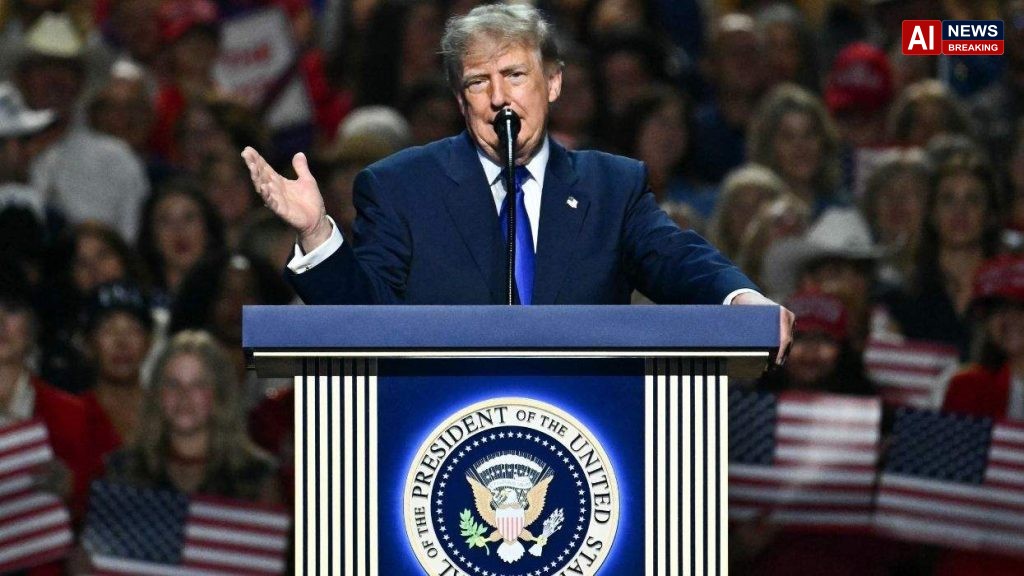
Trump announced the proposal during his address at the Republican Party’s midterm convention in Dallas, presenting the payment as a reward that Americans could receive if Republicans win control of both chambers of Congress on November 3.
“If the Republicans win the House of Representatives and the United States Senate,” Trump said, according to reports of his speech, he would issue a $5,000 dividend to every adult citizen. He added that the money would have to be spent within the United States.
The unusually direct connection between an election outcome and a proposed government payment immediately generated criticism from Democrats, fiscal-policy experts and some Republicans.
Trump’s wording has also raised questions about whether the proposal represents a genuine economic programme or primarily an attempt to energise Republican voters ahead of a difficult midterm campaign.
Why critics are calling it ‘bribery’
The strongest criticism focuses on the timing and political condition attached to Trump’s proposal.
Trump did not simply announce a new nationwide benefit. Instead, he explicitly linked the promised payment to Republicans winning the House and Senate.
That distinction has made the proposal politically explosive.
Critics argue that offering a substantial financial benefit immediately before an election can look like an attempt to persuade voters through personal economic gain. Some commentators have therefore described the announcement as a form of political “bribery” or an unusually aggressive attempt to purchase electoral support.
The Guardian reported that the proposal has already prompted accusations of voter bribery, while other reporting has noted that the legal situation is more complicated because Trump did not explicitly say that individual voters would receive the money only if they personally voted Republican. Instead, the proposed payment would theoretically apply broadly if Republicans won Congress.
That distinction matters.
A promise to enact a government programme if a political party wins an election is not automatically the same as offering money directly to individuals in exchange for their votes. Political parties routinely campaign on tax cuts, subsidies, welfare benefits and other financial policies.
But Trump’s formulation is unusual because of the enormous size of the proposed payment and the explicit “if Republicans win” condition.
The controversy is therefore likely to remain both political and legal, particularly if the proposal advances beyond campaign rhetoric.
The staggering cost of a $5,000 payment
The biggest obstacle may ultimately be financial rather than legal.
The United States has roughly 240 million adults. A simple calculation shows that paying $5,000 to each of them would require approximately $1.2 trillion.
Other estimates put the potential cost even higher depending on how eligibility is defined. The University of Pennsylvania’s Wharton Budget Model has estimated a cost of around $1.35 trillion for the proposal under certain assumptions.
That is an extraordinary amount of money even by the standards of the US federal government.
For comparison, the proposed dividend would be larger than many major federal programmes and would represent a substantial addition to the country’s already enormous fiscal deficit.
The United States is already carrying a national debt of roughly $40 trillion, while annual federal deficits remain measured in trillions of dollars.
That means the government would have to identify a credible source of funding before Congress could realistically approve such a programme.
And that is where Trump’s tariff argument comes under scrutiny.
Can tariffs actually pay for the dividend?
Trump has repeatedly promoted tariffs as a major source of government revenue.
During his Dallas speech, he suggested that the United States had collected enormous amounts of tariff revenue and could use that money to finance the proposed dividend.
However, independent estimates indicate that tariff revenue is nowhere near sufficient to fund a $5,000 payment to every adult American.
The New York Times reported that tariff collections had reached hundreds of billions of dollars, not the “trillions” suggested by Trump. Moreover, the administration has faced obligations to refund some tariff collections following legal challenges.
The resulting funding gap could therefore be enormous.
One analysis cited by WIRED estimated that gross tariff revenue collected between January 2025 and June 2026 was about $284 billion. After accounting for refunds, the net amount could be considerably smaller, leaving Washington potentially needing more than $1 trillion in additional financing for the proposed payments.
That raises a fundamental question:
If tariff revenue cannot cover the payment, where would the remaining money come from?
The obvious alternative would be borrowing.
That would mean the government effectively financed the “dividend” by increasing federal debt.
‘Dividend’ or another government transfer?
Trump’s terminology is also significant.
He has called the proposed payment a “dividend”, invoking the language of corporate shareholders.
In Trump’s presentation, the idea is that Americans would receive a financial return from the economic gains generated by his administration’s policies.
But the federal government is not a corporation, and the United States currently does not have a fiscal surplus large enough to distribute $1 trillion or more to citizens.
A genuine corporate dividend is normally paid from profits.
A federal payment financed through borrowing would be fundamentally different.
That distinction has led economists and fiscal conservatives to question whether “dividend” is an appropriate description of the proposal.
If the payment is ultimately funded through debt, taxpayers would not simply be receiving money generated by government “profits.” The government would be borrowing money today and adding to future obligations.
Trump has made similar cash promises before
The $5,000 proposal is also attracting skepticism because it follows several earlier Trump-backed ideas involving direct payments to Americans.
Trump previously promoted a “DOGE dividend”, under which savings supposedly generated by Elon Musk’s Department of Government Efficiency would have been distributed to taxpayers.
That programme did not materialise.
Trump later floated a $2,000 tariff-funded payment, arguing that revenue from tariffs could be returned to Americans.
That proposal also failed to become a nationwide cash programme.
The history has consequently made some economists and voters cautious about treating the latest announcement as an actual payment programme.
The new proposal would also face a more difficult fiscal environment.
Unlike an emergency stimulus package passed during the COVID-19 pandemic, the United States is not currently dealing with an economy shut down by a global public-health crisis. Any new trillion-dollar transfer would therefore require a much stronger justification in Congress.
The pandemic stimulus provides a useful comparison
The United States previously sent several rounds of stimulus payments to households during the COVID-19 crisis.
Those payments were designed to support families, maintain consumption and prevent an economic collapse during an unprecedented emergency.
Trump’s latest proposal is fundamentally different.
It is being discussed in the context of an election rather than an economic shutdown.
That distinction could become central to the debate over whether the programme would provide useful economic stimulus or simply increase demand at a time when inflation remains a concern.
CBS News noted that economists have previously debated the inflationary consequences of pandemic-era stimulus, particularly as consumer prices subsequently surged.
A $1 trillion-plus injection of cash into the US economy could therefore have significant macroeconomic consequences.
Could the payment fuel inflation?
The potential inflationary impact is one of the most important economic questions surrounding Trump’s plan.
If millions of Americans suddenly receive $5,000, a substantial proportion could be spent on goods and services.
That could increase consumer demand.
If businesses cannot increase supply quickly enough, prices could rise.
The effect would depend on several factors, including how the programme is financed, when payments are made, whether recipients spend or save the money, and the condition of the economy at the time.
MarketWatch reported that analysts expect a significant portion of the proposed payments could be spent, potentially boosting consumption while adding inflationary pressure.
That creates a difficult policy trade-off.
The government could provide households with more cash, but if the additional demand pushes prices higher, part of the value of that payment could effectively disappear.
For a household receiving $5,000, a significant increase in food, housing, fuel and other costs could reduce the real purchasing power of the benefit.
The Federal Reserve could face another dilemma
The Federal Reserve would also have to monitor the consequences.
If the payment programme generated a significant increase in inflation expectations, the central bank could face pressure to maintain higher interest rates or delay rate cuts.
Higher interest rates would increase borrowing costs for households, businesses and the federal government.
That would be particularly significant because the US government already spends enormous amounts on interest payments on its debt.
Consequently, a policy intended to put more money into Americans’ pockets could indirectly increase federal borrowing costs if investors demanded higher yields on Treasury securities.
Markets have already shown sensitivity to Trump’s announcement.
Reuters reported that Treasury yields moved higher amid broader concerns about fiscal pressure, rising energy prices and the proposed cash payments.
Why markets are watching the proposal
Investors generally pay close attention to policies that could significantly change government borrowing.
A $1 trillion-plus cash programme would potentially affect:
- Federal borrowing requirements
- Treasury bond yields
- Inflation expectations
- Consumer spending
- Interest rates
- The US dollar
- Equity markets
The timing is especially sensitive because the US economy is already dealing with elevated energy prices and geopolitical uncertainty linked to the Iran conflict.
Reuters reported that the combination of higher oil prices, inflation concerns and Trump’s proposed payments was adding to pressure in US financial markets.
For investors, the key question is not simply whether Americans receive $5,000.
It is how the government pays for it.
JD Vance appears to add a qualification
Trump’s announcement initially sounded universal, but Vice President JD Vance subsequently indicated that wealthy Americans might be excluded.
That creates another layer of uncertainty.
If the payment is means-tested, the total cost could be lower.
But the programme would then no longer be a straightforward $5,000 payment to every adult American.
Eligibility would need to be defined by Congress.
Questions would include whether the payment goes to:
- Every adult citizen;
- Citizens below a certain income threshold;
- Taxpayers;
- Households rather than individuals;
- Permanent residents;
- Social Security recipients;
- People who file federal tax returns.
Trump himself has not provided a detailed framework for the programme.
Congress would have to play a central role
Another major obstacle is that Trump cannot simply order a $1 trillion payment programme into existence without congressional authority and funding.
Congress controls federal spending.
Any large-scale nationwide payment would therefore need legislation, unless an existing statutory authority could somehow be used.
That means Republicans would have to support the proposal in Congress if they retain control after the midterms.
And even if Republicans win, there could be disagreements within the party.
Fiscal conservatives have historically been skeptical of large deficit-financed government transfers.
Some Republicans have already questioned whether the money would be better used to reduce the national debt.
That could make the proposal much harder to pass than it appears from the campaign stage.
A political gamble for Trump
The timing of the announcement is perhaps the most revealing aspect of the proposal.
The 2026 midterm elections are approaching, and Republicans face significant political challenges.
Trump has made himself the central figure in the Republican campaign, even though his name will not appear on the midterm ballot.
The proposed dividend allows him to frame the election as a direct choice for voters:
Vote Republican and receive the benefit; lose Republican control and the payment disappears.
That is a powerful political message, particularly for households struggling with higher living costs.
But it is also risky.
If voters view the promise as unrealistic or politically manipulative, the proposal could reinforce existing concerns about Trump’s economic management.
Democrats immediately attack the proposal
Democrats have seized on the announcement as evidence that Trump is attempting to use government money to influence the electorate.
California Governor Gavin Newsom, among other Democratic critics, has condemned the proposal in strongly political terms.
Democratic strategists are likely to argue that the payment is not a genuine economic dividend but a campaign promise designed to distract voters from inflation, energy prices, the federal deficit and the administration’s foreign-policy challenges.
The political effectiveness of that argument will depend largely on whether voters believe the payment could actually happen.
If Americans view the $5,000 cheque as realistic, the proposal could become a powerful campaign tool.
If they conclude that Congress will never approve it, the promise could instead reinforce perceptions of political theatre.
Republican reaction is not unanimous
The response within Trump’s own party has also been mixed.
Some Republicans have embraced the idea, particularly because direct payments are an easy message for voters to understand.
Others have raised questions about the cost.
Representative Chip Roy has expressed skepticism, while other Republicans have suggested that any payment should be targeted toward Americans who need it most.
That internal division could become important if Republicans actually win Congress.
A campaign promise is relatively easy to make.
Turning it into legislation requires lawmakers to agree on the details, the funding mechanism and the fiscal consequences.
The legal question is more complicated than the political accusation
Calling the proposal “bribery” is politically powerful, but the legal definition is considerably narrower.
The most obvious distinction is that Trump did not explicitly promise individual voters $5,000 in exchange for voting Republican.
His stated condition is that Republicans must win both chambers of Congress.
If enacted, the payment would apparently be available to qualifying Americans regardless of whether they personally voted Republican, Democrat, third-party or did not vote.
That could make the proposal legally different from directly paying voters for their ballots.
Nevertheless, the extraordinary nature of the announcement is likely to fuel debate over whether political leaders should condition government benefits on an electoral victory.
It also raises broader ethical questions about the relationship between campaign promises and public funds.
The real test will be what happens after November
For now, Trump’s $5,000 dividend remains a proposal rather than an approved federal programme.
There is no established payment date.
There is no final eligibility rule.
There is no detailed funding mechanism.
And there is no guarantee that Congress will approve it.
The outcome of the November elections will therefore be only the first step.
If Republicans retain control of the House and Senate, Trump would still have to persuade lawmakers to enact the programme.
If Democrats regain either chamber, the proposal would face an even steeper legislative barrier.
That makes the November election an important dividing line between campaign rhetoric and potential policy.
A promise with enormous political and fiscal stakes
Trump’s $5,000 dividend proposal combines three politically potent issues: cash payments, tariffs and the midterm elections.
It offers voters an immediate and easily understood financial benefit.
But the economic arithmetic is considerably more complicated.
A payment of $5,000 to roughly 240 million adults could cost about $1.2 trillion before accounting for changes in eligibility. Other estimates put the potential cost around $1.35 trillion.
Existing tariff revenues appear insufficient to cover anything close to that amount.
That leaves borrowing, spending cuts, tax increases or some combination of funding mechanisms as possible alternatives.
None would be politically simple.
At the same time, injecting more than $1 trillion into the economy could have consequences for inflation, interest rates and federal debt.
The proposal therefore represents much more than another campaign promise.
It is a test of whether Trump can convert a politically attractive idea into a financially credible policy.
What happens next?
The immediate focus will shift toward Congress, Republican candidates and the broader economic debate surrounding the midterms.
Several questions remain unanswered:
Who exactly qualifies for the $5,000 payment?
Will wealthy Americans be excluded?
Will Congress approve the programme?
How much tariff revenue is actually available?
Will the government borrow the difference?
Could the payments increase inflation?
Would the Federal Reserve respond with higher interest rates?
And perhaps most importantly:
Will voters view the promise as economic relief or election-year political bribery?
Those questions could determine whether Trump’s “Trump dividend” becomes a serious legislative proposal or another campaign pledge that never reaches Americans’ bank accounts.
Trump’s $5,000 dividend proposal is best understood as both an economic policy idea and an election strategy. The political appeal is obvious: a direct $5,000 benefit is tangible and easier for voters to understand than complicated tax or spending policies. The economic challenge is equally clear: the projected cost is more than $1 trillion, while tariff revenue appears far too small to finance the programme by itself.
The proposal also highlights a broader problem facing US fiscal policy: government benefits can be politically attractive while their financing is much less visible to voters. If funded through borrowing, the immediate benefit would be offset to some degree by higher federal debt and potentially higher interest costs. If financed through tariffs, American consumers and businesses could ultimately bear part of the cost through higher prices.
The most important issue, therefore, is not simply whether Americans could receive $5,000. It is whether the United States can finance such a programme without worsening inflation, debt and borrowing pressures. Until Trump and Congress provide a detailed funding and eligibility framework, the “Trump dividend” should be regarded as a major campaign promise rather than a guaranteed $5,000 payment.