 France deploys patrol fleet to curb Channel migrant crossings
  From a Nepal in Pain, a Young Leader Makes a Case for Climate Reparations
  Ukraine transfers two North Korean POWs to South Korea.
  Australia probes AI‑driven breach of My Health Record portal
  Engineering student’s ‘suicide’ turns out to be murder two arrested
 Muslim Minor Marriage in India: What Personal Law Says, What the Law Says and Why Courts Are Divided Explained
**
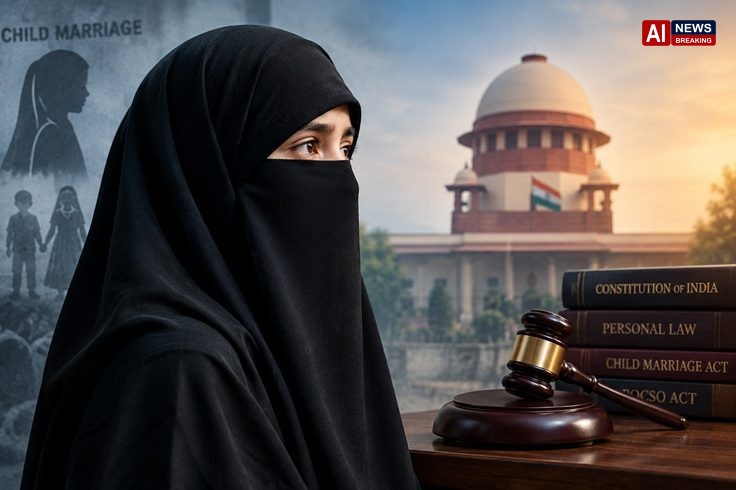
Muslim Minor Marriage in India: What Personal Law Says, What the Law Says and Why Courts Are Divided Explained - AI News Breaking
muslim minor marriage india:
The legal debate over Muslim minors and marriage has resurfaced after a September 2026 Punjab and Haryana High Court order referred to the traditional Muslim-law rule that puberty can determine capacity to marry. But other courts, including the Allahabad and Kerala High Courts, have held that statutory child-protection laws prevail over personal law. Here is what the law and courts have actually said.
The issue in focus
Can a Muslim boy or girl below the statutory age of marriage legally marry in India?
The question has become increasingly complicated because two different legal frameworks are being discussed at the same time.
On one side is Muslim personal law, under which classical principles traditionally connect capacity to marry with the attainment of puberty. Courts dealing with Muslim personal-law questions have referred to the traditional presumption that puberty is attained at 15 in the absence of evidence to the contrary.
On the other side are secular statutes enacted by Parliament, particularly the Prohibition of Child Marriage Act, 2006 (PCMA) and the Protection of Children from Sexual Offences Act, 2012 (POCSO).
The PCMA defines a child as a male who has not completed 21 years or a female who has not completed 18 years. It defines a child marriage as one in which either contracting party is a child. The Act applies to citizens without making its prohibition dependent on religion.
This creates the central legal tension: what happens when a marriage may be recognised under a traditional personal-law rule but the parties fall within the statutory definition of children?
Recent court decisions show that there is no single simple answer emerging from every High Court order.
What exactly does Muslim personal law say?
The starting point is important because the expression “Muslim personal law” can sometimes be used too loosely.
Marriage under classical Muslim law is generally treated as a contract, rather than as a sacrament in the same sense as under traditional Hindu law. The legal capacity of the parties, consent, the marriage proposal and acceptance, and other conditions therefore play a significant role.
Traditional Mohammedan-law texts have historically connected the capacity to enter into a marriage contract with puberty.
The principle was referred to by the Punjab and Haryana High Court in several cases. Article 195 of Mulla’s Principles of Mohammedan Law, as quoted by the court, states that a Muslim of sound mind who has attained puberty may enter into a contract of marriage. The same provision traditionally presumes puberty, in the absence of evidence, upon completion of 15 years.
That rule is fundamentally different from India’s modern statutory definition of a child.
Under the traditional rule being discussed in these judgments, 15 is a presumption of puberty, not necessarily a universal biological determination that every person becomes physically mature on their fifteenth birthday.
The distinction matters because personal law and statutory law are answering different questions.
Personal law historically addresses capacity to enter into a marriage contract.
Modern child-protection legislation addresses whether the State permits, prohibits or penalises conduct involving children.
That distinction lies at the heart of the present judicial disagreement.
Puberty, majority and marriage: three concepts that should not be confused
A major source of confusion in public discussion is the assumption that “puberty”, “majority” and “legal marriage age” are automatically the same thing.
They are not necessarily identical concepts.
In traditional Muslim-law jurisprudence, puberty has historically been important for determining legal capacity. Some High Court decisions have therefore described puberty and majority as effectively coinciding for particular purposes under Muslim law, with 15 used as the presumption where there is no contrary evidence.
But India’s statutory framework operates differently.
The Majority Act, 1875, the PCMA, and POCSO serve different purposes. The PCMA specifically creates an age-based definition for child marriage. Under that statute, a female below 18 and a male below 21 fall within the statutory definition of “child”.
Therefore, the fact that a person may be regarded as having attained puberty under a personal-law principle does not automatically answer whether a marriage involving that person complies with every applicable statute.
What does the Prohibition of Child Marriage Act actually do?
The PCMA was enacted specifically to prohibit child marriages and address their legal and criminal consequences.
Section 2 defines a child by age:
- Male: below 21 years
- Female: below 18 years
A marriage involving either contracting party who falls within that definition is a child marriage.
The Act generally makes child marriages voidable at the option of the contracting party who was a child at the time of marriage, subject to the statutory procedure and time limits.
The legislation also creates criminal consequences.
For example, Section 9 provides punishment for an adult male above 18 who contracts a child marriage. Section 10 deals with persons who perform, conduct, direct or abet a child marriage, while Section 11 addresses persons who promote or permit such marriages.
There are also circumstances under Section 12 in which a child marriage can be treated as void, rather than merely voidable.
This is significant because saying that a child marriage is “valid” or “invalid” without identifying the particular statutory provision can be misleading.
The legal consequences can depend on the circumstances, the parties involved and the particular proceeding before the court.
Why POCSO makes the issue even more complicated
The second major statute is the Protection of Children from Sexual Offences Act, 2012, commonly known as POCSO.
POCSO defines a child by reference to being below 18 years of age and establishes criminal offences relating to sexual assault and sexual exploitation of children.
This creates an important legal distinction.
Even if a marriage is claimed to be valid under a personal-law system, that does not necessarily create an exemption from a separate criminal statute.
Courts have therefore considered whether sexual relations involving a person below 18 can attract POCSO even when the parties claim to be married under Muslim personal law.
The Kerala High Court has expressly considered this issue and held that where conduct constitutes an offence under a special statute, that statute prevails over an inconsistent personal or customary-law rule.
That does not mean every case involving a Muslim minor is automatically identical. The factual circumstances and the precise criminal allegations remain important.
What the Punjab and Haryana High Court has said
The most recent development came from the Punjab and Haryana High Court in September 2026.
The case involved a Muslim couple who approached the court seeking protection of their life and liberty after marrying against the wishes of the woman’s family.
The man was 26 years old and the woman was 17 years and 8 months old.
The couple relied upon Muslim personal law and argued that the woman, having attained puberty, was competent to marry. The court referred to Article 195 of Mulla’s Principles of Mohammedan Law and earlier Punjab and Haryana High Court decisions.
The court observed that under the Muslim personal-law position cited before it, a person who has attained puberty — presumed at 15 in the absence of evidence — could marry a person of their choice.
However, the context of the order is crucial.
The proceedings were concerned with the couple’s life and liberty and their request for protection, rather than constituting a comprehensive determination of every possible criminal or statutory consequence arising from the marriage.
The court referred to earlier decisions including Kammu v. State of Haryana and Gulam Deen v. State of Punjab.
That distinction should not be lost when interpreting headlines about the case.
A protection order and a definitive ruling that every aspect of a marriage complies with all child-protection legislation are not necessarily the same thing.
The earlier Javed case and the Supreme Court’s 2025 order
The controversy is not new.
In Javed v. State of Haryana, the Punjab and Haryana High Court had previously considered whether a Muslim girl who had attained puberty could marry under Muslim personal law.
The High Court took the view that a Muslim girl who had attained puberty could marry a person of her choice under the personal law principles relied upon in that case.
The matter subsequently reached the Supreme Court through a challenge brought by the National Commission for Protection of Child Rights (NCPCR).
In August 2025, the Supreme Court dismissed the NCPCR’s challenge on the ground that the Commission lacked locus standi to challenge the particular protection order. The Supreme Court’s order therefore did not amount to an authoritative Supreme Court ruling finally settling the underlying conflict between Muslim personal law and the PCMA/POCSO framework.
This is an important legal point.
The dismissal should not be read as the Supreme Court affirming, on the merits, a general rule that Muslim minors can marry below the statutory age.
Rather, the case illustrates the difference between:
dismissal of a particular challenge on procedural or standing grounds
and
a binding Supreme Court judgment deciding the substantive legal question.
That distinction has been emphasised in subsequent discussions of the issue.
Kerala High Court takes the opposite approach
The Kerala High Court took a significantly different approach in Moidutty Musliyar v. Sub Inspector, Vadakkencherry Police Station, decided in July 2024.
The case involved allegations concerning the marriage of a minor Muslim girl. The accused argued that Muslim personal law permitted marriage after puberty and that the PCMA should therefore not apply.
The Kerala High Court rejected that argument.
It held that the Prohibition of Child Marriage Act applies to citizens irrespective of religion and supersedes Muslim personal law where the two are inconsistent in relation to child marriage.
The court also rejected the proposition that a Muslim girl’s attainment of puberty could by itself remove the application of the child-marriage statute.
Its reasoning was based on the fact that the PCMA is a subsequent statutory enactment dealing specifically with child marriage.
The judgment therefore represents one of the clearest High Court statements that personal law cannot be used as a defence to conduct expressly prohibited by child-protection legislation.
Allahabad High Court goes further in 2026
The issue returned to the courts in Rubi v. State of Uttar Pradesh, decided by the Allahabad High Court in July 2026.
The case concerned efforts by police and child-protection officials to prevent the marriage of a 16-year-old Muslim girl in Uttar Pradesh.
The court was asked to interfere with criminal proceedings against people accused of obstructing the police and Child Line personnel.
The Allahabad High Court rejected the argument that Muslim personal law permitted the marriage because the girl had attained puberty.
The court held that the statutory prohibition on child marriage applies regardless of religion and that personal law cannot override the PCMA or the protections contained in POCSO.
It specifically stated that the traditional Shariat-law position recognising puberty as the relevant capacity for marriage conflicts with the PCMA and POCSO where a child is involved.
The court also agreed with the reasoning of the Kerala High Court.
In effect, the Allahabad High Court treated the statutory child-protection framework as controlling where it conflicts with the traditional puberty-based rule.
Why the High Courts appear to disagree
At first glance, the judgments seem contradictory.
One court says that a Muslim who has attained puberty can marry under Muslim personal law.
Another says that Muslim personal law cannot override the statutory prohibition on child marriage.
The apparent contradiction becomes easier to understand when the nature of the proceedings is examined.
1. Personal-law question
A court may be asked what Muslim personal law traditionally says about capacity to marry.
In that context, the answer may involve puberty, consent and the principles contained in traditional Mohammedan-law texts.
2. Child-protection question
A different court may be asked whether the PCMA or POCSO applies to conduct involving a person below the statutory age.
Here, the court is applying a parliamentary statute rather than simply determining personal-law capacity.
3. Protection-of-life-and-liberty question
A High Court may also receive a petition under Article 226 from a couple claiming threats from relatives.
In such a proceeding, the immediate question can be whether the State should protect the petitioners from violence or unlawful interference.
That does not necessarily mean the court has finally adjudicated every question concerning the validity or criminal consequences of the marriage.
This distinction is particularly relevant to the recent Punjab and Haryana High Court order.
What about consent?
Consent is another important part of Muslim marriage law.
Traditional Muslim law places considerable importance on the consent of the parties. The provision from Mulla cited by the Punjab and Haryana High Court states that a marriage of a Muslim who has attained puberty is void if it is brought about without that person’s consent.
But consent under personal law cannot automatically answer the separate statutory question of whether the person is legally regarded as a child.
This is because modern child-protection statutes operate on age-based protections.
In other words:
Consent may be relevant to the validity of a marriage under personal law, but it does not automatically create an exemption from a child-protection statute.
That is one of the central reasons why the PCMA and POCSO have become so important in these cases.
What is khiyar-ul-bulugh?
Another concept sometimes cited in discussions of Muslim minor marriage is khiyar-ul-bulugh, sometimes described as the “option of puberty.”
The doctrine concerns the ability, in specified circumstances, of a person married as a minor to repudiate the marriage upon attaining the relevant age or maturity.
Arguments based on this doctrine have appeared in litigation involving Muslim child marriage.
But there is an important legal distinction.
A rule that gives a person an option to repudiate a marriage does not necessarily answer whether the State can prohibit the solemnisation of that marriage in the first place or impose criminal consequences on those who facilitate it.
This is another reason the PCMA has changed the legal landscape.
The Kerala High Court considered arguments concerning the traditional Muslim-law position but concluded that the statutory prohibition could not simply be displaced by personal law.
Does the PCMA automatically make every child marriage void?
Not necessarily.
This is another area where headlines can oversimplify the law.
The PCMA generally provides that a child marriage is voidable at the option of the party who was a child, rather than declaring every child marriage automatically void from the beginning.
However, Section 12 identifies specific circumstances in which a child marriage can be void, including situations involving taking or enticing a child out of the keeping of a lawful guardian, force or deceit, and certain other circumstances specified by the statute.
Therefore, the legal consequences of a particular marriage have to be assessed under the actual statutory provisions and facts.
The terms void, voidable, valid under personal law, and criminally prohibited conduct should not be treated as interchangeable.
The Supreme Court’s broader child-marriage jurisprudence
The Supreme Court has also examined child marriage from a broader constitutional and social perspective.
In Society for Enlightenment and Voluntary Action v. Union of India, decided in October 2024, the Supreme Court issued directions aimed at improving implementation of the PCMA and addressing the continuing problem of child marriage.
The Court also discussed the effect of child marriage on childhood and free choice and called for stronger institutional mechanisms to prevent such marriages.
That judgment is important because it demonstrates that the Supreme Court has treated child marriage as a matter requiring effective enforcement of the statutory framework.
However, the broader Supreme Court jurisprudence does not by itself amount to a specific final ruling resolving every aspect of the Muslim personal-law versus PCMA controversy.
What the law currently means in practical terms
The safest way to understand the present position is to separate the questions.
If a Muslim girl is 17
Under the PCMA’s definition, she is a child because she has not completed 18.
A traditional Muslim-law argument may point to puberty and the classical presumption at 15.
But the Kerala and Allahabad High Courts have held that such personal-law principles cannot override the PCMA’s prohibition.
The Punjab and Haryana High Court, meanwhile, has continued to refer to the traditional Muslim-law position in cases involving protection of life and liberty.
If a Muslim boy is 20
Under the PCMA, he remains a child because he has not completed 21.
Again, the personal-law question and statutory child-marriage question are distinct.
If one party is below 18
POCSO becomes particularly important because it defines a child by reference to being below 18 and criminalises specified sexual acts involving children.
Therefore, the existence of a nikah does not by itself eliminate potential exposure to criminal law.
The unresolved legal question
The most important point is that the current judicial landscape remains unsettled at the level of a definitive Supreme Court ruling directly resolving the entire conflict.
There are now at least three significant judicial strands:
Punjab and Haryana High Court: has repeatedly referred to the traditional Muslim personal-law position under which puberty, presumed at 15 in the absence of evidence, can confer capacity to marry, particularly in cases involving protection of life and liberty.
Kerala High Court: has held that the PCMA applies irrespective of religion and supersedes Muslim personal law to the extent of inconsistency concerning child marriage.
Allahabad High Court: in 2026, held that the puberty-based Muslim personal-law position cannot override the PCMA and POCSO and that child-marriage prohibitions apply regardless of religion.
The Supreme Court’s 2025 dismissal of the NCPCR challenge to a Punjab and Haryana High Court protection order was based on locus standi, rather than a final merits determination of the underlying personal-law issue.
That is why simply saying “the Supreme Court has approved Muslim minor marriage” would be an inaccurate description of the legal position.
Why this debate matters
The dispute is ultimately about the interaction between personal law and parliamentary legislation.
India recognises personal laws in several areas of family life, including marriage, divorce, inheritance and related matters. But personal-law rules operate within the broader constitutional and statutory framework of the country.
When Parliament enacts a law specifically addressing a subject and that legislation conflicts with a personal-law rule, courts may have to determine which rule governs the particular legal dispute.
Child marriage presents a particularly sensitive version of this question because the statutory framework is designed around the protection of children.
The legal debate is therefore not simply about religion.
It involves competing legal concepts:
personal-law autonomy, statutory supremacy, children’s rights, consent, personal liberty, criminal liability and constitutional protection.
The recent judgments show that courts are still working through how those principles interact in individual cases.
Key takeaways
- Traditional Muslim personal law has historically linked marriage capacity to puberty, with puberty traditionally presumed at 15 in the absence of evidence under the formulation cited from Mulla’s Principles of Mohammedan Law.
- The PCMA defines a female below 18 and a male below 21 as a child and defines a marriage involving such a person as a child marriage.
- The Kerala High Court has held that the PCMA supersedes Muslim personal law in cases of child marriage.
- The Allahabad High Court adopted a similar position in 2026, holding that Muslim personal law cannot override the PCMA and POCSO.
- The Punjab and Haryana High Court has continued to recognise the traditional Muslim-law position in protection-of-life-and-liberty cases, including its September 2026 order involving a 17-year-8-month-old Muslim woman.
- The Supreme Court’s August 2025 dismissal of the NCPCR challenge was based on locus standi, not a definitive merits ruling approving child marriage under Muslim personal law.
- POCSO remains a separate statutory framework and can have consequences irrespective of claims based on personal-law marriage.
AI Insights
The debate over Muslim minor marriage in India cannot be reduced to the question of whether “Muslim personal law allows marriage at 15.” That describes only one part of the legal picture.
The more important question is how that traditional rule interacts with legislation enacted by Parliament to prohibit child marriage and protect children from sexual offences.
The recent Punjab and Haryana High Court order demonstrates that traditional Muslim-law principles continue to appear in litigation concerning marriage and personal liberty. At the same time, the Kerala and Allahabad High Courts have taken the position that personal law cannot displace statutory child-protection laws.
The Supreme Court’s recent procedural dismissal in the NCPCR litigation also demonstrates why court orders must be read carefully. A decision concerning whether a particular party has the legal standing to challenge a protection order is not necessarily a final determination of the underlying substantive question.
For now, therefore, the legal landscape is best understood as an unresolved intersection between Muslim personal law and statutory child-protection law, with different High Courts emphasising different aspects of that relationship.
A definitive Supreme Court ruling directly resolving the conflict would have major significance for courts, families, law-enforcement agencies and child-protection authorities across India.