Use of Chief Minister C. Joseph Vijay’s deep fake videos to collect money: Rajasthan youth moves Madras High Court seeking bail
 Florida officer took possession of man’s home after finding him dead 4 years ago, police say
 Jury weighs fate of US woman who says father forced her into Syria’s war zone when she was a teen
 France bans certain protests to restore public
RBI Turns Hawkish: Repo Rate Raised to 5.50 as Inflation Risks Return
The RBI has raised its repo rate by 25 basis points to 5.50% and shifted its monetary-policy stance toward calibrated tightening. Governor Sanjay Malhotra’s message signals that further rate cuts are unlikely in the near term, even as the central bank raises its FY27 growth forecast.
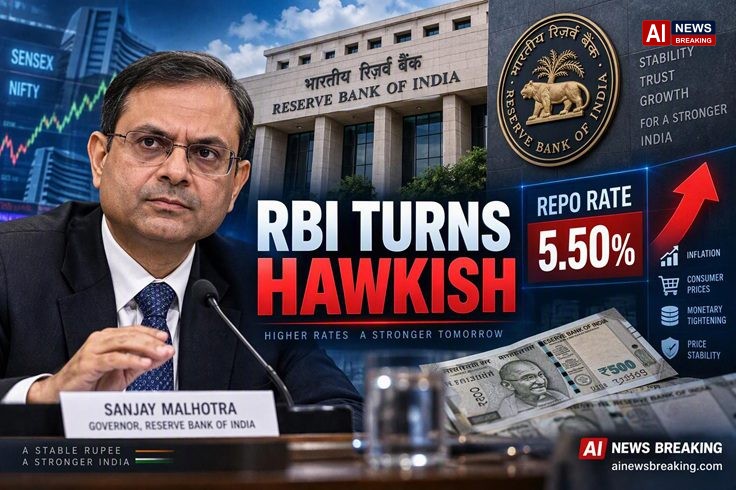
turns hawkish repo rate:
RBI’s October 2026 policy marks a decisive shift in monetary strategy
The Reserve Bank of India has delivered a significant signal to financial markets by raising the repo rate by 25 basis points to 5.50% and moving its monetary-policy stance from neutral toward calibrated tightening. The decision marks a clear change in the direction of monetary policy at a time when the Indian economy is still showing considerable growth momentum but inflation risks are becoming more difficult to ignore.
The decision is important not only because of the rate increase itself, but because of the message accompanying it. RBI Governor Sanjay Malhotra has indicated that the central bank is no longer preparing the ground for another round of rate cuts. Instead, policymakers are keeping the possibility of another increase open while remaining prepared to pause if economic and inflation conditions warrant caution.
That changes the market’s interpretation of the RBI’s next move.
For much of the recent monetary-policy cycle, investors had been focused on the possibility of lower borrowing costs supporting consumption, investment and equity valuations. The October decision reverses that assumption. The central bank is now signalling that controlling inflation and preventing renewed price pressures may require tighter financial conditions.
Key Highlights
1. Repo rate raised to 5.50%: The RBI increased the policy rate by 25 basis points.
2. Monetary stance turns tighter: The MPC shifted from a neutral approach to calibrated tightening.
3. FY27 growth forecast raised: The RBI now expects real GDP growth of around 7.1% for FY27.
4. Inflation forecast increased: The FY27 inflation projection has been raised to approximately 5.2%.
5. Rate cuts are no longer the base case: Governor Malhotra’s guidance leaves the next move between another hike and a pause, depending on incoming data.
Why did the RBI raise rates when India’s economy is growing?
At first glance, a rate hike appears unusual when the economy is expanding strongly.
India’s growth performance remains relatively resilient, and the RBI has actually become more optimistic about the country’s FY27 growth prospects. The central bank has raised its growth projection to 7.1%, reflecting stronger economic activity than previously anticipated.
But monetary policy is not determined by growth alone.
The RBI must simultaneously consider inflation, currency stability, imported price pressures, commodity markets, liquidity conditions and global financial risks.
That combination has become more complicated.
Oil prices remain a particularly important concern. A sustained increase in crude prices can quickly feed into transportation, manufacturing, logistics and household expenses. For an oil-importing economy such as India, expensive crude can also increase the country’s import bill and place pressure on the rupee.
A weaker rupee, in turn, can make imported goods and commodities more expensive.
This creates a potential inflationary feedback loop.
The RBI therefore appears to be acting before inflation becomes sufficiently entrenched to require much more aggressive tightening later.
The most important signal: RBI is no longer preparing for rate cuts
The headline rate increase is only part of the story.
The more important signal for financial markets may be the RBI’s change in communication.
The central bank’s calibrated tightening stance suggests that policymakers want financial conditions to become somewhat less accommodative. Governor Malhotra’s comments have also reduced expectations of an immediate return to rate cuts.
That matters because markets price assets based not only on what the central bank does today but also on what investors believe it will do tomorrow.
If investors had expected a sequence of rate cuts, bond yields could have fallen, borrowing costs could have eased and interest-rate-sensitive stocks could have benefited.
The October policy changes that calculation.
The market must now consider the possibility that the RBI could maintain elevated rates for longer or even raise rates again if inflationary pressures intensify.
Growth remains the RBI’s strongest argument for a measured approach
The RBI’s decision does not represent a warning that India’s economy is entering a slowdown.
In fact, the opposite is true.
The central bank has upgraded its FY27 growth forecast to 7.1%, indicating confidence in the underlying resilience of the Indian economy.
The first-quarter growth performance, at around 7.8%, provides evidence that domestic economic activity remains relatively strong.
This creates an unusual policy environment.
The RBI is tightening monetary policy not because growth has collapsed, but because economic momentum gives it greater room to focus on inflation risks.
That distinction is important.
A central bank facing weak growth and rising inflation has a difficult policy dilemma. A central bank facing strong growth and rising inflation has more flexibility to raise rates without necessarily causing an immediate recession.
The October policy appears to reflect the latter situation.
Inflation is back at the centre of the RBI’s calculations
Inflation remains the central reason for the policy shift.
The RBI has raised its FY27 inflation projection to approximately 5.2%, while recent consumer-price data have shown signs that price pressures are no longer as benign as they appeared earlier.
The problem is not necessarily an immediate inflation crisis.
The greater concern is the direction of travel.
Inflation can accelerate unexpectedly when several external factors move simultaneously: crude oil prices, exchange rates, shipping costs, geopolitical disruptions and food prices.
The current global environment contains several of those risks.
The West Asia conflict and uncertainty surrounding energy supplies have increased the possibility of sustained oil-price volatility. For India, even a temporary oil-price shock can affect inflation expectations and the external balance.
The RBI therefore appears to be choosing prevention over reaction.
Crude oil could become the biggest wildcard
For Indian financial markets, crude oil deserves particular attention following the October policy.
India imports a substantial share of its crude oil requirements. Higher international oil prices therefore affect the economy through several channels.
First, they increase the import bill.
Second, they can put pressure on the rupee.
Third, they increase transportation and logistics costs.
Fourth, they can raise input costs for companies.
And finally, they can eventually feed into consumer inflation.
This means that a sustained crude-oil rally could force the RBI to remain restrictive for longer than investors currently expect.
If oil prices stabilise or decline, however, some of the pressure on the central bank could ease.
That makes crude one of the most important variables to watch between now and the next MPC meeting.
What does the RBI decision mean for the Indian Stock market?
The immediate market reaction is likely to vary considerably across sectors.
Banks and financial stocks
Banks face a mixed picture.
Higher interest rates can support lending yields, but they can also reduce credit demand and increase funding costs. The impact will therefore depend on how quickly banks pass higher rates on to borrowers and depositors.
Large private-sector banks with strong deposit franchises may be better positioned than lenders heavily dependent on expensive wholesale funding.
NBFCs
Non-banking financial companies could face greater pressure because their business models are particularly sensitive to funding costs.
A prolonged tightening cycle could squeeze net interest margins and slow loan growth.
Real estate
Real estate is one of the most rate-sensitive parts of the economy.
Higher home-loan rates can affect affordability and potentially delay property purchases. Developers may also face higher financing costs.
However, India’s strong employment, urbanisation and household-income trends could provide support to the sector.
Automobiles and consumer durables
Higher borrowing costs can affect purchases financed through loans.
Cars, two-wheelers, appliances and other big-ticket consumer products could therefore see some demand sensitivity if lending rates remain elevated.
IT and export-oriented companies
IT exporters have a somewhat different exposure.
A weaker rupee can potentially support rupee-denominated revenue for exporters, although global technology spending and US economic conditions remain much more important drivers of earnings.
Oil-sensitive sectors
Industries with high fuel and transportation costs could face margin pressure if crude remains elevated.
Companies with strong pricing power will be better positioned to absorb higher input costs.
What happens to bonds and fixed-income investors?
The RBI’s tightening signal is particularly important for the bond market.
A higher policy rate generally creates upward pressure on short-term interest rates and can keep government bond yields elevated.
Investors who had positioned for aggressive monetary easing may therefore need to reassess their portfolios.
For fixed-income investors, the policy creates a more interesting environment than it did during the earlier easing cycle.
Higher yields can improve the attractiveness of new investments, but investors must balance that benefit against the possibility of further rate increases, which can hurt the prices of existing longer-duration bonds.
The direction of government borrowing, liquidity conditions and inflation expectations will therefore remain crucial.
What does this mean for borrowers?
For households and businesses, the message is straightforward: borrowing costs may remain higher for longer.
Existing floating-rate home loans, business loans and other credit products could become more expensive as banks and financial institutions transmit the policy change through their lending rates.
Consumers who were expecting a rapid decline in EMIs may now need to revise those expectations.
For businesses, higher interest costs could affect investment decisions, particularly in highly leveraged sectors.
However, the strong growth outlook provides an important counterbalance. If economic activity continues expanding at a healthy pace, companies may be able to absorb moderately higher financing costs through stronger revenues and cash flows.
Is another RBI rate hike possible?
The October decision leaves the door open.
That does not mean another hike is guaranteed.
The RBI will likely examine several indicators before deciding its next move:
- Consumer inflation
- Core inflation
- Crude oil prices
- Rupee-dollar exchange rate
- Food-price trends
- Domestic liquidity
- Credit growth
- Global interest rates
- Capital flows
- Economic growth
If inflation moves significantly higher, another rate increase could become necessary.
If inflation stabilises and commodity prices ease, the RBI could pause at the current level.
The critical point is that an immediate return to rate cuts has become much less likely.
RBI faces a delicate balancing act
The October policy demonstrates the difficult balancing act facing India’s central bank.
On one side is a relatively strong economy.
On the other are inflationary risks arising from global commodity markets and geopolitical uncertainty.
The RBI does not want to suppress economic activity unnecessarily. At the same time, it cannot allow inflation expectations to become entrenched.
This is why the calibrated-tightening language matters.
It provides the central bank with flexibility.
The RBI can raise rates again if inflation requires it, but it can also pause if the current increase proves sufficient.
What should investors watch next?
The next few weeks could be particularly important for Indian markets.
Investors should watch crude oil, the rupee, US Treasury yields, Federal Reserve policy expectations and domestic inflation data.
The interaction between these variables will determine whether the RBI’s October move becomes a one-off adjustment or the beginning of another tightening cycle.
The stock market will also have to digest a new combination of higher interest rates and stronger growth.
That could result in significant sector rotation rather than a uniform market reaction.
Companies with strong balance sheets, pricing power, low leverage and stable cash flows could become more attractive if borrowing costs remain elevated.
AI News Breaking Editorial Analysis
The RBI’s October decision is best understood as a pre-emptive policy move rather than a vote of no confidence in India’s economy.
The central bank is effectively saying that growth is strong enough to withstand somewhat tighter financial conditions, while inflation risks—particularly those originating outside India’s borders—cannot be ignored.
That is an important distinction.
India’s growth story remains intact, but the cost of maintaining that growth is increasingly influenced by factors beyond New Delhi’s control: crude oil, geopolitical tensions, global interest rates and currency movements.
The RBI therefore appears to be buying policy space.
By acting while growth is still strong, it can attempt to contain inflation without resorting to much more aggressive measures later.
For investors, the message is equally clear.
The era of assuming that every policy meeting will bring easier money is over, at least for now. The market must once again price in the possibility of higher-for-longer interest rates.
For households, the immediate implication is that cheaper loans may take longer to arrive.
For businesses, capital allocation and balance-sheet discipline will matter more.
And for equity investors, the focus may shift from broad liquidity-driven gains toward companies capable of delivering earnings growth despite tighter financial conditions.
The RBI has not abandoned India’s growth story.
Instead, it is attempting to ensure that inflation does not become the factor that eventually undermines it.
The next phase of India’s monetary cycle may therefore be defined not by how quickly rates can fall, but by how successfully the RBI can keep inflation under control without sacrificing the economy’s growth momentum.