Use of Chief Minister C. Joseph Vijay’s deep fake videos to collect money: Rajasthan youth moves Madras High Court seeking bail
 Florida officer took possession of man’s home after finding him dead 4 years ago, police say
 Jury weighs fate of US woman who says father forced her into Syria’s war zone when she was a teen
 France bans certain protests to restore public
Trump’s Foreign Policy Double Standards Russian Oil, Iran and Venezuela Raise Questions About US Principles
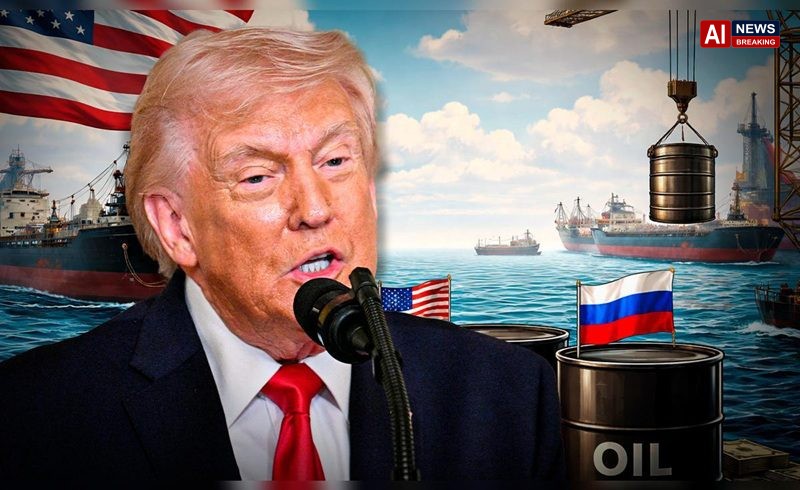
Hybridism of Trump: Trump’s decision to facilitate Russian diesel imports has renewed debate over US sanctions, the Ukraine war and the consistency of American foreign policy. This editorial examines the implications for Iran, Venezuela, international law and India’s strategic autonomy.
trumps foreign policy double:
AI News Breaking Editorial Analysis | World Politics | October 11, 2026
The central question: When Washington imposes economic pressure on other countries in the name of security, sovereignty and international law, should it be expected to follow the same principles when American economic or strategic interests change?
Introduction: One superpower, different rules?
International politics has always involved a difficult balance between national interests and universal principles. Governments speak about peace, sovereignty, democracy and international law, but their decisions are also shaped by energy prices, security calculations, domestic politics and economic pressure.
Under US President Donald Trump, this tension has become particularly visible. His administration has pursued a hard line against adversaries, used tariffs and sanctions as instruments of pressure, and defended military action on national-security grounds. Yet its recent decision to facilitate the import of Russian diesel has raised questions about how consistently those policies are applied.
On October 9, Trump announced an agreement with Russian President Vladimir Putin under which Russia would supply diesel to the American and global markets. The announcement included more than 300,000 tonnes in immediate supplies, followed by additional shipments. Washington also eased certain sanctions to permit the transactions. The decision came after years of US pressure on Moscow over its invasion of Ukraine and amid rising fuel prices linked to the wider Middle East conflict.
The development presents an important contradiction for public debate. If purchasing Russian energy is considered a means of supporting Moscow’s war economy when other countries do it, how should Americans interpret their own government’s decision to buy Russian fuel?
This is the question at the heart of what may be called the hybridism of Trump’s foreign policy: the coexistence of hard-line rhetoric and pragmatic exceptions, of demands for accountability and the exercise of military power, and of universal principles alongside national-interest calculations.
The term is an editorial description of a perceived policy pattern, not a formal political doctrine. Whether each example represents a genuine double standard must be assessed on its own evidence.
1. Russian oil: From sanctions to a commercial agreement
Following Russia’s full-scale invasion of Ukraine in February 2022, the United States and its partners introduced a series of sanctions and restrictions intended to limit Moscow’s access to revenue, technology and international markets. Energy became a central part of this strategy because oil and gas exports provide substantial income to the Russian state.
Countries that continued buying Russian energy faced political pressure from Washington and its allies. India, in particular, became part of the wider debate over whether discounted Russian oil purchases helped sustain Moscow’s war economy, even as New Delhi defended its decisions on the grounds of energy security, affordability and national interest.
The new US-Russia diesel arrangement changes the optics of that debate. Trump has presented the agreement as a way to increase supply and reduce pressure on American fuel prices. From the administration’s perspective, securing affordable energy for American consumers is a legitimate policy objective.
But the decision also creates a difficult question of consistency. If Russian energy purchases are treated as strategically damaging when made by another country, why should a comparable transaction be acceptable when it benefits the United States?
The distinction may lie in the specific product, sanctions rules, timing and terms of the transaction. A temporary licence is not necessarily equivalent to a general removal of sanctions, and a diesel shipment is not identical to every form of crude-oil trade. Those differences matter.
Nevertheless, the political criticism is understandable. Ukrainian President Volodymyr Zelenskyy condemned the agreement, arguing that easing pressure on Russian energy revenues could undermine efforts to constrain Moscow. US lawmakers also questioned whether the arrangement weakened the broader sanctions strategy.
The larger issue is not whether America should ever purchase Russian fuel. It is whether the rules governing such purchases are explained transparently and applied consistently.
Editorial observation: If energy security becomes a sufficient reason for the United States to relax restrictions, Washington must explain why the same consideration should or should not apply to other countries. A credible foreign policy requires clear criteria, not merely different justifications for similar conduct.
2. Tariff wars: Economic pressure as a political weapon
Trump has repeatedly treated tariffs as instruments of leverage. His approach links trade policy to negotiations over market access, manufacturing, security and relations with foreign governments.
Tariffs can serve legitimate policy purposes. They may protect selected domestic industries, respond to unfair trading practices or strengthen a government’s bargaining position. But they can also raise costs for importers, businesses and consumers, while inviting retaliation from trading partners.
The inconsistency question emerges when economic restrictions are presented as essential to national security or as punishment for another government’s conduct, yet are relaxed when domestic economic pressures become more urgent.
The Russian diesel agreement illustrates the tension between two policy objectives: limiting the financial resources available to Moscow and reducing the cost of fuel for American consumers. When the objectives collide, the administration appears to have prioritised an immediate energy-supply concern.
That does not establish that every tariff or sanction imposed by Washington is unjustified. Nor does it mean all restrictions should be maintained regardless of their economic consequences. It does, however, demonstrate why the administration needs to explain the principles that determine when economic pressure is applied, modified or abandoned.
For businesses and investors, unpredictable trade policy creates another problem. Companies make long-term decisions about supply chains, contracts, manufacturing and investment. If market access depends on rapidly changing political negotiations, the cost of uncertainty can become significant.
The international credibility of American economic policy therefore depends not only on the strength of its sanctions, but also on the predictability of the standards behind them.
3. Putin and the Ukraine war: Accountability and the limits of power
The war in Ukraine remains the most important test of the relationship between American rhetoric and international justice.
On March 17, 2023, the International Criminal Court issued arrest warrants for Putin and Russian children’s rights commissioner Maria Lvova-Belova over alleged war crimes involving the unlawful deportation and transfer of Ukrainian children from occupied areas to Russia. The warrants were issued by the Court on the basis of its assessment that there were reasonable grounds to believe the individuals bore criminal responsibility for the alleged conduct. They are not criminal convictions.
The distinction is important. An arrest warrant is a judicial measure, not a declaration of guilt following a completed trial. It also belongs to a different legal process from sanctions imposed by a national government.
The question for Washington is broader: how consistently should international legal principles apply when the alleged conduct involves a powerful state?
The United States has supported Ukraine and criticised Russian aggression, although its approach to the war has varied across administrations and negotiations. Trump’s recent engagement with Putin, including the diesel agreement, highlights the tension between diplomatic engagement and economic pressure.
There is a legitimate argument for negotiating with an adversary. Diplomatic contact can help prevent escalation, secure humanitarian arrangements, reduce the risk of wider conflict and create opportunities for a ceasefire. Talking to Putin is not, by itself, evidence of abandoning Ukraine.
But diplomatic pragmatism carries risks when economic concessions are made without clear safeguards or without demonstrating how they advance a settlement. If Russian energy revenue rises while the war continues, critics may reasonably ask whether the immediate economic benefit to the United States is being purchased at the expense of the wider strategy.
The same principle should apply to every major power: allegations of serious violations must be assessed through evidence and appropriate legal institutions, rather than through political convenience.
The credibility of international justice suffers when governments demand accountability from adversaries but appear reluctant to examine comparable allegations involving themselves or their allies.
4. Iran: Security arguments and the cost of military action
The Iran conflict brings the debate from economic pressure to the use of military force.
In 2026, the United States and Israel launched military strikes against Iran. The Trump administration defended its operations by citing security threats, while legal experts questioned aspects of the campaign, including the evidence presented publicly for the asserted justification and the limits of presidential authority.
Reuters reported in March that the strikes, including the killing of Iran’s Supreme Leader Ayatollah Ali Khamenei, raised serious questions under US domestic law and the international legal framework governing the use of force. The legality of individual operations depends on the circumstances, including the existence of an armed conflict, the applicable rules of international humanitarian law and the evidence supporting the claimed legal basis.
The fundamental issue is not that governments are prohibited from defending their populations. International law recognises self-defence under specified conditions. Nor does the death of a political leader automatically establish that an operation was unlawful. The relevant questions include whether force was legally justified, whether the targets were lawful military objectives, and whether the rules protecting civilians were respected.
However, a government cannot establish the legality of military action simply by describing an adversary as dangerous. Its justification must be examined against the facts and the applicable law.
This is where the comparison with Russia becomes politically difficult. Washington has invoked accountability and sovereignty in its response to the Ukraine war. It must therefore be prepared to explain its own military actions using standards that can withstand independent scrutiny.
The comparison should not erase the differences between Russia’s invasion of Ukraine and US military operations against Iran. The conflicts have different histories, stated objectives and factual circumstances. A serious editorial must examine those distinctions rather than assume the cases are legally identical.
Yet differences between conflicts do not eliminate the underlying principle: the legality of force must be evaluated through consistent rules, not solely by the identity of the state using it.
5. Venezuela: Sovereignty, intervention and regime change
Venezuela presents a related but distinct question: how far may a powerful country go in pursuing its security objectives against another state’s leadership?
The US operation that resulted in the capture of Venezuelan President Nicolás Maduro in January 2026 has generated substantial debate about sovereignty, executive authority and the limits of intervention. Critics have questioned the legal basis for the operation and whether the action was compatible with international law.
The United States may pursue criminal allegations, sanctions or diplomatic pressure against foreign officials, subject to the relevant legal constraints. But criminal accusations and political opposition to a government do not, by themselves, provide an unlimited right to use military force inside another sovereign state.
Under the United Nations Charter, the use of force is generally prohibited, subject to recognised exceptions, including lawful self-defence and force authorised by the Security Council. The application of those rules depends on the facts and the legal arguments presented.
Venezuela’s case should not be treated as identical to Iran or Ukraine. The governments, alleged threats, military circumstances and legal claims differ. Nevertheless, the principle of sovereignty is not meant to operate only when it protects countries aligned with Washington.
If the United States insists that other powers must respect the sovereignty of their neighbours, its own cross-border operations must be open to the same legal scrutiny.
This is not an argument that every intervention is necessarily unlawful. It is an argument that the burden of justification cannot disappear simply because the state undertaking the operation is powerful.
6. The central contradiction: Principles versus national interests
Taken together, the examples reveal a recurring challenge in US foreign policy.
Sanctions are intended to impose costs on governments whose conduct Washington opposes. Tariffs are used to shape the behaviour of trading partners. International justice is invoked to address alleged crimes. Military force is defended through claims of security and necessity.
But these instruments operate in a world where governments must also manage domestic prices, electoral pressures, supply disruptions, alliances and strategic competition.
The Russian diesel agreement makes that tension especially visible. A policy intended to constrain Moscow has been modified to address American fuel-market pressures. The administration can argue that the decision serves US consumers, while critics can argue that it weakens the economic pressure intended to influence Russia’s conduct in Ukraine.
Both arguments deserve examination. The decisive question is whether the administration has established a coherent framework for resolving such conflicts of interest.
A government cannot avoid scrutiny by describing every decision as pragmatic. Pragmatism may explain why a policy changes, but it does not automatically establish that the change is consistent, effective or fair.
Nor should every policy reversal be labelled hypocrisy. Governments can legitimately revise sanctions, negotiate with adversaries and use military force where the law permits it. The test is whether they explain their decisions, acknowledge the consequences and accept scrutiny under standards they expect others to follow.
7. What this means for India and the wider world
For India and other countries outside the core Western alliance, the debate has practical consequences.
India’s energy policy is shaped by affordability, supply security, domestic demand and its broader diplomatic relationships. New Delhi has repeatedly emphasised its strategic autonomy, while its purchases of Russian oil have attracted scrutiny from Western governments.
When Washington restricts another country’s access to Russian energy but later permits its own imports for domestic reasons, other governments are likely to question the consistency of the policy. The comparison does not mean that every transaction is legally or economically equivalent. It does mean that selective exceptions can weaken the persuasive power of broader restrictions.
For developing economies, energy decisions are not abstract geopolitical gestures. Higher oil and fuel prices can increase transport costs, raise the cost of food distribution, put pressure on inflation and complicate government budgets.
A sanctions policy that ignores these consequences may place unequal burdens on countries with different economic capacities. Conversely, unrestricted purchases may help finance a government engaged in a war. Policymakers must confront both realities.
India’s position illustrates why foreign policy cannot be reduced to a binary choice between supporting Washington and supporting Moscow. Countries may cooperate with the United States on security, trade and technology while maintaining energy relationships elsewhere.
The larger lesson is that global rules become more sustainable when they are transparent, predictable and sensitive to legitimate differences in national circumstances.
8. Can America retain global credibility?
The United States remains a major economic, military and diplomatic power. Its ability to influence other governments depends not only on its military strength or the size of its market, but also on whether its commitments are regarded as credible.
Sanctions are more effective when partners believe that the rules are based on identifiable objectives rather than arbitrary political choices. International legal arguments carry greater weight when governments accept independent scrutiny of their own actions. Diplomatic agreements are more durable when they are supported by transparent terms and a clear explanation of the concessions involved.
Frequent reversals can create uncertainty among allies and adversaries alike. Ukraine may question whether Washington’s economic policy remains aligned with its security needs. European partners may reassess the reliability of US commitments. Countries such as India may interpret selective sanctions relief as evidence that energy restrictions can be relaxed when powerful states face sufficient domestic pressure.
These reactions do not automatically mean that American influence will decline. Nor does a single energy agreement determine the future of the international order. The longer-term consequences will depend on whether the administration can demonstrate that its decisions fit into a coherent strategy.
For that reason, transparency matters. The public should know what conditions govern the Russian diesel agreement, how long the sanctions relief will last, what safeguards apply and whether the arrangement advances a broader diplomatic objective.
The same demand for clarity should apply to military operations: what threat justified the use of force, what legal authority was relied upon, what protections were provided for civilians and what conditions would bring the operation to an end?
These are not merely partisan questions. They are basic tests of accountable government.
Conclusion: The world needs consistent standards, not selective principles
Donald Trump’s foreign policy presents a difficult combination of economic nationalism, transactional diplomacy, coercive pressure and willingness to use military force. Supporters may regard this flexibility as a practical way to prioritise American interests. Critics may see a pattern in which principles are emphasised against adversaries but adjusted when domestic or strategic priorities change.
The Russian diesel agreement has brought that debate into sharper focus. Washington spent years seeking to restrict Russian energy revenues because of the war in Ukraine, yet has now facilitated a fresh supply arrangement with Moscow in response to American market pressures. That decision does not, by itself, settle the larger debate about sanctions, but it creates a legitimate demand for explanation.
The Iran and Venezuela cases raise an equally important question about sovereignty and the legal limits of force. A country may have serious security concerns, but those concerns must be evaluated under the applicable law. The identity of the government involved cannot be the sole measure of whether an action is justified.
The world does not require every government to pursue identical policies in every conflict. Circumstances differ, and national interests are real. What it does require is that governments explain their exceptions, apply legal principles consistently and accept accountability for their decisions.
Ultimately, the question surrounding Trump’s foreign policy is not simply whether America should put its own interests first. Every government has a responsibility to protect its people. The deeper question is whether the principles Washington asks other countries to respect are also principles it is willing to apply to itself.
For a world increasingly shaped by wars, sanctions, energy insecurity and competition among major powers, credibility will depend on the answer.