Use of Chief Minister C. Joseph Vijay’s deep fake videos to collect money: Rajasthan youth moves Madras High Court seeking bail
 Florida officer took possession of man’s home after finding him dead 4 years ago, police say
 Jury weighs fate of US woman who says father forced her into Syria’s war zone when she was a teen
 France bans certain protests to restore public
PM Modi, Tamil Nadu CM Vijay Inaugurate Chennai Metro Phase 2 Stretch Traffic Diversions Announced
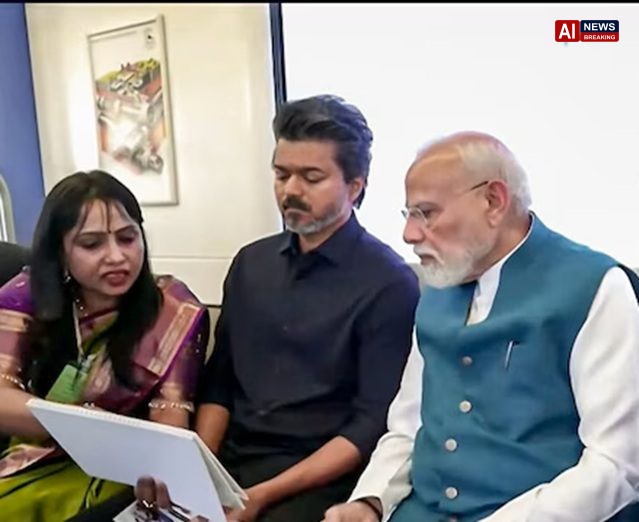
modi tamil nadu vijay:
Chennai Metro Phase 2 News: Prime Minister Narendra Modi inaugurated the first operational stretch of Chennai Metro Rail Phase 2 on Sunday, October 11, alongside Tamil Nadu Chief Minister C. Joseph Vijay. The 14.64-kilometre Poonamallee Bypass–Vadapalani section is expected to improve connectivity across Chennai’s western suburbs. Meanwhile, traffic diversions for commercial and heavy vehicles remained in force at several locations from 8 a.m. to 4:30 p.m. because of the Prime Minister’s visit.
Key Highlights
- Metro inauguration: PM Narendra Modi inaugurated the first operational section of Chennai Metro Phase 2.
- Route: The new section connects Poonamallee Bypass with Vadapalani across approximately 14.64 kilometres.
- Chief Minister: Tamil Nadu CM C. Joseph Vijay attended the inauguration alongside the Prime Minister.
- Traffic restrictions: Commercial and heavy vehicles faced diversions from 8 a.m. to 4:30 p.m. on October 11.
- Development projects: The Prime Minister’s Chennai visit also covered infrastructure and development projects worth more than ₹13,000 crore, according to the Prime Minister’s Office.
PM Modi’s Chennai Visit: What Happened?
Prime Minister Narendra Modi visited Chennai on Sunday, October 11, for the inauguration of the first operational stretch of Chennai Metro Rail Phase 2 and the launch of several development initiatives in Tamil Nadu.
The metro inauguration was a central part of the visit, which focused on expanding urban transport infrastructure, strengthening road and railway connectivity, and improving logistics facilities. Tamil Nadu Chief Minister C. Joseph Vijay also participated in the programme.
According to the Prime Minister’s Office, the Prime Minister was scheduled to travel on the metro between Porur Bypass and Poonamallee Bypass stations before attending other engagements in Chennai. His itinerary also included a visit to the Jalakandeswarar Temple, a walkthrough of the Sudha Gopalakrishnan Brain Centre at IIT Madras, and development-project events.
The programme brought together urban transportation, national infrastructure investment and public services, with the new metro section expected to provide an additional travel option for people moving between Chennai’s western suburbs and other parts of the metropolitan area.
Chennai Metro Phase 2: Details of the New Stretch
The newly inaugurated operational section connects Poonamallee Bypass and Vadapalani. It forms part of Chennai Metro Rail Phase 2, a major expansion programme designed to extend rapid-transit connectivity beyond the existing network.
The section covers approximately 14.64 kilometres and includes 11 stations planned to serve residential neighbourhoods, developing commercial areas and important transport corridors.
The project has been developed at an estimated cost of around ₹4,900 crore. It also incorporates a 3.7-kilometre double-decker structure, an engineering feature intended to accommodate different transport infrastructure within a constrained urban corridor.
The expansion is important for Chennai because road congestion and longer travel times remain challenges for commuters travelling between residential suburbs and employment centres. A dependable metro connection can provide an alternative to private vehicles, taxis and buses, particularly during peak commuting periods.
The new section is expected to improve access to the western side of the city and create additional opportunities for passengers to connect with the wider metro network as more sections become operational.
How the Metro Expansion Could Help Commuters
The opening of an additional metro section can affect everyday travel in several ways.
Reduced dependence on road transport: Passengers travelling along the new corridor may be able to avoid some road congestion by shifting to metro services.
Improved suburban connectivity: Residents in and around Poonamallee, Porur and Vadapalani may benefit from better access to transport links, subject to station locations and service availability.
More predictable journey times: Rail services operating on a dedicated corridor can offer more consistent travel times than road journeys affected by traffic conditions.
Support for economic activity: Better connectivity can make commercial districts, educational institutions, healthcare facilities and workplaces easier to reach.
Potential environmental benefits: If the metro attracts substantial numbers of passengers away from private vehicles, it could help reduce road traffic and associated emissions over time.
These benefits will depend on service frequency, passenger demand, station access, feeder buses, pedestrian infrastructure and the integration of the new section with other transport services.
Chennai Metro Phase 2 and the Future of Urban Transport
Chennai’s expanding metro network reflects a broader effort to improve public transportation in India’s major cities. As metropolitan populations grow, conventional road networks face increasing pressure from private vehicles, commercial traffic, buses and freight movement.
Expanding rail-based mass transit can help address some of these challenges by providing higher-capacity transport along busy corridors. However, infrastructure construction alone does not guarantee a major reduction in congestion.
The long-term effectiveness of the new section will depend on whether commuters find it convenient to use the metro for regular journeys. Reliable train operations, reasonable fares, easy access to stations and connections with buses and other transport services will be important.
For passengers living far from stations, the availability of feeder transport and safe walking routes may determine whether the metro becomes a practical daily option.
The opening of the Poonamallee Bypass–Vadapalani section is therefore an important operational milestone, while the wider impact will become clearer as passenger numbers and travel patterns develop.
Chennai Traffic Diversions on October 11: What Motorists Need to Know
The Greater Chennai Traffic Police announced special traffic arrangements in view of Prime Minister Narendra Modi’s visit to the city.
The restrictions applied to commercial and heavy motor vehicles from 8 a.m. to 4:30 p.m. on Sunday, October 11, 2026. Diversions were introduced at several important junctions and roads to manage vehicle movement around the areas associated with the visit.
The arrangements affected routes connecting Tambaram, Pallavaram, Koyambedu, Kathipara, Porur, Ramapuram, Velachery and other parts of Chennai.
Motorists and transport operators were advised to follow police directions and use the prescribed alternative routes.
1. GST Road: Diversions Near Tambaram
Heavy vehicles travelling towards Chennai from Tambaram on GST Road were diverted at Tiruneermalai Junction towards Kundrathur Road.
Vehicles approaching from Pallavaram were diverted towards Tambaram near the International Airport Junction, close to Hotel Airways.
These changes were intended to regulate the movement of commercial vehicles on an important southern approach to the city.
Drivers transporting goods through the area needed to account for the possibility of additional travel time and plan their journeys accordingly.
2. Jawaharlal Nehru 100 Feet Road: Koyambedu to Kathipara
Vehicles travelling from Koyambedu towards Kathipara Bridge via Jawaharlal Nehru 100 Feet Road were diverted at Ashok Nagar Second Avenue towards Koyambedu or K.K. Nagar.
Vehicles approaching from Ashok Pillar were diverted at the CIPET Junction towards Guindy Industrial Estate.
These diversions affected an important urban corridor used by commuters and commercial vehicles travelling between western Chennai and the Guindy area.
3. Mount–Poonamallee Road: Porur and Ramapuram
Vehicles travelling towards Kathipara Bridge from Mount–Poonamallee Road were diverted at Porur Toll Plaza towards Maduravoyal.
Additional diversions were announced at Ramapuram Junction, where vehicles were directed towards Arasamaram Junction.
Motorists using this corridor were advised to check their routes before travelling, particularly if their journeys involved Porur, Ramapuram or surrounding neighbourhoods.
4. OMR and Sardar Patel Road
Vehicles approaching Lok Bhavan from Old Mahabalipuram Road, Sardar Patel Road and Gandhi Mandapam Road were diverted towards CPT at Gandhi Mandapam Junction.
The arrangements affected traffic approaching important administrative and institutional areas of Chennai.
Drivers unfamiliar with the alternative routes were advised to follow the directions provided by traffic personnel rather than attempting to enter restricted stretches.
5. Velachery Main Road
Vehicles travelling from Velachery Main Road towards Sardar Patel Road were diverted back towards Velachery at Guru Nanak Junction.
The diversion was intended to manage traffic movement on the approach to the affected corridor.
Commuters travelling between Velachery and other parts of southern Chennai were advised to allow additional time for their journeys.
6. Anna Salai: Diversions Near Lok Bhavan
Vehicles approaching from Anna Salai were diverted at the M.C. Raja U-turn towards Anna Salai. They were then allowed to proceed towards their respective destinations in accordance with the traffic arrangements.
Because restrictions could affect access to nearby roads and junctions, motorists were advised to follow on-site instructions from traffic police.
Traffic Advisory for Commercial and Heavy Vehicles
The special arrangements were directed at commercial and heavy motor vehicles during the specified period. Drivers should distinguish these restrictions from any separate restrictions that may apply to particular roads or security zones.
The published advisory identified the diversion routes, but the availability of an individual road could change depending on police instructions and operational requirements.
People travelling by private car, taxi, bus or two-wheeler should not automatically assume that every diversion applicable to heavy vehicles applies to them in the same way. They should follow the latest instructions issued by the Greater Chennai Traffic Police.
The specified window was 8 a.m. to 4:30 p.m. on October 11. Travellers checking this report after that period should consult current traffic updates rather than assume that the same restrictions remain active.
PM Modi’s Tamil Nadu Visit: Other Development Projects
The Chennai visit extended beyond the metro inauguration. According to the Prime Minister’s Office, the programme included projects spanning highways, railways, ports, petroleum infrastructure and education, with the combined value of projects to be inaugurated, dedicated or initiated exceeding ₹13,000 crore.
Highway Infrastructure
The programme included national highway projects worth approximately ₹3,700 crore.
Among the projects identified by the Prime Minister’s Office were the four-laning of the Vadugapatti–Therkuvenganallur section of NH-744, improvements to a section of the Madurai Ring Road, and the foundation stone for the Thiruvarur Bypass on NH-83.
These projects are intended to improve regional connectivity, reduce congestion and support the movement of people and goods.
The actual benefits will depend on construction quality, completion schedules, integration with existing roads and how effectively the upgraded infrastructure addresses local transport bottlenecks.
Railway Connectivity and Amrit Bharat Stations
The programme also covered railway infrastructure projects valued at more than ₹750 crore.
The initiatives included the Karaikal–Peralam railway line, three rail flyovers in and around Coimbatore, and the inauguration of five redeveloped Amrit Bharat stations at Palani, Vellore Cantonment, Ambasamudram, Paramakkudi and Namakkal.
Railway infrastructure can play an important role in reducing delays at busy crossings and improving regional access to passenger services.
Station redevelopment can also improve passenger facilities, although the practical impact will depend on maintenance, accessibility and the quality of services provided after the inauguration.
Port Development and Logistics
The Prime Minister’s programme included projects involving Chennai Port, Kamarajar Port and V.O. Chidambaranar Port.
The initiatives were intended to improve cargo handling, storage capacity, maritime facilities and logistics efficiency. Such improvements can be significant for industries that depend on the movement of raw materials and finished goods.
Efficient ports and better road and rail connections can reduce delays in supply chains. Their economic impact, however, depends on cargo demand, operating efficiency and the ability of connecting infrastructure to handle additional traffic.
Petroleum Infrastructure
The Prime Minister’s Office also identified a proposed Group II/III lube oil base stocks project at the existing Chennai Petroleum Corporation Limited refinery in Manali.
The project was estimated to cost approximately ₹1,620 crore and was designed for a capacity of 270,000 tonnes per annum.
The initiative aims to support the production of higher-quality base stocks used in lubricant manufacturing. Domestic production capacity in this area could contribute to industrial supply chains, depending on execution, product quality and market demand.
IIT Madras Brain Centre
Another scheduled engagement involved the Sudha Gopalakrishnan Brain Centre at IIT Madras.
The centre is associated with advanced research and the study of the human brain. Investment in scientific research facilities can strengthen India’s research ecosystem by supporting access to advanced infrastructure and enabling new research programmes.
The benefits of such facilities are generally measured over time through research output, scientific collaboration, training and the practical applications of discoveries.
Why the Chennai Metro Inauguration Matters
The opening of a new metro section is both a transportation development and a test of how effectively major infrastructure projects can respond to the needs of a growing city.
For Chennai, the western suburbs have become increasingly important to residential development, commerce and daily commuting. A stronger mass-transit network can help connect these areas with established urban centres.
The new section may also influence travel decisions. If metro journeys become more convenient and predictable than road travel for particular routes, some commuters may choose public transport more frequently.
That shift could support wider urban objectives, including reduced congestion and more efficient use of road space. However, meaningful change requires more than a single metro segment. A well-connected network, dependable services and convenient station access are all necessary.
The expansion also highlights the importance of coordinating transport infrastructure with local roads, bus services, pedestrian facilities and future urban development.
What Commuters Should Watch Next
Passengers planning to use the new stretch should check the latest Chennai Metro Rail service information for operational stations, train timings, fares and any temporary restrictions.
The number of stations initially available for passenger service may differ from the total number planned for the corridor. Commuters should therefore confirm that their intended boarding and destination stations are open before travelling.
Motorists should also check current traffic advisories if they need to travel through areas affected by the Prime Minister’s visit. The traffic restrictions announced for October 11 were time-specific, and subsequent arrangements may differ.
For the longer term, passengers will be watching service reliability, the integration of the new line with the wider metro network and whether feeder transport makes stations accessible to people living beyond walking distance.
The inauguration of the Poonamallee Bypass–Vadapalani stretch marks a significant stage in Chennai Metro Rail Phase 2. The new section is intended to improve public transport connectivity across the western suburbs and provide another option for commuters navigating the city.
The Prime Minister’s visit also covered wider infrastructure projects involving highways, railways, ports, petroleum facilities and research. Meanwhile, traffic diversions were announced for commercial and heavy vehicles at multiple locations to manage movement during the visit.
The metro’s long-term success will depend on the quality and reliability of its services, convenient access to stations and integration with other forms of public transport. For Chennai residents, the key question is how effectively the new infrastructure translates into shorter, more predictable and more convenient daily journeys.