Use of Chief Minister C. Joseph Vijay’s deep fake videos to collect money: Rajasthan youth moves Madras High Court seeking bail
 Florida officer took possession of man’s home after finding him dead 4 years ago, police say
 Jury weighs fate of US woman who says father forced her into Syria’s war zone when she was a teen
 France bans certain protests to restore public
Starlink vs Reliance Jio: Is America’s Tech Hegemony Challenging India’s Digital Sovereignty
Elon Musk’s Starlink dispute with Mukesh Ambani’s Reliance Jio goes beyond business rivalry. AI News Breaking examines American technological influence, India’s satellite spectrum policy and the challenge of protecting digital sovereignty while ensuring fair competition.
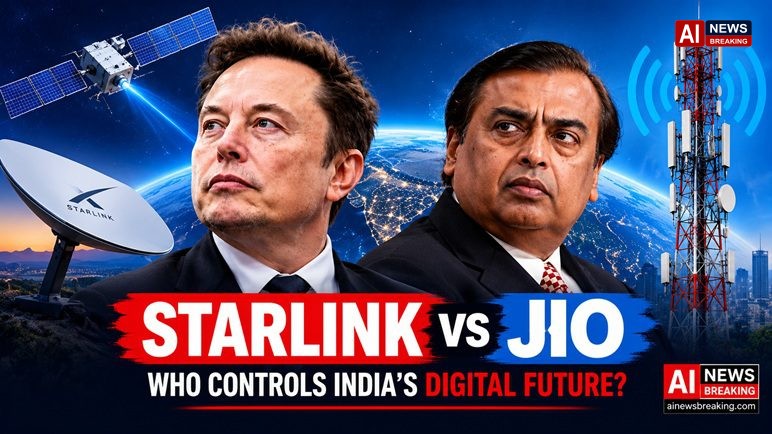
starlink reliance americas tech:
AI News Breaking Editorial Analysis | Special Editorial
By the Editorial Team, AI News Breaking
The escalating confrontation between Elon Musk’s Starlink and Mukesh Ambani’s Reliance Jio has exposed a larger battle over the future of India’s digital economy. Beneath the public exchange between two of the world’s most influential business leaders lies a critical question: who will control the infrastructure that connects India to the internet — Indian institutions and companies, or powerful global technology corporations?
The dispute has also revived concerns about American technological hegemony. From satellite communications and artificial intelligence to cloud computing, digital platforms and advanced semiconductors, US-based companies occupy influential positions across the global technology ecosystem. Their innovations have transformed modern life, but their growing reach raises questions about market concentration, national security, data governance and the ability of sovereign governments to regulate essential digital services.
For India, the challenge is not simply to choose between Musk and Ambani. It is to ensure that neither domestic corporate concentration nor foreign technological dominance undermines the national interest.
Key Highlights: What the Starlink–Jio Dispute Means
- Musk challenges Indian business interests: In October 2026, Elon Musk alleged that powerful business interests were obstructing Starlink’s Indian entry to protect existing market positions. He subsequently questioned Mukesh Ambani’s influence.
- The Indian government rejects discrimination allegations: The Ministry of Communications said the satellite communications approval framework was fair and non-discriminatory, with security assessments still required.
- Spectrum policy is at the centre of the disagreement: Reliance Jio argued for spectrum auctions, while Starlink supported administrative allocation. India ultimately chose administrative allocation for satellite communications spectrum.
- American technological power raises strategic questions: Dependence on foreign-controlled satellite infrastructure can create vulnerabilities involving service continuity, data governance and national security.
- India needs competition, not corporate protectionism: Consumers should benefit from better connectivity and reasonable prices, while the government safeguards security, transparency and domestic technological capacity.
1. The Musk–Ambani confrontation: A business dispute with national consequences
The latest controversy intensified in October 2026, when Musk accused unnamed Indian business interests of attempting to preserve their dominance by delaying Starlink’s commercial launch. He later directly questioned Ambani’s influence in India.
The Indian government rejected the suggestion that Starlink was being unfairly treated. According to reporting published on October 8, the government maintained that satellite operators were subject to a common regulatory framework and that security assessments remained an important requirement.
The regulatory history also complicates Musk’s argument. Starlink received its Indian satellite communications licence in June 2025, but a licence alone does not authorise immediate commercial operations. Further requirements, including security compliance and spectrum assignment, must be satisfied. Other licensed operators, including Jio Satellite Communications and OneWeb, have also faced regulatory requirements.
The distinction matters. A disagreement over regulation does not establish that a government is protecting a domestic billionaire, just as a company’s promise of improved connectivity does not establish that its entry should be exempt from security requirements.
The appropriate test is whether the rules are transparent, proportionate, consistently applied and subject to meaningful oversight.
2. What is American technological hegemony?
Hegemony, in international relations, refers to the ability of a powerful state or group to shape the rules, institutions and choices available to others. It does not necessarily mean direct political control. Influence can also emerge through economic dependence, technological standards, financial networks and control over critical infrastructure.
In the digital age, this influence increasingly operates through technology.
US companies have developed globally significant positions in satellite communications, cloud infrastructure, operating systems, social media, artificial intelligence and semiconductor design. Their products and services support businesses, governments, educational institutions and consumers across national borders.
This position provides substantial commercial advantages. It can also give companies considerable influence over how other countries access, process, store and transmit information.
Starlink represents one dimension of this shift. Rather than relying exclusively on terrestrial mobile towers and fibre-optic networks, satellite broadband can deliver connectivity through a constellation of satellites orbiting Earth. This can be particularly valuable in remote villages, mountainous regions, islands, disaster zones and border areas.
But a network that provides essential connectivity can also become strategically important infrastructure.
If a country relies heavily on an external provider, decisions made by that provider about prices, technical support, service availability or network operations may affect users far beyond the company’s home market.
This is the central concern behind the debate over technological hegemony: when technology becomes essential to national life, who has the power to determine the terms of access?
It is important, however, to distinguish corporate influence from government policy. Starlink is a US company, but its commercial decisions cannot automatically be treated as actions directed by the American government. The issue is the structural power created when essential technologies are concentrated in a small number of companies.
3. Starlink: Connectivity revolution or strategic dependence?
Starlink, operated by SpaceX, uses low-Earth-orbit satellites to provide broadband connectivity. Its technology has the potential to reach areas where building terrestrial infrastructure is difficult, expensive or commercially unattractive.
For India, this could offer significant public benefits.
Remote schools could obtain more reliable internet access. Health centres could use digital consultation services. Disaster-response teams could establish communications when conventional networks fail. Businesses operating in geographically isolated areas could connect to wider markets.
Satellite broadband could also provide additional resilience when terrestrial cables or mobile networks are disrupted.
These benefits should not be dismissed merely because the provider is American.
Yet the strategic questions are equally important.
Who controls network operations? How will Indian authorities enforce lawful interception requirements? What safeguards govern the handling of Indian users’ data? Can service be restricted during a legally authorised emergency? What happens if commercial or geopolitical tensions disrupt access?
These questions are not proof that Starlink will misuse its position. They are standard considerations whenever a foreign-controlled company supplies infrastructure that may become important to a country’s economy and security.
India must assess the actual technical architecture, contractual obligations, security arrangements and enforcement mechanisms rather than rely solely on corporate assurances.
The objective should be to obtain the benefits of satellite connectivity without creating an avoidable strategic dependency.
4. Reliance Jio’s position: Defending competition or protecting an established market?
Reliance Jio transformed India’s telecom sector by driving aggressive competition, expanding mobile data access and putting pressure on rival operators to lower prices. Its entry helped reshape consumer expectations about affordable connectivity.
However, Jio is also an established commercial player with major interests in India’s telecommunications market.
When Starlink sought to enter India, the disagreement over spectrum allocation became a central point of contention. Jio argued that satellite spectrum should be auctioned, while Starlink favoured administrative allocation.
These positions reflect competing economic arguments.
An auction can provide a transparent mechanism for allocating scarce spectrum and can help establish comparable costs between competing services. But expensive auctions may also make certain satellite services less viable, particularly when operators must serve sparsely populated areas.
Administrative allocation can reduce some barriers to entry and may be more suitable for certain satellite services, but it requires clear eligibility rules, transparent pricing and strong safeguards against preferential treatment.
India ultimately adopted administrative allocation for satellite communications spectrum, rather than the auction model sought by Jio.
That outcome is important. It demonstrates that the policy debate cannot simply be reduced to an American company fighting an Indian billionaire. Indian operators themselves have competing commercial interests, while the government must balance competition, public benefit, investment and national security.
There is no justification for assuming that every objection raised by an established domestic company is protectionist. Equally, domestic market leadership should not give any company the power to determine which competitors are allowed to enter.
The correct question is whether a policy serves the public interest.
5. The United States and the power of global technology corporations
American technological influence extends beyond satellite broadband.
Companies based in the United States occupy influential positions in cloud computing, AI models, digital advertising, mobile operating systems, social media and advanced chip design. Many countries depend on these services to operate businesses, communicate, conduct research and develop digital public services.
This creates a form of structural influence.
A company that supplies a critical platform may influence pricing, technical standards, access conditions and the pace of innovation. Where alternatives are limited, customers can face substantial switching costs.
Cloud computing illustrates the problem. Moving a large organisation’s databases, applications and security systems between providers can be expensive and technically difficult. Artificial intelligence raises similar concerns when businesses become dependent on a limited number of proprietary models, computing platforms or specialised chips.
Satellite communications adds another dimension because the physical network extends beyond a country’s territory.
The strategic question is not whether American technology is inherently undesirable. American innovation has produced substantial economic and social benefits worldwide. The question is whether countries have enough alternatives, bargaining power and regulatory authority to prevent commercial dependence from becoming excessive.
India should apply the same standard to technology providers from every country, including its own domestic champions.
6. Is technology becoming a new instrument of geopolitical power?
Modern geopolitical influence is exercised through more than military strength, trade agreements and diplomatic pressure.
Technology can shape the choices available to governments and businesses. Access to advanced computing, communications networks, chips, software and technical expertise increasingly affects economic competitiveness and national resilience.
Satellite communications is especially sensitive because connectivity can matter during conflicts, natural disasters and other emergencies.
The war in Ukraine has illustrated the strategic importance of satellite communications, including the role of commercial systems in maintaining connectivity. Such examples demonstrate the wider importance of private technology infrastructure during geopolitical crises.
They do not, by themselves, establish that a particular commercial provider will use its network to advance US foreign policy in India. Nevertheless, they show why governments must examine the relationship between corporate control and strategic dependence.
The broader lesson is that a commercial service may acquire geopolitical significance even when it was originally developed to meet civilian demand.
For India, this means satellite connectivity should be governed not merely as a consumer product but as infrastructure with potential economic, security and emergency-management implications.
7. India’s digital sovereignty: The real issue behind the feud
Digital sovereignty means a country’s ability to establish and enforce rules over its digital infrastructure, data, communications systems and technological development.
It does not require the country to manufacture every component domestically or reject foreign investment. In an interconnected economy, such complete independence would be unrealistic and often counterproductive.
Instead, digital sovereignty requires sufficient control to ensure that essential services remain reliable, secure, accountable and consistent with national law.
India has already recognised the strategic importance of satellite communications through its licensing and regulatory framework. The Department of Telecommunications has authorised multiple operators to provide satellite communications services, while the government has identified their potential to improve access in underserved and remote areas.
The next challenge is implementation.
India must ensure that companies comply with security conditions, lawful interception obligations and applicable rules governing operations within the country. It must also ensure that licensing requirements do not become opaque instruments for favouring particular businesses.
A sovereign regulatory system must be strong enough to control foreign providers and impartial enough to discipline domestic companies.
If India allows a foreign corporation to operate without adequate safeguards, it risks excessive dependence. If it protects an established domestic corporation from legitimate competition, it risks higher prices, weaker innovation and reduced consumer choice.
Neither outcome represents genuine digital sovereignty.
8. The consumer must not become a casualty of the billionaire rivalry
For millions of Indian households, the practical question is not whether Musk or Ambani wins a public argument. It is whether internet access becomes more affordable, dependable and widely available.
Satellite broadband is unlikely to replace terrestrial mobile networks and fibre in every setting. Its economics and performance vary according to location, capacity, equipment costs and service conditions.
However, it could be an important alternative in areas where conventional infrastructure is difficult to deploy.
Competition among Starlink, Jio-linked satellite services, OneWeb and future providers could create new options for consumers and businesses. The extent of that benefit will depend on pricing, coverage, network capacity, service quality and regulatory conditions.
India should therefore judge the market by measurable outcomes:
- More reliable connectivity in remote and underserved areas.
- Transparent prices and clear contractual terms.
- Effective protection of user data and network security.
- Fair opportunities for qualified domestic and international providers.
- Reliable service during emergencies and natural disasters.
- Greater choice without creating excessive dependence on any single company.
The government should also distinguish between satellite broadband and conventional mobile services when comparing their spectrum requirements, costs and competitive effects. Fairness does not always mean identical rules for technologies with different technical characteristics; it means that regulatory differences must have defensible public-interest reasons.
9. What India should do next
India needs a long-term strategy that combines competition, security and domestic technological development.
First, publish clear and consistent rules. The government should communicate licensing milestones, spectrum-assignment requirements, security conditions and the reasons for regulatory delays as transparently as national security permits. Companies should be able to understand what is required and how decisions can be challenged.
Second, enforce the same standards for all qualified operators. Starlink, Jio-linked satellite services, OneWeb and future entrants should face requirements proportionate to their technical systems and risks. No company should receive preferential treatment because of its nationality, market position or political influence.
Third, protect strategic control over communications. India must establish that licensed providers can meet applicable requirements for lawful interception, emergency response, service restrictions and security oversight. These safeguards should be technically enforceable, not merely written into agreements.
Fourth, build domestic capabilities. India should invest in satellite manufacturing, launch services, ground equipment, secure communications, semiconductor capabilities and research. Domestic capacity would increase resilience and bargaining power without requiring the exclusion of foreign companies.
Fifth, preserve consumer choice. Spectrum policy should be assessed against public benefit, efficient use of scarce resources, competition and the practical needs of different satellite services. Consumers should not bear unnecessary costs arising from disputes between powerful businesses.
Finally, avoid technological isolation. International partnerships can accelerate innovation and improve access to advanced systems. The objective should be to participate in global technology markets from a position of greater strength, not to withdraw from them.
10. Beyond Musk versus Ambani: A test of India’s strategic maturity
The Starlink–Jio dispute presents a difficult test for Indian policymakers.
Musk’s criticism raises legitimate questions about whether regulatory delays can discourage competition. But allegations of deliberate obstruction should be supported by evidence, particularly when official records indicate that other operators have also been awaiting clearances.
Reliance Jio’s arguments about spectrum allocation deserve examination on their merits. But an established operator should not be permitted to convert regulatory influence into an advantage that unnecessarily excludes competitors.
Likewise, Starlink’s technological capabilities should be evaluated objectively, without assuming that a foreign company is either a threat by definition or a solution to every connectivity problem.
India’s response should be guided by institutions, verifiable facts and the public interest rather than the personalities involved.
The larger question of American technological hegemony is real, but it should be examined precisely. Corporate concentration, dependence on foreign infrastructure and limited alternatives can create strategic vulnerabilities. Those risks require competition policy, regulatory oversight and investment in domestic capabilities—not unsupported claims that every commercial conflict is part of a geopolitical conspiracy.
The Editor’s Verdict: India must not exchange one monopoly for another
The Musk–Ambani confrontation is a reminder that the control of digital infrastructure is becoming a central issue of economic sovereignty.
India cannot afford to allow either foreign technological dominance or domestic corporate concentration to dictate the terms of its digital future. The country needs foreign investment, global innovation and strong Indian businesses. It also needs independent regulators, credible security safeguards and genuine competition.
The United States will continue to exercise considerable technological influence through companies that operate globally. India should respond by strengthening its own capabilities, diversifying critical infrastructure and ensuring that every provider operates under clear Indian law.
The goal is not to defeat an American entrepreneur or protect an Indian billionaire. It is to ensure that neither possesses excessive power over the choices available to Indian citizens.
The real test of digital sovereignty is not who owns the satellites or who wins the argument on social media. It is whether India retains the authority to set the rules, protect its people, encourage competition and guarantee that essential connectivity serves the national interest.
In the final analysis, India’s digital future must be determined by its citizens and institutions—not by the commercial ambitions of the world’s most powerful technology executives.