Indonesia denies foreign claim to rescued orangutans
 Turkey hosts COP31 climate talks in Antalya.
 Pope meets Argentine bishops.
 APOD: 2026 November 8 – Major Fireball Meteor
 Indonesian Horror Hit ‘Pabrik Gula’ Gets 2028 Sequel as MD Entertainment Lines Up Three Imax Films
Global AI Stock Sell-Off: Is the Artificial Intelligence Boom Turning Into a Financial Warning | AI News Breaking Editorial Analysis
The global AI investment boom faces a major reality check as Wall Street and Asian markets experience sharp technology-led losses. Are soaring AI valuations, data-centre spending and uncertain profits signalling a bigger financial risk?
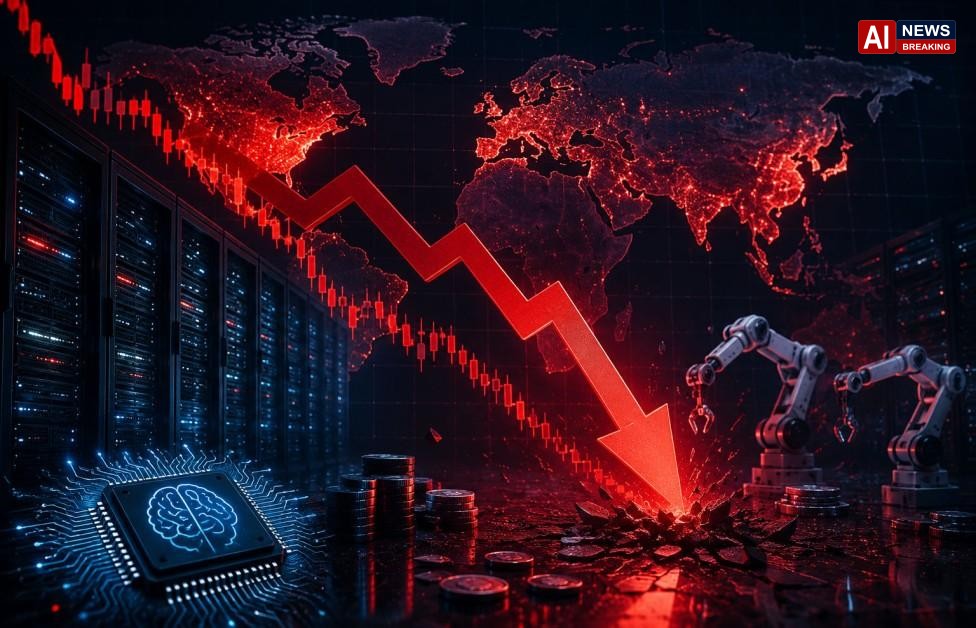
global stock selloff artificial:
Editorial Analysis · 6 November 2026
Wall Street’s technology sell-off has exposed growing concerns over AI valuations, massive data-centre investments and uncertain returns. As losses spread across Asian markets, the question is no longer whether artificial intelligence will transform the global economy, but whether investors have already priced in too much of its promised future.
The global artificial intelligence industry is facing an important financial reality test. After months of extraordinary enthusiasm surrounding AI companies, semiconductor manufacturers and data-centre infrastructure, investors are beginning to question whether the enormous amounts of money being invested in the technology can generate profits quickly enough to justify current valuations.
On November 5, US stock markets experienced one of their sharpest technology-led sell-offs in more than a year. The Nasdaq Composite plunged 5.5%, the S&P 500 declined 4.4%, and the Dow Jones Industrial Average fell 3.4%. The Nasdaq also moved into correction territory, trading nearly 12% below its October record closing high. AP News+1
The pressure quickly spread to Asian markets on November 6. Japan’s Nikkei and South Korea’s KOSPI suffered substantial declines, while semiconductor companies in Taiwan and South Korea faced intense selling pressure. South Korea’s KOSPI briefly fell more than 8%, triggering a temporary trading halt. AP News+1
This is more than an ordinary stock-market correction. It represents a growing debate about the economics of the AI revolution: whether technology companies are building infrastructure based on genuine future demand or whether financial markets have become too optimistic about the speed and scale of AI profitability.
For the global economy, and particularly for countries such as India that are increasingly connected to international technology and capital markets, the consequences deserve serious attention.
Key Highlights
- Wall Street sell-off: The Nasdaq fell 5.5% and the S&P 500 dropped 4.4% on November 5, 2026.
- Asian markets under pressure: Japan, South Korea and Taiwan experienced sharp declines as concerns spread across semiconductor and AI-related companies.
- AI investment questioned: Investors are reassessing whether massive spending on chips, servers and data centres will deliver adequate financial returns.
- Political uncertainty: The US midterm election results have raised questions about possible regulatory scrutiny and the future pace of data-centre development.
- Global economic implications: A prolonged AI-sector correction could affect technology investment, financing conditions, investor confidence and emerging markets, including India.
1. Wall Street’s sudden reality check: What triggered the AI stock sell-off?
The November 5 sell-off demonstrated how quickly investor sentiment can change when expectations surrounding a popular investment theme begin to weaken.
For months, AI-related companies had benefited from strong investor enthusiasm. Semiconductor manufacturers, cloud-computing businesses, data-centre operators and technology giants were regarded as major beneficiaries of an expanding AI economy.
However, several developments combined to challenge that optimism.
First, investors became increasingly concerned about the scale of spending required to build AI infrastructure. Technology companies are committing enormous capital to advanced processors, computing facilities, networking equipment and electricity infrastructure. The financial returns from these investments may take years to fully materialise.
Second, questions about AI profitability have become more important. Strong demand for artificial intelligence services does not automatically mean that every company building the infrastructure will earn attractive profits.
Third, political developments in the United States added another layer of uncertainty. The Democrats’ strong performance in the midterm elections raised investor concerns about potential regulatory scrutiny of data-centre expansion and possible changes to technology investment policy. Reuters+1
The result was a broad reassessment of technology valuations and the future earnings assumptions supporting them.
2. The numbers behind the market shock
The scale of the November 5 decline illustrates the concentration of risk in the global technology sector.
| Market indicator | November 5 performance |
|---|---|
| Nasdaq Composite | -5.5% |
| S&P 500 | -4.4% |
| Dow Jones Industrial Average | -3.4% |
| Philadelphia Semiconductor Index | -12.2% |
| Nasdaq from October record | Around -11.9% |
Source: Reuters and Associated Press market reports, November 5–6, 2026. Figures are reported closing or indicated benchmark changes, not live prices. AP News+2
The semiconductor sector experienced particularly severe pressure. Nvidia declined 9.3%, while Advanced Micro Devices (AMD) dropped 17.3% during the US session. AP News
These declines matter because semiconductor companies are central to the AI investment cycle. They supply the processors and computing components required to train and operate advanced AI systems.
When investors begin questioning future data-centre construction and computing demand, semiconductor valuations can come under pressure even if the long-term demand for AI remains substantial.
3. The biggest question: Who will pay for the AI revolution?
The AI industry has attracted extraordinary investment because businesses believe artificial intelligence can transform productivity, customer services, software development, manufacturing, research and financial operations.
However, the economic model must ultimately work.
Building an AI data centre is expensive. Companies need advanced chips, servers, cooling equipment, electricity, land, networking infrastructure and highly specialised employees. These facilities also require continuous maintenance and substantial operating expenditure.
The investment becomes financially sustainable only when the revenue generated by AI services, cloud computing and related products justifies the initial capital expenditure.
This raises an uncomfortable question for investors: What happens if the infrastructure is built faster than profitable demand develops?
Consider a hypothetical situation in which a company invests billions of dollars in computing capacity based on expectations of rapid customer growth. If customers subsequently reduce spending, negotiate lower prices or shift towards cheaper alternatives, the company’s expected returns could fall significantly.
The technology may still be useful. The problem would be the financial assumptions behind the investment.
That distinction is central to understanding the current market correction.
4. Is the AI industry creating a financial bubble?
The word bubble is increasingly appearing in discussions about artificial intelligence. But it is important to distinguish between a genuine technological revolution and excessive financial speculation surrounding that revolution.
Artificial intelligence is not a fictional business concept. It is already being used in software development, healthcare research, financial services, customer support, industrial automation and scientific applications.
The potential problem is that investors may be assigning valuations based on profits that have not yet materialised.
A company may possess advanced AI technology, millions of users and significant market influence, but its valuation can still become difficult to justify if operating costs remain high and commercial returns disappoint.
There are three major warning signs.
Valuations running ahead of earnings: Investors may be paying for years of anticipated growth before companies demonstrate that their AI operations can generate sustainable profits.
Capital expenditure without guaranteed returns: Large infrastructure commitments create financial obligations even when customer demand develops more slowly than expected.
Concentration of market performance: When a relatively small group of technology and semiconductor companies drives a large share of stock-market gains, a correction in those businesses can affect the wider market.
The current sell-off does not establish that an AI bubble has definitively burst. It does, however, demonstrate that investors are becoming less willing to accept optimistic growth assumptions without stronger evidence of profitability.
5. Data centres: The expensive foundation of the AI economy
Behind every major AI model is a substantial physical infrastructure network.
The global AI industry requires increasingly powerful computing facilities capable of processing enormous quantities of information. These facilities depend on advanced semiconductors, high-performance servers, electricity generation, cooling systems and high-speed connectivity.
Consequently, the AI investment boom has expanded beyond Silicon Valley and traditional software companies.
It now affects:
- Semiconductor manufacturers.
- Data-centre operators.
- Electricity and power-generation companies.
- Construction and engineering businesses.
- Telecommunications providers.
- Cloud-computing companies.
- Infrastructure lenders and private-credit investors.
This interconnected investment structure creates opportunities but also increases the potential for financial stress.
If demand for AI computing continues expanding, infrastructure investors could benefit substantially. However, if companies overestimate future demand, expensive facilities could remain underutilised.
The challenge is particularly significant because data-centre projects require long-term capital commitments. Unlike a software subscription that can be discontinued relatively quickly, infrastructure investments cannot always be reversed without substantial financial losses.
Reuters reported that concerns over the scale of AI infrastructure spending, its financing and the time required to generate returns were among the major factors behind the November 5 technology sell-off. Reuters+1
6. Debt financing: Could the AI boom become a credit-market problem?
One of the most important dimensions of the AI investment cycle is how companies are financing their expansion.
Technology businesses have historically used operating cash flow to fund substantial portions of their investment. However, the growing scale of data-centre construction and computing infrastructure has also increased the importance of external financing.
Debt can accelerate development, but it introduces additional risks.
A company that borrows to construct a data centre must repay its obligations regardless of whether the facility achieves its expected utilisation rate.
If AI demand grows rapidly, borrowing can support profitable expansion. If demand slows, the same debt can become a burden.
This creates a possible chain reaction:
- AI companies commit substantial funds to infrastructure.
- Infrastructure operators borrow to finance construction.
- Expected customer demand fails to develop at the anticipated pace.
- Revenue and cash flow fall below projections.
- Refinancing becomes more expensive or difficult.
- Lenders and investors reassess the value of their exposure.
Such a situation could extend the consequences of an AI-sector correction beyond the stock market.
It is not evidence that a banking crisis is imminent. The extent of the risk depends on borrower balance sheets, loan quality, collateral, financing structures and the ability of lenders to absorb losses.
Nevertheless, the relationship between AI investment and credit markets deserves greater attention.
7. The US political factor: Can regulation slow the AI infrastructure race?
The AI investment boom is no longer only a question of technology and corporate profitability. It has increasingly become a political and regulatory issue.
The United States is central to the global AI industry. Its technology companies, semiconductor ecosystem, cloud-computing infrastructure and financial markets play a major role in determining the direction of the sector.
The November 2026 midterm election results have introduced fresh uncertainty.
Investors are assessing whether the changed political balance in Washington could lead to greater scrutiny of data-centre construction, electricity consumption, environmental effects and the concentration of power among major technology companies.
There are legitimate public-interest questions surrounding the rapid expansion of AI infrastructure.
Who should bear the cost of additional electricity demand? Should communities receive greater influence over large data-centre projects? How should governments balance technological competitiveness with environmental protection and consumer interests?
These are important policy debates.
However, investors are concerned that additional restrictions, regulatory delays or political uncertainty could slow the pace of infrastructure expansion and affect the revenue expectations of companies supplying the AI industry.
The political dimension does not mean that AI development will stop. It means that the next phase of growth may face greater scrutiny over its economic, environmental and social consequences. Reuters+1
8. Why the Asian market reaction matters
The AI investment cycle is global, and Asia occupies a central position in its supply chain.
South Korea, Taiwan and Japan are important participants in the semiconductor, memory-chip, electronic-component and advanced manufacturing industries.
When investors reduce exposure to AI-related assets, the impact can spread quickly through these markets.
On November 6, South Korea’s KOSPI experienced an intraday decline exceeding 8%, triggering a temporary trading halt. Japan’s Nikkei also suffered a substantial fall, while Taiwanese semiconductor stocks faced significant selling pressure. Markets News – Business Standard+1
These developments highlight a major vulnerability in the global technology economy: the concentration of critical manufacturing and infrastructure within a relatively small number of companies and markets.
A slowdown in AI infrastructure investment could affect:
- Semiconductor orders and manufacturing capacity.
- Memory-chip prices and demand.
- Technology exports.
- Corporate earnings in Asia.
- Foreign investment flows.
- Regional stock-market confidence.
However, a market decline does not necessarily indicate a permanent deterioration in the underlying semiconductor industry. Investors may be repricing future expectations rather than forecasting the disappearance of demand.
The key issue is whether the decline in AI-related spending, if it occurs, will be temporary or structural.
9. What does the AI market correction mean for India?
India is not at the centre of the global semiconductor manufacturing ecosystem, but it is increasingly connected to the international AI economy.
Indian IT services companies, technology startups, digital platforms, data-centre developers and engineering businesses are all exposed to the global direction of AI investment.
A sustained global correction could affect India through several channels.
Indian IT services: If global businesses reduce technology budgets, Indian IT service providers could face pressure on discretionary projects. On the other hand, demand for AI integration, automation and cost-saving services could create new business opportunities.
Stock-market sentiment: A prolonged decline in global technology shares could influence investor appetite for technology and growth stocks in India. However, domestic earnings, valuations and economic conditions will remain important.
Foreign portfolio investment: If global investors move towards safer assets, emerging markets could experience capital outflows. The impact on India would depend on broader global risk conditions and domestic fundamentals.
Data-centre investment: Lower global confidence could make some infrastructure projects more expensive to finance or delay investment decisions. Projects with strong customer commitments and sustainable economics may remain attractive.
Employment and skills: Companies may accelerate automation to reduce costs. This could change hiring patterns, especially in technology services, while increasing demand for specialised AI, cybersecurity, cloud and data skills.
For India, the situation presents both a warning and an opportunity.
The country should not simply attempt to follow the global AI spending race. It should focus on developing commercially sustainable AI applications, strengthening domestic digital infrastructure, improving computing access and building skilled human capital.
The objective should be productive investment rather than investment driven entirely by global market enthusiasm.
10. Is this another dot-com bubble?
The comparison between the AI boom and the dot-com bubble of the late 1990s is difficult to avoid.
During the internet boom, investors poured money into companies based on expectations that the internet would transform business and society. Many businesses eventually failed, and the subsequent market crash destroyed enormous amounts of investor wealth.
Yet the internet itself did not fail. It became one of the foundations of the modern global economy.
Artificial intelligence may follow a similar pattern in one important respect: the technology could succeed even if many companies and investments associated with it fail.
However, the two periods are not identical.
Today’s major AI investors include established technology companies with substantial existing revenues, customers and infrastructure. This provides a different financial foundation from many speculative internet businesses of the late 1990s.
At the same time, large technology companies are making increasingly expensive commitments, and investors are attaching significant value to anticipated future AI growth.
The lesson is clear: a revolutionary technology does not guarantee revolutionary profits for every company involved.
The market must eventually distinguish between businesses with sustainable competitive advantages and those whose valuations depend on expectations that may be difficult to achieve.
11. What should investors and policymakers watch next?
The next phase of the AI market will depend less on ambitious announcements and more on measurable financial performance.
Investors should monitor:
- AI revenue growth: Are companies generating real commercial income from their AI products?
- Capital expenditure: Is spending increasing faster than operating cash flow?
- Profit margins: Are AI services becoming more profitable as technology improves?
- Data-centre utilisation: Are newly constructed facilities attracting sufficient customers?
- Debt exposure: Are AI infrastructure companies taking on excessive borrowing?
- Semiconductor demand: Are chip orders supported by genuine customer requirements?
- Regulatory developments: Will governments introduce policies that significantly change infrastructure investment economics?
Policymakers should also examine the concentration of critical AI infrastructure, financing risks, energy requirements and cybersecurity vulnerabilities.
Financial regulators need to understand how risks move between technology companies, private-credit funds, banks and infrastructure investors.
The goal should not be to discourage technological progress. It should be to ensure that the financial system can support innovation without becoming excessively dependent on unrealistic growth expectations.
AI News Breaking Editorial Analysis: The AI revolution must pass the profitability test
The November 2026 technology sell-off is a warning that the financial markets are entering a more demanding phase of the artificial intelligence revolution.
For years, investors rewarded companies for their AI ambitions, infrastructure commitments and promises of future technological leadership. Now they are asking a more fundamental question: where are the sustainable profits?
This is a necessary question for any major technological transformation.
Artificial intelligence has genuine potential to improve productivity, support scientific research, transform industries and create new economic opportunities. Its long-term importance should not be judged by a single day of stock-market losses.
But the financial markets must also recognise that technology investment involves risk. Not every data centre will generate exceptional returns. Not every AI startup will become profitable. Not every semiconductor company will benefit equally. And not every high valuation will survive a change in investor expectations.
The world should also avoid confusing the success of artificial intelligence with the success of every company associated with it.
The internet survived the dot-com crash. The companies that dominated the market before and after that crash were not necessarily the same. Artificial intelligence could experience a similar process of financial consolidation and technological advancement.
For India, the message is particularly important. The country should build its AI future around productivity, domestic capabilities, skilled employment and sustainable infrastructure rather than speculative investment alone.
The real question is not whether artificial intelligence will change the world. It almost certainly will. The real question is whether the financial system has mistaken the promise of that future for profits that have not yet arrived.
The AI revolution may be entering its most important test—not a test of technological capability, but a test of economic reality.
Editorial disclaimer: This article presents independent analysis of market developments and potential financial risks. A market correction does not establish that an AI bubble has burst, nor does it predict an inevitable global financial crisis. This editorial is not investment advice.