Indonesia denies foreign claim to rescued orangutans
 Turkey hosts COP31 climate talks in Antalya.
 Pope meets Argentine bishops.
 APOD: 2026 November 8 – Major Fireball Meteor
 Indonesian Horror Hit ‘Pabrik Gula’ Gets 2028 Sequel as MD Entertainment Lines Up Three Imax Films
Trump Strikes Iran Again While Qatar Pushes for Peace: Is Washington Choosing War or Diplomacy
Fresh US strikes on Iran have intensified tensions even as Qatar attempts to broker a peace deal. Explore Trump’s military strategy, Iran’s seven conditions, the nuclear dispute and the potential consequences for global oil markets and India.
Trump Strikes Iran Again While Qatar Pushes for Peace: Is Washington Choosing War or Diplomacy - AI News Breaking
AI News Breaking | 7 November 2026
The United States has carried out fresh limited strikes against Iran while diplomatic efforts led by Qatar continue to prevent a wider conflict. President Donald Trump is maintaining military pressure on Tehran, but Iran’s demands over sanctions, frozen assets, nuclear negotiations and the Strait of Hormuz present major obstacles to a settlement. Is Washington pursuing peace through military pressure, or is the Middle East moving towards another dangerous phase of war?
The US–Iran conflict has reached another critical moment. On November 6, US President Donald Trump confirmed that American forces had conducted fresh limited strikes against an Iranian air-defence installation near Qeshm Island, a strategically important location close to the Strait of Hormuz. The announcement came at a time when Qatar was attempting to bring Washington and Tehran closer to an agreement that could prevent the resumption of large-scale military operations.
The latest military action has exposed the contradiction at the centre of the conflict: while Washington and Tehran continue exchanging diplomatic proposals through intermediaries, military operations and threats remain part of their strategy.
Iran is demanding substantial concessions before agreeing to reopen the Strait of Hormuz and begin broader negotiations. The United States, meanwhile, wants its security concerns and Iran’s nuclear programme addressed as part of any durable settlement.
For Qatar, the challenge is to prevent the diplomatic process from collapsing under the pressure of military escalation.
For the rest of the world, the stakes extend far beyond the Middle East. The conflict threatens international shipping, energy security, global inflation and the economic stability of countries that depend on imported oil, including India.
Key Highlights
- Fresh US strikes: Trump confirmed limited American strikes against an Iranian air-defence system near Qeshm Island on November 6.
- Qatar’s peace initiative: Doha is working on a temporary confidence-building arrangement involving the US blockade, frozen Iranian funds, nuclear inspections and the reopening of Hormuz.
- Iran’s seven conditions: Tehran is demanding sanctions relief, the release of frozen assets, compensation and an end to military pressure, among other concessions.
- Nuclear disagreement: Iran has submitted a nuclear proposal through Qatar, but wants its wider demands addressed before detailed negotiations.
- Global economic threat: Continued disruption around Hormuz could affect oil shipments, shipping costs, fuel prices and inflation.
- India’s strategic concern: New Delhi must balance energy security, relations with Washington and Tehran, and the safety of its citizens and commercial interests in the region.
1. Trump confirms fresh strikes on Iran: What happened near Qeshm Island?
The latest escalation centres on Qeshm Island, located near the Strait of Hormuz in the Persian Gulf.
On Friday, November 6, Trump confirmed that US forces had carried out limited strikes against an Iranian air-defence installation in the area. He described the operation as a relatively minor military action, saying American forces had quickly destroyed the facility. Iranian state media reported explosions in the Suza area of Qeshm Island.
The location is strategically significant.
Qeshm lies close to one of the world’s most important maritime routes. Military installations in and around the island can influence the security environment of the Strait of Hormuz, through which a substantial share of internationally traded petroleum and liquefied natural gas passes.
The latest strike follows earlier US attacks in the same general area, which American officials described as defensive operations against Iranian missile threats.
Washington’s position is that limited military action is necessary to protect American assets and maintain security in the region.
Tehran, however, views American military operations as further evidence that Washington is continuing to apply force while simultaneously demanding negotiations.
That difference in interpretation creates a serious diplomatic problem. An operation described by one side as defensive can be considered an act of aggression by the other, increasing the possibility of retaliation.
The immediate question is whether the latest strikes will remain limited or become the starting point for another round of military confrontation.
2. Qatar’s peace proposal: Can diplomacy stop another round of war?
While military tensions continue, Qatar has emerged as one of the most important diplomatic intermediaries between Washington and Tehran.
Doha has been facilitating indirect communications, carrying proposals between the two governments and attempting to identify a temporary arrangement that could prevent further escalation.
According to the Associated Press, a proposed two-day confidence-building arrangement includes several important elements:
- The United States would lift its blockade.
- Washington would release some frozen Iranian funds.
- Iran would permit international nuclear inspectors to access sites damaged during earlier attacks.
- The Strait of Hormuz would reopen under a temporary arrangement.
- Broader negotiations would subsequently address Iran’s nuclear programme and other outstanding disputes. AP News
This proposal is significant because it attempts to separate immediate crisis management from the much more complicated negotiations over nuclear weapons, sanctions and regional security.
Instead of requiring both governments to resolve every disagreement immediately, Qatar’s approach seeks an initial agreement that could reduce military tensions and restore maritime activity.
However, the proposal faces a fundamental obstacle: Washington and Tehran disagree over which concessions should come first.
The United States wants meaningful commitments on Iran’s nuclear programme and regional security. Iran wants sanctions relief, the removal of the American blockade and the release of its frozen assets before proceeding with broader negotiations.
A temporary arrangement may therefore be easier to achieve than a comprehensive peace agreement.
But even a temporary understanding could be important if it prevents further attacks and restores confidence in international shipping.
3. Iran’s seven conditions: Why Tehran is refusing to negotiate without concessions
Iran has made clear that it does not intend to enter broader negotiations simply because Washington is willing to discuss a ceasefire.
On November 5, a senior Iranian official told Reuters that Tehran had sent a nuclear proposal to the United States through Qatar. However, the official said the proposal would be discussed only after Washington addressed Iran’s seven demands.
Iran’s demands include:
- Lifting US sanctions.
- Releasing frozen Iranian financial assets.
- Providing compensation for war-related damage.
- Ending the US naval blockade.
- Addressing the wider military confrontation and regional hostilities.
- Recognising Iran’s demands concerning the Strait of Hormuz.
- Establishing conditions for negotiations that Tehran considers acceptable.
The precise wording and complete legal terms of the seven conditions have not been independently established in the publicly available reporting. The points above summarise the demands described by Iranian officials and reporting on the negotiations, rather than a verified complete text of a formal agreement.
Iran’s position reflects a broader strategic calculation.
Tehran does not want to enter negotiations from a position in which it believes Washington can continue imposing military and economic pressure without making concessions.
The Iranian leadership also wants assurances that any agreement will not simply become a temporary pause before another American or Israeli military operation.
Washington, on the other hand, is unlikely to accept an arrangement that leaves its central nuclear and regional security concerns unresolved.
This is where the negotiations face their greatest difficulty.
Both governments want the other side to make the first major concession.
4. The nuclear question: The biggest obstacle to a permanent settlement
The Iranian nuclear programme remains at the heart of the conflict.
For Washington and its regional partners, Iran’s nuclear capabilities represent a major security concern. The central objective of American policy is to prevent Iran from developing a nuclear weapon and to establish credible verification of its nuclear activities.
Tehran maintains that its nuclear programme is peaceful and rejects what it considers excessive external restrictions on its sovereign rights.
The issue has become more complicated following attacks on Iranian nuclear facilities.
The International Atomic Energy Agency has reported that Iran possessed approximately 440.9 kilograms of uranium enriched to 60% before the conflict’s disruption of monitoring and verification. This material is not the same as a confirmed stockpile of weapons-grade uranium, but enrichment to this level is a major proliferation concern because it is much closer to weapons-grade enrichment than ordinary civilian nuclear fuel. AP News
The condition of the material, its location and the extent of current international access are critical questions.
Without reliable inspections, the international community cannot confidently establish the full status of Iran’s nuclear programme.
This makes the proposed IAEA inspection arrangement particularly important.
If Iran allows meaningful verification at damaged nuclear sites, it could create an opening for further negotiations. If access remains restricted, Washington may argue that a temporary ceasefire does not adequately address the underlying nuclear threat.
A durable settlement will therefore require more than an agreement to stop military operations. It will need a credible monitoring mechanism that addresses the concerns of both sides.
5. Why the Strait of Hormuz has become Iran’s strongest strategic bargaining point
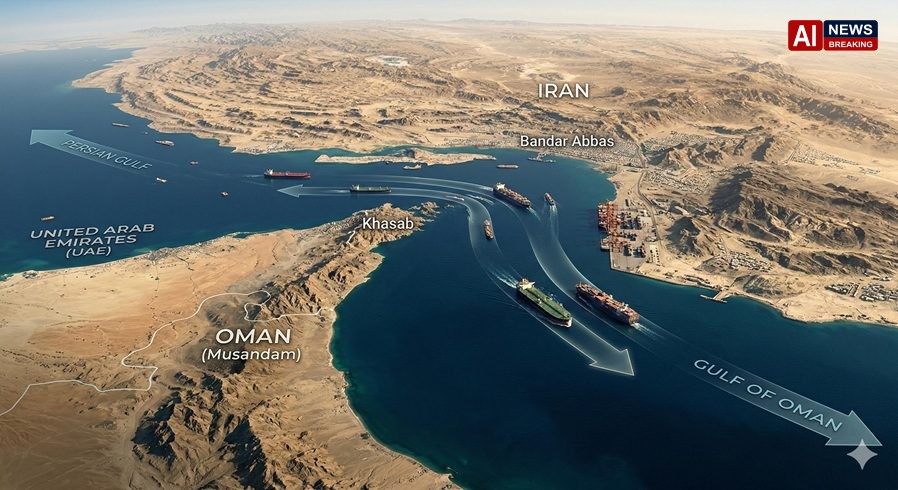
The Strait of Hormuz is arguably the most important geographical factor in the current confrontation.
This narrow maritime passage connects the Persian Gulf with the Gulf of Oman and the wider Arabian Sea.
Its importance is enormous because it provides a major route for oil and gas exports from Gulf producers to international markets.
Iran’s ability to threaten or restrict maritime traffic in the region gives Tehran strategic leverage that extends well beyond its conventional military capabilities.
For the United States, keeping the waterway open is a major international security and economic objective.
For Iran, the strait has become an important bargaining instrument in negotiations over sanctions, military pressure and regional security.
The disagreement is not simply about whether ships should be allowed to pass.
It also concerns who controls maritime security, which shipping arrangements are recognised, what role foreign military forces should play and whether Iran can obtain economic concessions in return for restoring normal traffic.
This creates a dangerous situation for the international community.
Even without a formal declaration that the strait is permanently closed, attacks, threats, insurance restrictions and military activity can discourage commercial shipping.
A waterway does not need to be physically blocked to become economically inaccessible.
That is why the future of Hormuz is central to any agreement between Washington and Tehran.
6. Trump’s strategy: Military pressure or negotiated settlement?
Trump’s approach towards Iran raises an important strategic question.
Is Washington using military force to strengthen its negotiating position, or is it moving towards a policy in which military escalation has become an alternative to diplomacy?
The latest strikes suggest that the administration wants to maintain military pressure while leaving diplomatic channels open.
There are potential advantages to this strategy from Washington’s perspective.
Military operations can demonstrate American capabilities, damage selected Iranian installations and signal that further attacks may carry consequences.
However, military pressure does not necessarily translate into political success.
Iran has demonstrated that it can use geographical advantages, regional alliances, missile capabilities and disruption risks to impose costs on its opponents.
Even if American forces achieve tactical military objectives, Washington still needs an agreement that addresses the long-term security problems surrounding the Persian Gulf.
There is also a political dimension.
The November 2026 US midterm elections have weakened the Republican Party’s political position, with Democratic gains increasing the prospect of congressional scrutiny of the administration’s policies. The economic consequences of the war, particularly fuel prices and public frustration, have become important political considerations. The Wall Street Journal+1
Trump therefore faces a difficult calculation.
Continuing the military campaign could demonstrate determination but risk additional casualties, higher energy costs and further political opposition.
Accepting a diplomatic settlement could reduce those costs, but it may require concessions that the administration considers strategically difficult.
The challenge is not simply winning a military confrontation. It is finding a political outcome that Washington can defend domestically and internationally.
7. Israel’s role: Can the US and Iran reach peace without resolving the wider regional conflict?
The US–Iran confrontation cannot be understood as an isolated dispute between two countries.
Israel remains a major factor in the security calculations of both Washington and Tehran.
Israel considers Iran’s nuclear programme, missile capabilities and regional military relationships significant national security threats. Iran, meanwhile, views Israeli military operations and American support for Israel as central elements of the regional conflict.
The war has also affected other parts of the Middle East.
The confrontation involving Israel and Iran-backed Hezbollah in Lebanon, together with attacks linked to the Houthis in Yemen, has expanded the geographical risks associated with the conflict. Reuters has reported that the fighting and related attacks have affected regional infrastructure and security interests beyond Iran itself. Investing.com+1
This raises a difficult question for Qatar’s mediation effort:
Can Washington and Tehran agree to stop fighting while other regional confrontations remain unresolved?
A bilateral understanding could reduce the immediate danger, but it might not eliminate the underlying tensions.
A lasting settlement would need to address regional security guarantees, attacks on shipping, the role of armed groups, Israeli security concerns and the possibility of renewed military action.
Without a broader regional framework, even a successful US–Iran agreement could remain fragile.
8. Russia’s involvement: Is Moscow becoming an important diplomatic player?
Russia is another important participant in the changing diplomatic landscape.
Iranian security official Mohsen Rezaei travelled to Moscow and delivered a message from Iran’s Supreme Leader to Russian President Vladimir Putin, according to Iranian statements reported during the latest diplomatic developments. Russia has expressed willingness to support efforts to end the conflict.
Moscow has several reasons to remain involved.
First, Russia maintains strategic relations with Iran and has an interest in preventing a regional conflict from developing in ways that could threaten its wider geopolitical position.
Second, the conflict affects international energy markets, shipping routes and the balance of power across the Middle East.
Third, Russian involvement offers Tehran another diplomatic channel beyond Qatar and other regional intermediaries.
However, Russia’s role should not be exaggerated. There is no confirmed evidence that Moscow can independently deliver an agreement acceptable to both Washington and Tehran.
Its diplomatic influence may be useful, but the decisive negotiations will still depend on the positions taken by the United States and Iran.
9. The global economic consequences: Why the world cannot ignore this war
The US–Iran conflict is not only a military and diplomatic crisis. It is also a major risk to the global economy.
The most immediate concern is energy security.
The Persian Gulf is a critical source of oil and natural gas for international markets. Any prolonged disruption to shipping through Hormuz can create uncertainty about supply availability and increase the cost of transporting energy.
The economic effects can spread through several channels.
Oil prices: Supply uncertainty can increase crude oil price volatility, affecting importing countries and energy-intensive industries.
Shipping costs: Tankers may face higher insurance premiums, longer routes and increased security expenses.
Inflation: Higher energy and transport costs can raise the prices of goods, food distribution, manufacturing and services.
Currency markets: Countries that depend heavily on imported energy may face pressure on their currencies if their import bills increase.
Central-bank policy: Persistent energy inflation could make it more difficult for central banks to reduce interest rates.
Global trade: Businesses may delay investment and shipments because of uncertainty over the security of major trade routes.
The consequences would be particularly difficult for developing economies with large energy-import requirements.
Even countries that are geographically distant from the Middle East could experience the economic effects through higher fuel prices, currency pressure and weaker investor confidence.
The conflict therefore has the potential to become a global economic problem even if the actual military operations remain concentrated in the Persian Gulf.
10. India in the middle: Energy security, diplomacy and national interests
For India, the US–Iran conflict is particularly sensitive.
India maintains important relationships with both the United States and Iran. Washington is a major strategic, technological and economic partner, while Tehran has historical, geographical and economic significance for India’s regional interests.
India also has substantial energy requirements and remains exposed to fluctuations in international crude oil prices.
A prolonged disruption in the Strait of Hormuz could create several economic challenges.
First, crude oil imports: Higher international oil prices could increase India’s import bill and put pressure on the current account balance.
Second, petrol and diesel prices: Sustained increases in crude prices could eventually affect domestic fuel costs, transport expenses and household budgets, depending on government policy and oil-company pricing decisions.
Third, the rupee: Higher energy-import costs could contribute to pressure on the Indian currency, particularly if accompanied by foreign capital outflows.
Fourth, inflation: Increased fuel, logistics and production costs could affect food distribution, manufacturing and consumer prices.
Fifth, Indian citizens in the Gulf: A wider conflict could create security and evacuation challenges for Indian nationals living and working across the region.
There is also a strategic dimension.
India has invested in connectivity projects involving Iran, particularly the Chabahar port, which offers an important potential route towards Afghanistan and Central Asia.
A prolonged confrontation could complicate India’s regional connectivity ambitions and its ability to maintain balanced relations with the countries involved.
What should India’s diplomatic approach be?
India should continue to support de-escalation, respect for international law, maritime security and a negotiated settlement.
New Delhi should avoid allowing its relations with either Washington or Tehran to become a casualty of the wider confrontation.
At the same time, India must prepare for possible energy-market disruption through diversified supplies, strategic petroleum reserves, alternative shipping arrangements and close monitoring of international oil prices.
India’s national interest lies in a stable Middle East, secure maritime routes and freedom to maintain constructive relations with all major regional and international partners.
11. Three possible scenarios: What happens next in the US–Iran conflict?
The next phase of the conflict will depend on whether the two governments can translate diplomatic proposals into an enforceable arrangement.
Three broad scenarios are possible.
Scenario 1: A temporary ceasefire and reopening of Hormuz
Diplomatic outcome
The most favourable scenario would involve Qatar successfully negotiating an initial agreement.
The United States could ease its blockade and release agreed frozen funds, while Iran could permit inspections at damaged nuclear sites and restore maritime passage through the Strait of Hormuz.
Such an arrangement could create the conditions for wider negotiations on sanctions, uranium enrichment and regional security.
However, a temporary agreement would not automatically end the conflict’s underlying political and military tensions.
Scenario 2: Limited military operations continue alongside negotiations
Continued uncertainty
A second possibility is that Washington and Tehran continue exchanging diplomatic proposals while conducting or threatening limited military operations.
This would create a prolonged period of uncertainty.
Neither government would formally abandon diplomacy, but neither would be prepared to make the concessions required for a comprehensive agreement.
For international markets, this could mean continuing volatility in oil prices, shipping insurance, energy stocks and regional currencies.
Scenario 3: Renewed major military escalation
Highest regional risk
The most dangerous scenario would involve further American strikes followed by Iranian retaliation against US interests, Israeli targets or regional infrastructure.
If the confrontation expands, the Strait of Hormuz could become even more dangerous for commercial shipping.
Other regional actors could become involved, increasing the possibility of a wider Middle Eastern war.
This scenario would carry the greatest economic and humanitarian costs.
It could also make future diplomatic negotiations more difficult because military escalation would deepen mistrust and increase political pressure on both governments.
12. What must happen for a lasting peace agreement?
A durable settlement requires more than a temporary pause in military operations.
The United States and Iran must address several difficult questions:
- Nuclear verification: What level of uranium enrichment will Iran be permitted to maintain, and how will the IAEA verify compliance?
- Sanctions relief: Which sanctions can Washington remove, and what conditions must Tehran meet?
- Frozen assets: How much Iranian money can be released, and under what arrangements?
- Maritime security: Can both sides agree on safe and predictable commercial shipping through the Strait of Hormuz?
- Military de-escalation: What guarantees can prevent further attacks by either side?
- Regional security: How will the agreement address Israel, Lebanon, Yemen and other regional flashpoints?
- Enforcement: What mechanism will ensure that commitments are honoured and disputes do not immediately lead to renewed fighting?
These are complex issues, and they cannot be resolved through military statements or temporary political understandings alone.
Qatar’s diplomatic initiative may provide a starting point, but a lasting agreement will require sustained negotiations and credible guarantees.
America can win battles, but can it secure peace?
The latest US strikes against Iran reveal the central contradiction in Washington’s approach to the conflict.
On one side, the United States is demonstrating its military capabilities and maintaining pressure on Tehran. On the other, it is allowing Qatar to pursue diplomatic arrangements that could prevent another major escalation.
This raises a fundamental question about modern American foreign policy: can military superiority deliver a political settlement when the opposing country retains strategic leverage over geography, energy supplies and regional security?
The answer is not straightforward.
The United States has considerable military and economic power, but Iran’s position around the Strait of Hormuz gives it influence that cannot be understood solely through conventional military comparisons.
Similarly, Iran may be able to disrupt regional security and international energy markets, but prolonged confrontation carries enormous costs for its own economy and population.
Neither side can easily secure all its objectives through continued military pressure.
The danger is that both governments may believe that further escalation will improve their negotiating positions. History shows that such calculations can produce prolonged conflicts in which the economic and humanitarian costs grow faster than the prospects of political success.
Qatar’s mediation therefore deserves international attention. Even a temporary agreement that restores shipping, allows nuclear inspections and reduces military pressure could provide an important opportunity for wider negotiations.
For India, the priority should be clear: protect national energy interests, maintain balanced diplomatic relationships and support a peaceful resolution based on international law.
For the international community, the Strait of Hormuz should not become a permanent instrument of geopolitical confrontation.
The United States may have the power to strike Iran, and Iran may have the ability to disrupt one of the world’s most important energy corridors. But neither military strength nor geographical leverage can guarantee lasting peace.
The real test of leadership in the Middle East will not be who can deliver the next military strike. It will be who can prevent the next war.