Europe warns of Russia’s hybrid attacks but struggles to counter them
  Former chief election commissioner calls SIR scheme illegal.
  A Corruption Scandal Is Reshaping Brazil’s Presidential Election
  US citizen injured in Illinois after ICE agents mistook him for fugitive, tried to arrest him
  At 10 years old, Smithsonian’s Black museum is undaunted amid pressure from Trump administration
 India Assembly Election Results 2026: BJP Sweeps Bengal and Assam, TVK Disrupts Tamil Nadu, Congress Returns in Kerala Full Seat Share Analysis
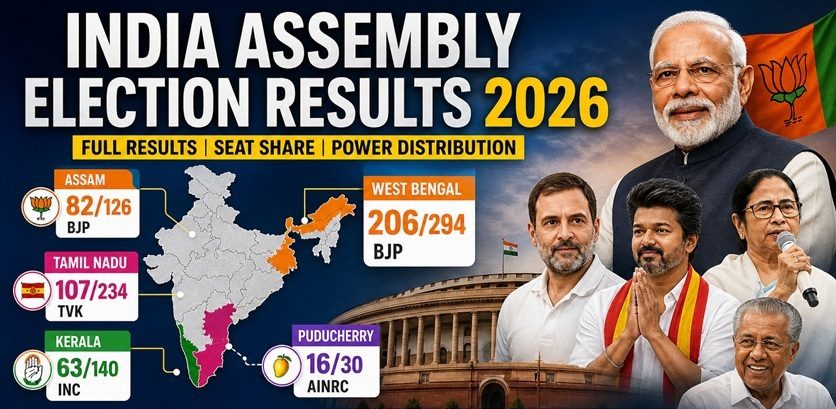
The India Assembly Election Results 2026 have delivered a politically transformative mandate across five key regions—West Bengal, Tamil Nadu, Kerala, Assam, and Puducherry—reshaping the balance of power ahead of the next national electoral cycle. The results, when viewed through a seat share and power distribution lens, reveal a striking mix of dominance, disruption, and coalition-era realities.
From the Bharatiya Janata Party’s (BJP) historic surge in West Bengal to the emergence of Tamilaga Vettri Kazhagam (TVK) as a major force in Tamil Nadu, and the Congress-led resurgence in Kerala, the 2026 elections underline a critical shift: Indian politics is becoming increasingly regionally diverse yet structurally polarized.
Seat Share as the Real Story: Understanding the 2026 Verdict
While raw seat counts provide a snapshot, seat share percentage offers deeper insight into how decisively a party has won a state. In a first-past-the-post (FPTP) system like India’s, even modest vote advantages can translate into overwhelming legislative control.
The 2026 results highlight three distinct patterns:
- High dominance states (above 60% seat share)
- Stable majority states (50–60%)
- Fragmented or coalition-driven mandates (below 50%)
These patterns are clearly visible across the five states.
West Bengal: BJP’s Structural Landslide Rewrites Political History
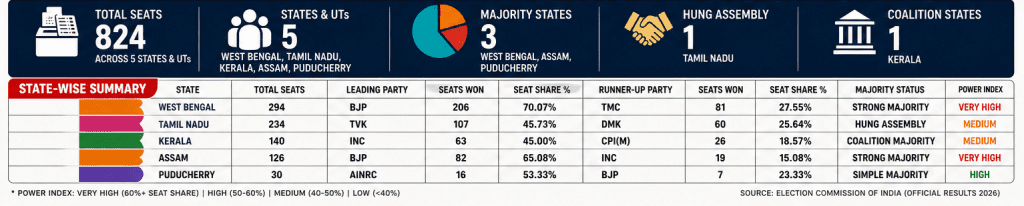
West Bengal delivered the most dramatic outcome of the election cycle. The BJP secured 206 out of 294 seats, translating to a commanding 70.07% seat share, firmly placing it in the “very high power” category.
The Trinamool Congress (TMC), which had dominated the state for over a decade, was reduced to 81 seats (27.55%), marking a significant political reversal.
This result is not just a victory—it is a structural landslide. A seat share exceeding 70% indicates:
- Deep penetration across regions
- Consolidation of swing voters
- Efficient vote-to-seat conversion
For BJP, this win signals:
- Expansion into eastern India
- Successful localization of national narratives
- Strong organizational groundwork
For TMC, the result raises strategic questions about:
- Anti-incumbency management
- Electoral alliances
- Leadership recalibration
West Bengal now stands as one of the strongest pillars of BJP’s expanding political geography.
Assam: BJP Consolidates Its Northeast Stronghold
In Assam, the BJP replicated its dominance with 82 out of 126 seats, achieving a 65.08% seat share—another “very high power” outcome.
The Congress trailed significantly with 19 seats (15.08%), while regional players like AGP and BOPF secured 10 seats each (7.94%).
The Assam result demonstrates:
- Stability over volatility
- Continued voter confidence in incumbent governance
- Strong alliance management in the Northeast
Unlike Bengal, where change drove the mandate, Assam reflects continuity politics, where governance delivery, welfare schemes, and regional leadership played decisive roles.
With both Bengal and Assam delivering high seat shares, BJP’s eastern corridor strategy has clearly paid off.
Tamil Nadu: TVK’s Breakthrough Creates a New Political Axis
Tamil Nadu produced the most disruptive and unpredictable outcome. Actor-turned-politician Vijay’s party, Tamilaga Vettri Kazhagam (TVK), emerged as the single largest party with 107 seats, accounting for a 45.73% seat share.
However, this falls short of the majority mark (118), placing the state in a hung assembly scenario.
The traditional Dravidian giants saw mixed fortunes:
- DMK: 60 seats (25.64%)
- AIADMK: 47 seats (20.09%)
This marks a historic break from decades of bipolar politics in Tamil Nadu.
Key implications:
- Rise of third-force politics
- Fragmentation of traditional vote banks
- Increased importance of post-poll alliances
TVK’s nearly 46% seat share is remarkable for a debut force, indicating:
- Strong urban and youth support
- Effective campaign messaging
- Anti-incumbency against established parties
Tamil Nadu now enters a coalition negotiation phase, making it the most politically fluid state post-results.
Kerala: Congress-Led UDF Returns with Coalition Stability
Kerala’s results reaffirm its traditional pattern of alternating power. The Congress-led United Democratic Front (UDF) secured 63 seats, translating to a 45.00% seat share.
The CPI(M)-led Left Democratic Front (LDF) managed 26 seats (18.57%), while allies like IUML added 22 seats (15.71%).
Unlike Bengal or Assam, Kerala reflects a balanced, coalition-driven structure:
- No single party crosses 50%
- Governance depends on alliance cohesion
The UDF’s victory signals:
- Effective consolidation of minority and urban votes
- Strategic alliance coordination
- Strong anti-incumbency sentiment
For Congress, Kerala represents:
- A critical morale boost
- Proof of regional competitiveness
- A foundation for broader national revival
Puducherry: NDA Maintains Control with Comfortable Majority
In the Union Territory of Puducherry, the All India N.R. Congress (AINRC) led the charge with 16 out of 30 seats, achieving a 53.33% seat share.
The BJP secured 7 seats (23.33%), reinforcing the NDA’s overall control in the region.
With a simple majority secured, Puducherry falls into the “high power” category, indicating:
- Stable governance outlook
- Limited fragmentation
- Continued voter preference for incumbency
Though smaller in scale, Puducherry’s result adds to the NDA’s broader narrative of regional stability and alliance effectiveness.
| State | Leading Party | Seats Won | Seat Share % | Runner-Up | Seats | Seat Share % | Majority Status | Power Index* |
|---|---|---|---|---|---|---|---|---|
| West Bengal | BJP | 206 | 70.07% | TMC | 81 | 27.55% | Strong Majority | 🔴 Very High |
| Tamil Nadu | TVK | 107 | 45.73% | DMK | 60 | 25.64% | Hung Assembly | 🟡 Medium |
| Kerala | INC | 63 | 45.00% | CPI(M) | 26 | 18.57% | Coalition Majority | 🟡 Medium |
| Assam | BJP | 82 | 65.08% | INC | 19 | 15.08% | Strong Majority | 🔴 Very High |
| Puducherry | AINRC | 16 | 53.33% | BJP | 7 | 23.33% | Simple Majority | 🟢 High |
National Power Map: What the Seat Share Data Reveals
When aggregated, the 2026 election results reveal a multi-layered national political structure:
1. BJP’s Expansion and Efficiency
- Dominant in West Bengal and Assam
- High seat conversion efficiency
- Strong regional penetration beyond traditional strongholds
2. Congress’ Selective Revival
- Strong comeback in Kerala
- Competitive presence in other states
- Still reliant on alliances
3. Rise of New Political Forces
- TVK in Tamil Nadu disrupts legacy politics
- Signals growing voter openness to alternatives
4. Coalition Politics Still Relevant
- Tamil Nadu and Kerala highlight coalition dependency
- Regional alliances remain decisive
Seat Share vs Political Power: Why It Matters
Seat share is not just a statistic—it defines:
- Legislative control
- Policy-making ability
- Stability of governance
For example:
- 70%+ seat share (Bengal) → near-total control
- 45% seat share (Tamil Nadu) → negotiation-driven governance
- 53% seat share (Puducherry) → stable but not overwhelming power
This distinction is critical for:
- Investors
- Policy analysts
- Political strategists
Implications for 2029 General Elections
The 2026 assembly results serve as a strategic preview for the 2029 Lok Sabha elections.
Key takeaways:
- BJP’s eastern expansion strengthens its national base
- Congress gains a revival platform but needs broader wins
- Regional players can significantly alter electoral equations
Tamil Nadu, in particular, could become a battleground state in national politics due to TVK’s emergence.
AI Insights: A Fragmented Yet Decisive Mandate
The India Assembly Election Results 2026 present a complex but clear message:
- Voters are willing to deliver decisive mandates where convinced
- Yet equally open to fragmented outcomes where alternatives emerge
From BJP’s dominance in Bengal and Assam to TVK’s disruption in Tamil Nadu and Congress’ comeback in Kerala, the electoral map reflects a dynamic and evolving democracy.
As India moves closer to the next general election cycle, these results will shape:
- Political alliances
- Campaign strategies
- Governance priorities
In essence, the 2026 elections are not just about who won—they are about how power is distributed, and that distribution will define India’s political trajectory in the years ahead.