Europe warns of Russia’s hybrid attacks but struggles to counter them
  Former chief election commissioner calls SIR scheme illegal.
  A Corruption Scandal Is Reshaping Brazil’s Presidential Election
  US citizen injured in Illinois after ICE agents mistook him for fugitive, tried to arrest him
  At 10 years old, Smithsonian’s Black museum is undaunted amid pressure from Trump administration
 Indian Railways Nears Complete Electrification Milestone: Only 269 Route Kilometres Remain Across Five States
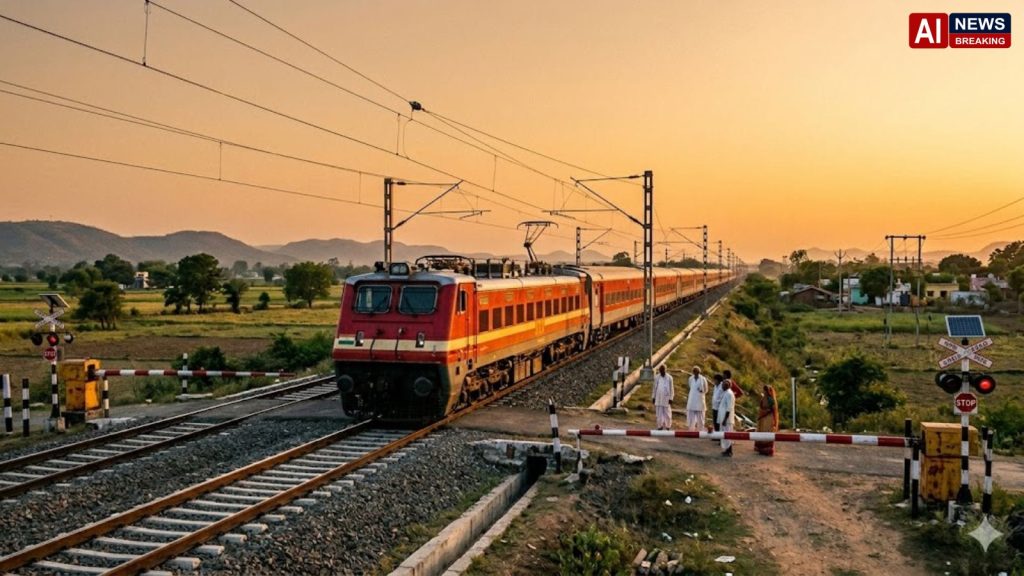
Indian Railways Consumes Nearly 3 Billion Units of Electricity Every Month to Power World's Fourth-Largest Rail Network - AI News Breaking
Indian Railways is approaching a historic infrastructure milestone with nearly 100% electrification of its broad-gauge network. Only 269 route kilometres remain to be electrified across five states, marking the final stretch of one of the world’s largest railway modernisation drives. Officials say the achievement will significantly reduce fuel costs, emissions, and dependence on imported diesel.
For more than a century, the rhythmic chug of diesel locomotives defined India’s vast railway landscape—snaking through plains, cutting across mountains, and connecting remote villages with metropolitan hubs. Today, that sound is steadily being replaced by the quieter hum of electric traction as Indian Railways moves within striking distance of a complete electrification milestone.
According to senior railway officials involved in infrastructure planning, only 269 route kilometres of broad-gauge track remain to be electrified across five states. Once completed, the Indian Railways network will be virtually 100 percent electrified, placing it among the largest fully electrified railway systems in the world.
This transition is not merely technical. It represents a structural transformation of India’s transportation backbone—one that affects energy consumption, logistics costs, industrial competitiveness, and environmental sustainability on a national scale.
A Multi-Decade Transformation Nears Completion
The electrification drive has unfolded over several decades, but its pace accelerated sharply in the last ten years. What once seemed like a gradual modernization plan has now become one of the most ambitious infrastructure overhauls undertaken by the Indian state.
At independence, Indian Railways operated entirely on steam locomotives. Dieselization began in the mid-20th century, bringing greater efficiency and range. However, it also introduced dependence on imported crude oil and fluctuating global fuel prices.
Electric traction was introduced selectively on high-density corridors, but for decades it remained limited due to infrastructure constraints and the sheer scale of India’s rail network.
The turning point came in the late 2010s, when policymakers began treating electrification not as a supplementary upgrade, but as a core national priority. Budgetary allocations increased, project approvals were streamlined, and execution timelines were tightened.
As a result, what once progressed at a cautious pace is now nearing completion across thousands of kilometres of track.
The Final 269 Kilometres: A Symbolic Threshold
The remaining 269 route kilometres are distributed across five states, primarily in sections that are either geographically challenging, operationally complex, or located in lower-density corridors.
Railway engineers describe such residual stretches as the “last-mile electrification problem”—where earlier phases naturally prioritised high-traffic routes, leaving less commercially dense lines for the final stage.
While officials have not released a detailed public breakdown of each section, the remaining work typically involves:
- Partial corridor upgrades where feeder infrastructure is still being completed
- Signalling integration with electrified sections
- Bridge and tunnel adjustments for overhead equipment clearance
- Coordination with state utilities for uninterrupted power supply lines
Despite being numerically small in comparison to India’s overall railway network—which spans more than 65,000 route kilometres—the remaining sections often require disproportionately careful execution due to terrain and operational continuity requirements.
Economic Implications: Cutting Fuel Costs and Import Dependence
One of the most immediate impacts of full electrification is expected in operating expenditure.
Diesel locomotives have historically accounted for a significant portion of Indian Railways’ fuel bill. With global oil prices remaining volatile, this exposure has long been considered a structural vulnerability.
Electric traction, by contrast, offers:
- Lower energy cost per tonne-kilometre
- Reduced maintenance requirements for locomotives
- Higher hauling capacity with modern electric engines
- Better acceleration and operational efficiency
Railway economists estimate that complete electrification can save thousands of crores annually in fuel expenditure alone, although the exact figure depends on electricity pricing, demand cycles, and freight composition.
Moreover, electrification shifts fuel dependency from imported crude oil to domestically generated electricity. Given India’s expanding renewable energy capacity, this transition also aligns with broader energy security goals.
Environmental Impact: A Major Step Toward Emissions Reduction
Beyond economics, electrification carries significant environmental consequences.
Rail transport is already one of the most energy-efficient modes of transportation. However, diesel locomotives still contribute to greenhouse gas emissions and local air pollution, especially along densely populated corridors.
By replacing diesel traction with electric locomotives, Indian Railways is expected to reduce:
- Carbon dioxide emissions
- Nitrogen oxide and particulate emissions along rail corridors
- Noise pollution in urban and semi-urban zones
The environmental benefits are further amplified when the electricity supply increasingly comes from renewable sources such as solar and wind power.
India has set ambitious climate targets, including achieving net-zero emissions by mid-century. Rail electrification is widely viewed as one of the most impactful sectoral contributions toward those goals.
Operational Efficiency and Network Capacity Gains
Electrification is not only about cleaner energy—it also changes how the railway network operates.
Electric locomotives offer higher horsepower and faster acceleration, enabling:
- Reduced travel time for passenger trains
- Improved punctuality across congested routes
- Higher average speeds on freight corridors
- Better line capacity utilization
In high-density sections, the shift to electric traction allows for tighter scheduling intervals between trains, effectively increasing the carrying capacity of existing infrastructure without laying new tracks.
This is particularly important for freight movement, where Indian Railways competes with road transport and must maintain both cost and time efficiency.
Strategic Infrastructure: Powering Freight Corridors
A significant portion of the electrification drive has been aligned with Dedicated Freight Corridors (DFCs) and industrial supply chains.
Freight trains carrying coal, cement, steel, fertilizers, and agricultural goods form the backbone of India’s logistics ecosystem. Electrification enhances their reliability and reduces per-unit transport costs, which can have cascading effects on commodity pricing.
For industries, improved rail logistics can translate into:
- Lower input costs
- Faster inventory turnover
- Reduced dependence on road haulage
- Lower carbon footprint for supply chains
In a competitive global manufacturing environment, these gains are increasingly seen as strategic rather than incremental.
Engineering Scale: One of the Largest Projects in Railway History
The scale of Indian Railways electrification is difficult to compare globally.
Few countries operate railway networks of comparable size, and even fewer have attempted full-scale electrification across such diverse terrain—ranging from Himalayan foothills and desert regions to coastal belts and dense urban corridors.
The engineering challenges include:
- High-altitude installations in cold regions
- Flood-prone zones requiring resilient infrastructure
- Wildlife corridors demanding careful overhead design
- Urban stretches with limited clearance for overhead electrification equipment
Each of these environments requires tailored engineering solutions, making electrification a highly decentralized and context-specific process.
Institutional Push and Policy Continuity
A key factor behind the acceleration of electrification has been sustained policy continuity.
Unlike earlier phases where infrastructure projects often experienced delays due to funding cycles or administrative bottlenecks, recent years have seen:
- Dedicated electrification task forces
- Increased capital expenditure allocations
- Faster tendering and execution processes
- Greater coordination between central and zonal railway authorities
Officials have also emphasized standardized designs and modular execution models, allowing contractors to replicate successful installation frameworks across different regions.
The Role of Renewable Energy Integration
Another emerging dimension is the integration of renewable energy into railway operations.
Indian Railways has begun investing in solar and wind energy projects to power stations, workshops, and in some cases traction loads. While grid electricity remains the primary source for electrified lines, the long-term vision includes reducing the carbon intensity of railway electricity consumption.
This creates a layered sustainability model:
- Electrification reduces diesel use
- Renewable energy reduces emissions from electricity generation
- Efficiency improvements reduce total energy demand per kilometre
Together, these changes push the system toward a lower-carbon operational baseline.
Challenges That Remain Beyond Electrification
Even as electrification nears completion, Indian Railways faces broader structural challenges.
These include:
- Aging infrastructure on older routes
- Congestion in high-traffic corridors
- Need for modernization of signalling systems
- Passenger comfort and service quality improvements
- Financial sustainability amid rising capital expenditure
Electrification solves one major dimension of modernization, but it also increases expectations for further reforms in speed, reliability, and safety.
The Symbolism of Completion
The final stretch of 269 kilometres carries symbolic weight far beyond its numerical size.
It marks the end of an era defined by diesel dependency and the beginning of a fully electrified national rail grid. For policymakers, it is a demonstration of long-term infrastructure planning. For engineers, it is the culmination of decades of incremental technical progress. For passengers and freight operators, it represents a quieter, faster, and more efficient railway experience.
In a country where railways are not just a mode of transport but a national institution, such a transition carries cultural significance as well.
Looking Ahead
Once electrification reaches completion, attention is likely to shift toward:
- Increasing average train speeds
- Expanding semi-high-speed corridors
- Upgrading signalling to advanced digital systems
- Further integration with multimodal logistics hubs
- Enhancing passenger amenities and safety systems
The electrification milestone, while historic, is therefore not an endpoint but a foundation for the next phase of railway modernization.
The near-completion of Indian Railways’ electrification is less about a single infrastructure upgrade and more about a systemic energy transition within one of the world’s largest transport networks. Its long-term significance lies in decoupling rail logistics from global oil volatility while integrating it more deeply with India’s evolving electricity grid. The real strategic impact will depend on how effectively electrification is paired with renewable energy expansion, signalling modernization, and freight corridor optimization—otherwise, efficiency gains may plateau despite full electrification.