Europe warns of Russia’s hybrid attacks but struggles to counter them
  Former chief election commissioner calls SIR scheme illegal.
  A Corruption Scandal Is Reshaping Brazil’s Presidential Election
  US citizen injured in Illinois after ICE agents mistook him for fugitive, tried to arrest him
  At 10 years old, Smithsonian’s Black museum is undaunted amid pressure from Trump administration
 India-UK Free Trade Deal Explained: Key Benefits, Economic Gains, and What It Means for Businesses and Consumers
The India-UK Free Trade Agreement has come into effect, promising to boost bilateral trade, reduce tariffs, and create new opportunities for businesses and workers in both countries, with significant benefits for sectors such as textiles, automobiles, and pharmaceuticals.
indiauk free trade deal:
News Summary:
- The India–United Kingdom Free Trade Agreement officially came into effect on 15 July 2026.
- The India-UK Free Trade Agreement (FTA) is expected to significantly boost bilateral trade, reduce tariffs, and create new opportunities for businesses and workers in both countries.
- The deal will benefit sectors such as textiles, automobiles, pharmaceuticals, technology services, and alcoholic beverages while strengthening economic ties between the two nations.
- Experts believe the agreement could become one of India’s most important trade partnerships, enhancing exports, investment, and job creation.
India and the United Kingdom have concluded a landmark Free Trade Agreement (FTA) that promises to reshape economic relations between the two countries. The trade pact is being hailed as one of India’s most comprehensive bilateral economic agreements in recent years and is expected to unlock billions of dollars in additional trade and investment opportunities. The India–United Kingdom Free Trade Agreement officially came into effect on 15 July 2026.
The agreement comes at a time when both nations are seeking to diversify their economic partnerships, strengthen supply chains, and create new growth opportunities in an increasingly competitive global economy.
For India, the deal offers improved market access for its exports, greater investment opportunities, and enhanced mobility for professionals. For the United Kingdom, it opens the door to one of the world’s fastest-growing major economies while providing businesses with easier access to Indian markets.
But what exactly does the India-UK trade deal include, and who stands to benefit the most?
What Is the India-UK Free Trade Agreement?
A Free Trade Agreement is a treaty between countries that aims to reduce or eliminate tariffs, simplify trade regulations, and promote economic cooperation.
The India-UK FTA seeks to:
- Lower import and export duties.
- Increase bilateral trade.
- Promote investments.
- Improve market access.
- Facilitate services and professional mobility.
- Strengthen economic partnerships.
The agreement covers multiple sectors, including manufacturing, agriculture, technology, services, and consumer goods.
Major Economic Gains for India
1. Boost to Indian Exports
One of the biggest advantages of the agreement is increased access to UK markets for Indian exporters.
Indian products expected to benefit include:
- Textiles and garments.
- Leather products.
- Gems and jewellery.
- Pharmaceuticals.
- Engineering goods.
- Food products.
- Marine exports.
- Chemicals and plastics.
Reduced tariffs make Indian goods more competitive in British markets, potentially increasing export volumes significantly over the coming years.
The UK remains one of India’s important export destinations, and the trade agreement is expected to strengthen this position further.
2. Increased Employment Opportunities
Higher exports often translate into greater domestic production requirements.
Industries likely to benefit from increased employment include:
- Textile manufacturing.
- Leather processing.
- Food processing.
- Pharmaceuticals.
- Information technology services.
- Engineering and manufacturing.
Small and medium enterprises (SMEs) may particularly benefit as export opportunities expand under simplified trade arrangements.
3. Better Market Access for Services
India’s services sector contributes substantially to its economy.
The agreement provides opportunities in:
- Information technology.
- Financial services.
- Professional services.
- Consulting.
- Education.
- Digital services.
Indian technology firms and service providers are expected to gain easier access to UK clients and business opportunities.
This is especially important given India’s position as a global leader in IT and business process management services.
Benefits for Indian Professionals
One of the most significant aspects of the agreement involves provisions that improve mobility for professionals.
Potential beneficiaries include:
- IT professionals.
- Engineers.
- Architects.
- Financial experts.
- Consultants.
- Researchers.
Simplified procedures and greater recognition of professional qualifications can help skilled Indian workers access opportunities in the UK more efficiently.
Educational cooperation and talent mobility provisions could further strengthen India’s growing global workforce.
Major Benefits for the United Kingdom
Lower Tariffs on British Goods
British exporters will gain improved access to India’s large consumer market.
Products expected to benefit include:
- Automobiles.
- Luxury goods.
- Machinery.
- Medical devices.
- Cosmetics.
- Consumer products.
Reduced tariffs make British goods more affordable for Indian consumers and businesses.
Boost for the UK’s Manufacturing Sector
British manufacturers stand to benefit from:
- Increased exports.
- Expanded consumer access.
- Lower trade barriers.
- Enhanced investment opportunities.
The Indian market’s growing middle class presents enormous commercial potential for UK businesses across multiple industries.
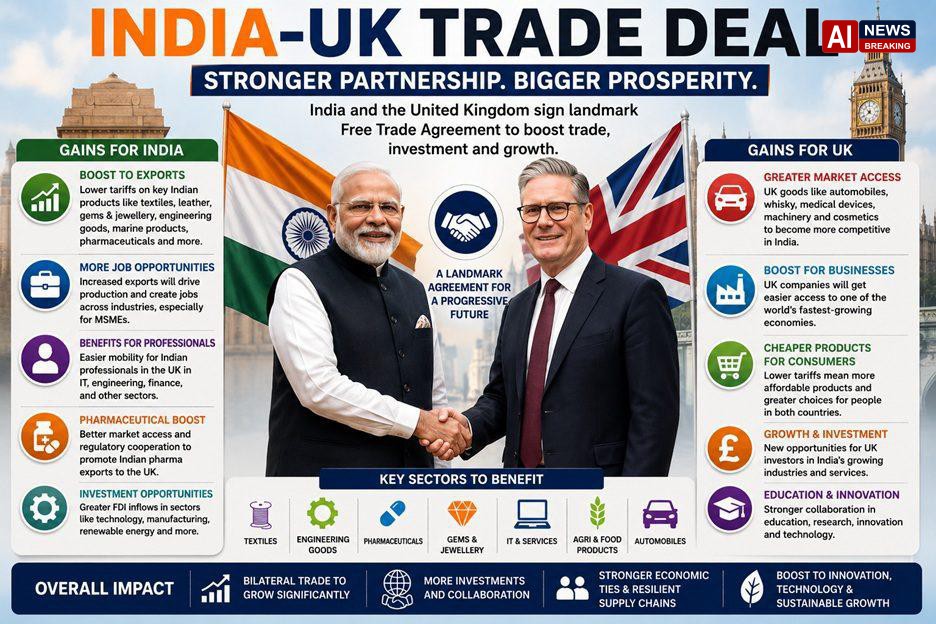
Cheaper Products for Consumers
Consumers in both countries are likely to benefit from lower tariffs.
Indian Consumers Could See:
- Reduced prices on certain imported British products.
- Greater product choices.
- Increased competition among brands.
UK Consumers Could See:
- More affordable Indian goods.
- Expanded access to Indian products.
- Competitive pricing in several categories.
Trade agreements often improve consumer welfare by lowering costs and increasing market competition.
Impact on the Automobile Sector
The automobile industry is expected to be among the biggest beneficiaries.
UK Gains
British automobile manufacturers could benefit from:
- Reduced import duties.
- Better access to India’s expanding automobile market.
- Increased premium vehicle sales.
India Gains
Indian auto component manufacturers may experience:
- Higher exports.
- New supply chain opportunities.
- Increased foreign investment.
The agreement could deepen manufacturing collaboration between automotive industries in both nations.
Textile Industry Expected to Gain Significantly
India’s textile and apparel sector is expected to emerge as one of the biggest winners.
Potential advantages include:
- Zero or reduced tariffs.
- Increased export competitiveness.
- Greater market share in the UK.
- Employment generation.
India is among the world’s leading textile producers, and improved market access could provide substantial growth opportunities for exporters.
The textile industry also supports millions of workers across the country, making export growth economically significant.
Pharmaceutical Sector Opportunities
India’s pharmaceutical industry has earned a global reputation for affordable and high-quality medicines.
The trade agreement could facilitate:
- Greater pharmaceutical exports.
- Faster regulatory cooperation.
- Improved market access.
- Expanded healthcare partnerships.
The UK’s healthcare sector offers considerable opportunities for Indian pharmaceutical companies.
Investment Opportunities
The agreement is expected to encourage greater investment flows in both directions.
Potential Areas Include:
- Technology.
- Manufacturing.
- Renewable energy.
- Infrastructure.
- Financial services.
- Healthcare.
- Artificial intelligence.
- Digital innovation.
British investment could support India’s economic development priorities, while Indian companies may expand their footprint in UK markets.
Strategic Importance of the Trade Deal
Beyond economics, the India-UK trade deal carries strategic significance.
It strengthens:
- Bilateral diplomatic relations.
- Economic cooperation.
- Supply chain resilience.
- Global trade partnerships.
- Innovation ecosystems.
For India, the agreement aligns with its broader strategy of expanding trade partnerships with major global economies.
For the UK, it supports post-Brexit efforts to deepen economic engagement with fast-growing markets worldwide.
Challenges That Remain
While the agreement presents substantial opportunities, some challenges remain.
These include:
Regulatory Compliance
Businesses must adapt to:
- New standards.
- Documentation requirements.
- Trade regulations.
Competition
Domestic industries may face increased competition from imported products.
Implementation
Effective implementation will determine whether businesses fully realize the agreement’s potential benefits.
Governments will need to ensure:
- Smooth customs procedures.
- Transparent regulations.
- Efficient dispute resolution mechanisms.
What Does It Mean for India’s Economy?
Economists expect the agreement to contribute positively to India’s economic growth by:
- Increasing exports.
- Generating employment.
- Attracting investment.
- Strengthening manufacturing.
- Enhancing global competitiveness.
The deal also supports India’s ambition of becoming a major global manufacturing and services hub.
With bilateral trade expected to grow substantially over the coming years, businesses across sectors are likely to explore new commercial opportunities arising from the agreement.
Key Takeaways
The India-UK trade deal is expected to deliver several major benefits:
| Sector | Expected Gains |
|---|---|
| Textiles | Increased exports and jobs |
| Pharmaceuticals | Better UK market access |
| IT Services | Improved professional mobility |
| Automobiles | Reduced tariffs and investment opportunities |
| Consumers | Lower prices and more choices |
| Manufacturing | Higher production and exports |
| Investment | Greater bilateral capital flows |
| SMEs | New export opportunities |
The India-UK Free Trade Agreement marks an important milestone in the economic relationship between two major democracies. By lowering trade barriers and creating new opportunities for businesses, workers, and investors, the deal has the potential to generate significant economic benefits for both nations.
While successful implementation will be key to unlocking its full value, the agreement positions India and the United Kingdom to strengthen their economic partnership in an increasingly interconnected global marketplace.
The India-UK trade deal reflects a broader shift in global trade dynamics, where strategic partnerships are becoming increasingly important for economic resilience and growth. For India, the agreement provides an opportunity to expand exports, attract investments, and enhance its position as a global services and manufacturing hub. For the UK, access to India’s rapidly growing economy offers significant long-term commercial advantages. If effectively implemented, the deal could serve as a model for future trade agreements that balance economic growth, consumer benefits, and strategic cooperation in the post-pandemic global economy.