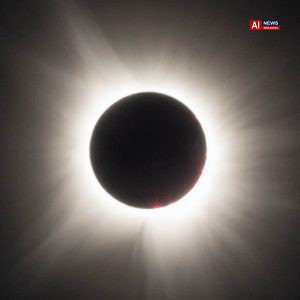
 Total Solar Eclipse August 12, 2026 Live Updates: Rare Celestial Event Darkens Skies Across Greenland, Iceland and Spain
  Parliament Monsoon Session Day 18: Lok Sabha Adjourned Amid Opposition Protests as Amit Shah Offers Debate on Students’ Agitation
  Trump tariffs prompt Canadian firms to move
  US deports Juan Carlos to Eswatini
  KSHRC Appoints Expert to Monitor Waste Management in Thiruvananthapuram
 Total Solar Eclipse August 12, 2026 Live Updates: Rare Celestial Event Darkens Skies Across Greenland, Iceland and Spain
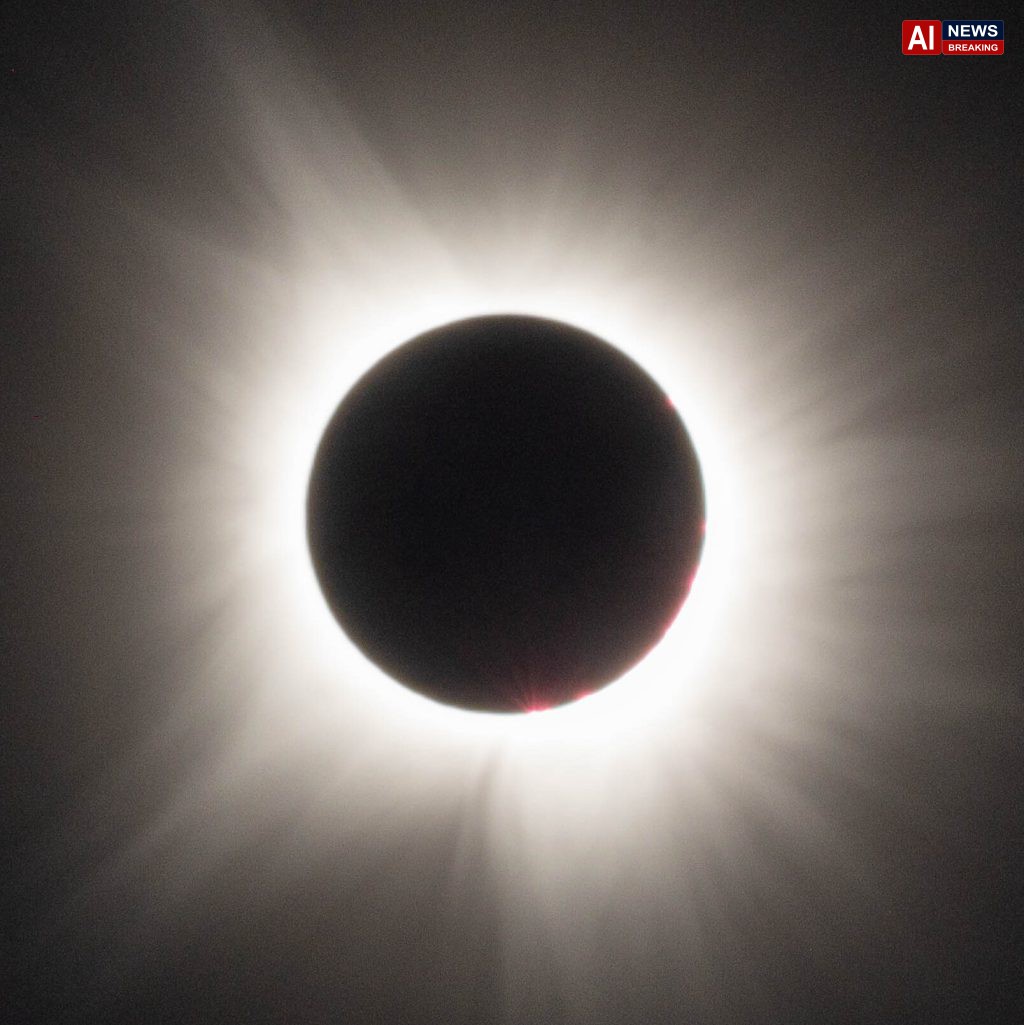
Total Eclipse - AI News Breaking
The only total solar eclipse of 2026 is sweeping across parts of the Northern Hemisphere on Wednesday, August 12, creating a rare spectacle for observers in Greenland, Iceland, northern Russia, Spain and a small part of Portugal. Millions more people across Europe, North America and northern Africa can witness a partial eclipse.
The eclipse is drawing astronomers, photographers and skywatchers to the path of totality, where the Moon completely blocks the Sun for a brief period. Scientists are also using the event to study the Sun, Earth’s atmosphere and the effects of a rapidly changing solar environment.
Total Solar Eclipse 2026: A Rare Skywatching Event Begins
The world’s attention has turned to the sky on Wednesday as a spectacular total solar eclipse crosses the Northern Hemisphere.
The August 12, 2026 eclipse is the only total solar eclipse occurring this year, making it one of the most anticipated astronomical events of 2026. The Moon is passing directly between Earth and the Sun, temporarily blocking the Sun’s visible disk for observers positioned inside a narrow path of totality.
According to NASA, the total eclipse is crossing Greenland, Iceland, northern Russia, the Atlantic Ocean, Spain and a small section of Portugal. A much wider region will experience a partial eclipse, including parts of North America, Canada, Europe and northwestern Africa.
The event is particularly significant because total solar eclipses are relatively rare at any one location. The Moon’s shadow creates a narrow corridor across Earth’s surface, meaning that even people relatively close to the path may see only a partial eclipse.
For those directly under the Moon’s umbra, however, daylight temporarily gives way to darkness as the Moon completely covers the bright face of the Sun.
What Is Happening During the Eclipse?
A solar eclipse occurs when the Moon moves between Earth and the Sun and casts its shadow onto Earth’s surface.
A total solar eclipse happens when the apparent size of the Moon is large enough to completely cover the Sun’s bright photosphere.
During totality, observers can see the Sun’s outer atmosphere, known as the corona. Normally, the corona is overwhelmed by the intense brightness of the solar disk and cannot easily be viewed with the naked eye.
The August 12 eclipse provides observers with a short window in which the corona becomes visible around the dark silhouette of the Moon.
NASA says that for most locations inside the path of totality, complete darkness will last for less than two minutes. Near the centre of the eclipse path, totality can last slightly longer, but remains under two and a half minutes.
That short duration is one reason eclipse chasers travel thousands of kilometres to position themselves along the centreline.
Where Will the Total Eclipse Be Visible?
The path of totality is relatively narrow compared with the enormous area where the partial eclipse can be seen.
The eclipse begins its journey across northern Russia before moving toward Greenland and Iceland. The Moon’s shadow then crosses the North Atlantic before reaching the Iberian Peninsula.
Northern Spain is among the most accessible and heavily anticipated locations for viewing totality.
A small area in northwestern Portugal also falls within the path.
NASA identifies Greenland, Iceland and Spain as major regions where totality will be visible, while northern Russia also experiences the complete eclipse.
The exact experience varies substantially depending on location.
In northern Russia, totality occurs around the middle of the day. Greenland and Iceland experience the event later in the afternoon or evening. In Spain and the far northwestern part of Portugal, totality occurs close to sunset.
This creates another visually striking possibility: a total or deeply eclipsed Sun appearing close to the horizon.
Iceland Becomes a Major Eclipse-Watching Destination
Iceland is one of the most important viewing locations for the 2026 eclipse.
Reykjavík is within the path of totality, giving residents and visitors an opportunity to experience the Moon completely covering the Sun.
NASA’s published local circumstances indicate that Reykjavík’s partial eclipse begins at 4:47 p.m., with totality beginning at 5:48 p.m. and ending at 5:49 p.m. local time. The partial phase concludes at 6:47 p.m.
The narrow timing makes weather conditions particularly important.
Even though eclipse geometry can be calculated years in advance with extraordinary precision, clouds can determine whether an observer actually sees the event.
That is why professional eclipse chasers often monitor weather forecasts closely and remain prepared to travel to another location within the path.
Spain Prepares for a Spectacular Eclipse
Spain is expected to be one of the most accessible locations for witnessing the 2026 total solar eclipse.
Several cities lie close to or within the path of totality, including León, Zaragoza and Valencia.
NASA’s eclipse timetable lists totality beginning at approximately 8:28 p.m. in León, 8:29 p.m. in Zaragoza and 8:32 p.m. in Valencia, with totality lasting roughly one to two minutes depending on the location.
The timing also creates a dramatic visual effect because the eclipse occurs relatively late in the day.
In some locations, the partial eclipse continues toward sunset.
This means photographers have an opportunity to capture the eclipsed Sun against a darkening horizon, provided atmospheric conditions remain favourable.
Millions More Will See a Partial Eclipse
The total eclipse is confined to a narrow corridor, but the partial eclipse covers a much larger portion of Earth.
NASA says partial phases will be visible from parts of Alaska, Canada, the northern United States, much of Europe and northwestern Africa.
In the United States, the eclipse will be visible at varying levels from Alaska and northern regions toward the eastern and northeastern parts of the country.
However, most people in the continental United States will not experience totality.
Instead, they will see the Moon cover only part of the Sun’s disk.
The percentage of solar coverage changes according to location.
For example, NASA’s figures show Anchorage experiencing a substantially deeper partial eclipse than cities farther south and east. Boston will see a smaller fraction of the Sun covered, while Detroit experiences only a small partial eclipse.
This distinction is crucial.
A partial eclipse can still be visually impressive, but it does not produce the same sudden darkness and view of the solar corona associated with totality.
Why Totality Is So Special
The defining moment of a total solar eclipse occurs when the Moon completely covers the Sun.
As the last bright portion of the solar disk disappears, daylight can rapidly diminish.
The sky may take on unusual colours, temperatures can fall, and the landscape can appear dramatically different.
Observers inside the path may see the Moon’s dark disk surrounded by the Sun’s faint corona.
Bright stars and planets can also become visible during totality.
The experience lasts only briefly.
As the Moon continues moving across the Sun, sunlight begins to return. The partial phase then continues until the Moon has completely moved away from the solar disk.
The entire event can last hours at a given location, but totality itself is measured in minutes or even seconds.
Eclipse Safety: The Most Important Rule
Despite the excitement surrounding the event, experts continue to emphasise one essential safety rule: never look directly at the Sun during the partial phases without proper solar eye protection.
Ordinary sunglasses are not sufficient.
NASA recommends certified solar viewing glasses, handheld solar viewers or other safe solar filters designed specifically for direct solar observation.
The danger remains even when the Sun appears partially covered.
In fact, a partially eclipsed Sun can still be bright enough to cause serious eye injury if viewed directly without appropriate protection.
During the brief period of totality, when the Moon completely blocks the Sun’s bright surface, direct viewing is safe. However, protection must be put back on immediately as soon as any part of the bright solar disk reappears.
People unable to obtain appropriate solar viewers can use indirect viewing methods, such as a simple pinhole projector.
Scientists Also Watch the Eclipse
The eclipse is more than a spectacular public event.
Scientists use solar eclipses as natural experiments.
When the Moon blocks direct sunlight, researchers can study the solar corona and investigate how the Sun’s atmosphere behaves.
The corona contains extremely hot plasma and is closely connected to solar activity and space weather.
Observations made during eclipses can complement measurements from spacecraft and ground-based solar observatories.
The temporary reduction in sunlight also creates an opportunity to study Earth’s atmosphere.
As solar radiation suddenly decreases along the eclipse path, researchers can observe changes in atmospheric temperature, winds and ionisation.
Previous eclipse studies have shown that eclipses can produce measurable changes in atmospheric and ionospheric conditions.
The 2026 event therefore provides both an extraordinary public spectacle and a valuable scientific opportunity.
The Role of Weather
For eclipse observers, astronomical precision is only half the equation.
The Moon’s position can be predicted with extraordinary accuracy, but weather cannot.
Clouds are one of the biggest threats to eclipse viewing.
Iceland, Greenland and parts of northern Spain have different weather patterns, and even small differences in cloud cover can determine whether an observer gets a clear view.
This is why eclipse tourism has become increasingly sophisticated.
Visitors often travel to locations where historical weather statistics provide a better chance of clear skies.
Some experienced eclipse chasers even prepare multiple backup locations.
If clouds threaten the primary viewing location, they may drive or travel elsewhere within the path of totality.
A Global Audience Watches Online
The eclipse is also becoming a global digital event.
People outside the path of totality can follow live broadcasts from observatories and astronomy organisations.
Online coverage allows viewers to watch the Moon’s shadow travel across the planet even when the eclipse is not visible from their location.
Timeanddate is among the organisations providing live coverage, with a stream focused on the eclipse’s progression across Russia, Greenland, Iceland and Spain.
Digital broadcasts are particularly important for people in regions where only a minor partial eclipse is visible or where local weather prevents direct observation.
The combination of ground-based cameras, telescopes, satellites and live-streaming technology means millions of people can now experience a total eclipse remotely.
A Major Moment for Astronomy in 2026
The August 12 eclipse is being described as one of the major astronomical events of the year.
It is the only total solar eclipse of 2026, increasing its significance for both professional astronomers and amateur skywatchers.
The event also arrives more than two years after the highly watched April 8, 2024 total solar eclipse that crossed Mexico, the United States and Canada.
Unlike the 2024 event, the 2026 eclipse places Europe at the centre of the totality path.
For Spain and Iceland in particular, the event represents an important opportunity for astronomy tourism and public scientific engagement.
Hotels, viewing locations and transportation networks in the path have been receiving attention from eclipse travellers who planned their trips well in advance.
What Happens After August 12?
A total solar eclipse is not simply a single moment in the astronomical calendar.
Solar eclipses occur when the geometry of the Sun, Moon and Earth aligns closely enough for the Moon’s shadow to reach Earth.
The exact path changes from eclipse to eclipse because of the Moon’s orbital motion and Earth’s rotation.
That means each total eclipse offers a unique geographic experience.
For people outside the 2026 path of totality, another opportunity will eventually arrive, but it may require travel to a distant part of the world.
For those fortunate enough to stand under the Moon’s shadow on August 12, however, the experience will last only a few minutes.
How to Watch the August 12 Eclipse Safely
Anyone planning to observe the eclipse should prepare before looking toward the Sun.
Use certified eclipse glasses or another appropriate solar viewing filter during every partial phase.
Do not substitute ordinary sunglasses, cameras, binoculars or telescopes without properly designed solar filters.
Optical equipment can intensify sunlight and cause severe eye damage if used incorrectly.
The safest approach is to follow established guidance from NASA and reputable astronomy organisations.
People can also watch through live streams if local weather is poor or if they are outside the eclipse’s visibility zone.
Why the 2026 Eclipse Will Be Remembered
The August 12, 2026 total solar eclipse combines several factors that make it especially significant.
It is the year’s only total solar eclipse.
Its path crosses Greenland, Iceland, northern Russia and Spain, bringing totality to regions with millions of potential observers and major international tourism infrastructure.
It also provides scientists with another opportunity to study the Sun and Earth’s atmosphere.
Most importantly, it demonstrates the extraordinary predictability of celestial mechanics.
The exact timing and path of the eclipse can be calculated decades in advance because the motions of the Earth and Moon follow well-understood orbital patterns.
Yet every eclipse remains visually unique.
Clouds, landscapes, atmospheric conditions and the location of each observer ensure that no two experiences are exactly the same.
Insight: The August 12, 2026 eclipse demonstrates how a predictable astronomical event can simultaneously become a scientific opportunity, a global media event and a major tourism phenomenon. The narrow path of totality highlights an important feature of eclipses: geographic position determines the experience, meaning millions can watch the same celestial event while seeing dramatically different levels of solar coverage. From a scientific perspective, the eclipse offers researchers a naturally occurring experiment involving both the Sun’s corona and Earth’s atmosphere. From a public-interest perspective, live digital coverage has transformed eclipses from geographically limited events into global experiences. The most important takeaway is that the eclipse is not merely about spectacle; it connects orbital mechanics, solar physics, atmospheric science, public education and modern technology in a single extraordinary event.