Europe warns of Russia’s hybrid attacks but struggles to counter them
  Former chief election commissioner calls SIR scheme illegal.
  A Corruption Scandal Is Reshaping Brazil’s Presidential Election
  US citizen injured in Illinois after ICE agents mistook him for fugitive, tried to arrest him
  At 10 years old, Smithsonian’s Black museum is undaunted amid pressure from Trump administration
 ‘A Student Told Me Andhbhakt Believes One Person Is God’: Rahul Gandhi’s Remarks Trigger Uproar in Parliament
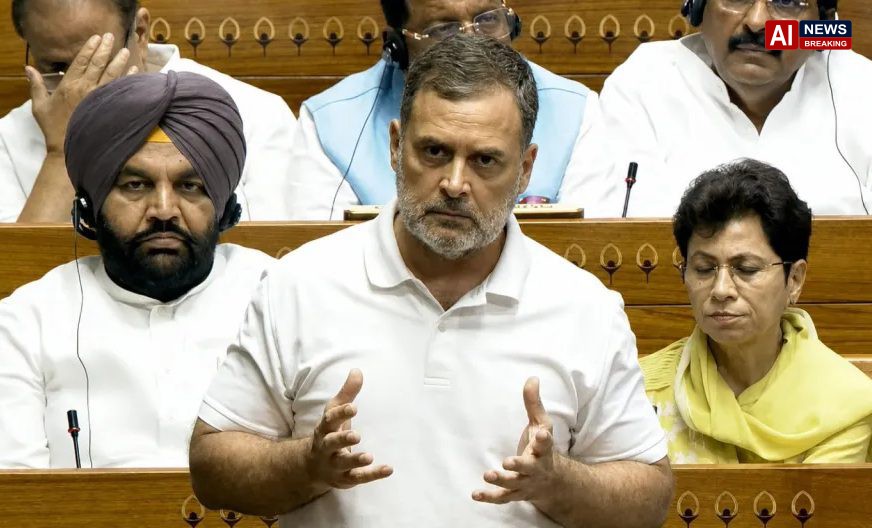
'A Student Told Me Andhbhakt Believes One Person Is God': Rahul Gandhi's Remarks Trigger Uproar in Parliament - AI News Breaking
student told andhbhakt believes:
Leader of Opposition Rahul Gandhi sparked a major political controversy in the Lok Sabha after recounting a student’s description of an “andhbhakt” during a debate on exam paper leaks and student protests. His remarks led to protests from BJP members, demands for an apology, and renewed debate over parliamentary language and the government’s handling of student issues.
Rahul Gandhi’s ‘Andhbhakt’ Remark Sparks Heated Exchanges in Lok Sabha
A stormy session of Parliament unfolded on Wednesday after Leader of Opposition Rahul Gandhi made controversial remarks during a Lok Sabha debate on exam paper leaks, student protests, and the state of India’s education system.
Speaking during discussions surrounding the Public Examinations (Prevention of Unfair Means) Amendment Bill, 2026, Gandhi said that a student had explained to him the meaning of an “andhbhakt” (blind follower), stating that such a person is “convinced that one person is God.”
The comments immediately triggered loud protests from treasury benches, with BJP members accusing the Congress leader of using unparliamentary language and targeting supporters of Prime Minister Narendra Modi. The ensuing uproar disrupted proceedings and added to the already tense atmosphere of the Monsoon Session.
What Rahul Gandhi Said
During his speech, Rahul Gandhi linked his remarks to the ongoing student-led protests over alleged paper leaks and police action against demonstrators.
According to accounts of the proceedings, Gandhi referred to three categories of people while discussing the issue: students, “idiots,” and “andhbhakts.” He said a student had told him that an “andhbhakt” is someone who believes a single individual can solve all problems and is treated as a divine figure.
The Congress leader used the anecdote to criticize what he described as excessive political devotion and to argue that institutions, rather than individuals, should remain at the center of India’s democracy.
His remarks came amid a broader speech focused on alleged irregularities in public examinations, demands for accountability from the government, and support for students protesting in New Delhi and elsewhere across the country.
BJP Demands Apology
The ruling Bharatiya Janata Party reacted sharply to Gandhi’s comments, accusing him of insulting millions of Indians.
Parliamentary Affairs Minister Kiren Rijiju and several BJP MPs demanded that Gandhi withdraw his remarks and apologize to the House. Members of the treasury benches described the comments as inappropriate and unbecoming of the Leader of Opposition.
BJP leaders argued that using terms such as “idiot” and “andhbhakt” in Parliament lowered the standards of public discourse and diverted attention from substantive policy discussions.
Outside Parliament, party spokespersons also criticized Gandhi’s comments, describing them as politically motivated and reflective of what they called the Congress party’s disconnect from public sentiment.
Debate Overshadowed by Political Sparring
The controversy overshadowed what was expected to be a significant debate on examination reforms and the recent wave of student protests.
Over the past several weeks, opposition parties have intensified their criticism of the government following allegations of exam paper leaks and police action against demonstrators demanding reforms.
Rahul Gandhi has emerged as one of the most vocal supporters of the students, repeatedly calling for accountability and demanding action against those responsible for both examination irregularities and alleged excesses during protests.
He has previously called for the resignation of former Education Minister Dharmendra Pradhan and sought explanations from Home Minister Amit Shah regarding police action during demonstrations.
Student Protests Continue to Shape Political Narrative
The controversy comes against the backdrop of a growing student movement that has dominated political discourse during the Monsoon Session.
Student groups have raised concerns regarding:
- Alleged examination paper leaks.
- Delays in recruitment processes.
- Transparency in competitive examinations.
- Police action against protesters.
- Broader education reforms.
Rahul Gandhi has repeatedly described students as “India’s future” and argued that their concerns deserve greater attention from policymakers.
The government, meanwhile, has defended its response and maintained that it is committed to protecting the integrity of the country’s examination system.
Parliamentary Language Under Spotlight
The incident has once again reignited discussions regarding the standards of parliamentary language and conduct.
Political analysts note that heated exchanges have become increasingly common in legislatures around the world, particularly during debates involving emotionally charged subjects such as education, unemployment and governance.
Questions raised following the controversy include:
- What constitutes unparliamentary language?
- Should anecdotal references be treated differently from direct accusations?
- How should political leaders balance criticism with decorum?
- What role does Parliament play in setting standards for public discourse?
The Speaker is expected to review portions of the proceedings if objections from members continue.
Looking Ahead
With the Monsoon Session continuing, the controversy is unlikely to subside quickly.
The BJP is expected to continue pressing for an apology, while Congress leaders have defended Gandhi’s remarks as part of a larger argument about democratic institutions and political accountability.
As Parliament resumes its legislative agenda, the episode serves as a reminder that debates over education policy, student welfare and political rhetoric remain deeply intertwined in India’s current political landscape.
For many observers, however, the larger issue remains the concerns raised by students regarding the examination system—an issue that continues to resonate far beyond the walls of Parliament.
Key Highlights
- Rahul Gandhi’s “andhbhakt” remarks sparked major protests in the Lok Sabha.
- BJP leaders demanded an apology, calling the comments unparliamentary.
- The controversy arose during a debate on exam paper leaks and student protests.
- Gandhi has consistently backed student demands for education reforms.
- The incident has reignited discussions about parliamentary decorum and political rhetoric.
Insight: The controversy surrounding Rahul Gandhi’s remarks illustrates how parliamentary debates increasingly serve as arenas for both policy discussions and symbolic political battles. While the immediate focus remains on the language used in the House, the underlying issues—student protests, examination integrity and institutional accountability—continue to shape public discourse. In democratic systems, moments of political controversy often overshadow substantive policy debates, making it essential to distinguish between the rhetoric of politics and the realities that give rise to it.